ONOR IMMIGRATION LAW

OFFICIAL LOGO Onor Immigration Law We honor your journey-1

Newsletter • Fifth Edition • July 2026

A MESSAGE FROM OUR TEAM

Welcome to the 5th edition of the ONOR Immigration Law Newsletter.

This edition marks an important milestone for our firm.

Over the past several months, ONOR Immigration Law has continued to expand its reach while remaining firmly connected to the values that inspired its founding. We have been privileged to work alongside organisations such as the Filipino International Nursing Diaspora Network and Nurture RN to support international nursing education and professional development through major symposia in both Sydney, Australia and Manila, Philippines.

These events brought together nurse leaders, educators, researchers, policymakers, students, and healthcare professionals from around the world to discuss the future of nursing, leadership, and international workforce mobility. They also provided an opportunity to contribute to ensuring that healthcare professionals are equipped not only with clinical excellence, but also with the legal knowledge and strategic planning necessary to build successful international careers.

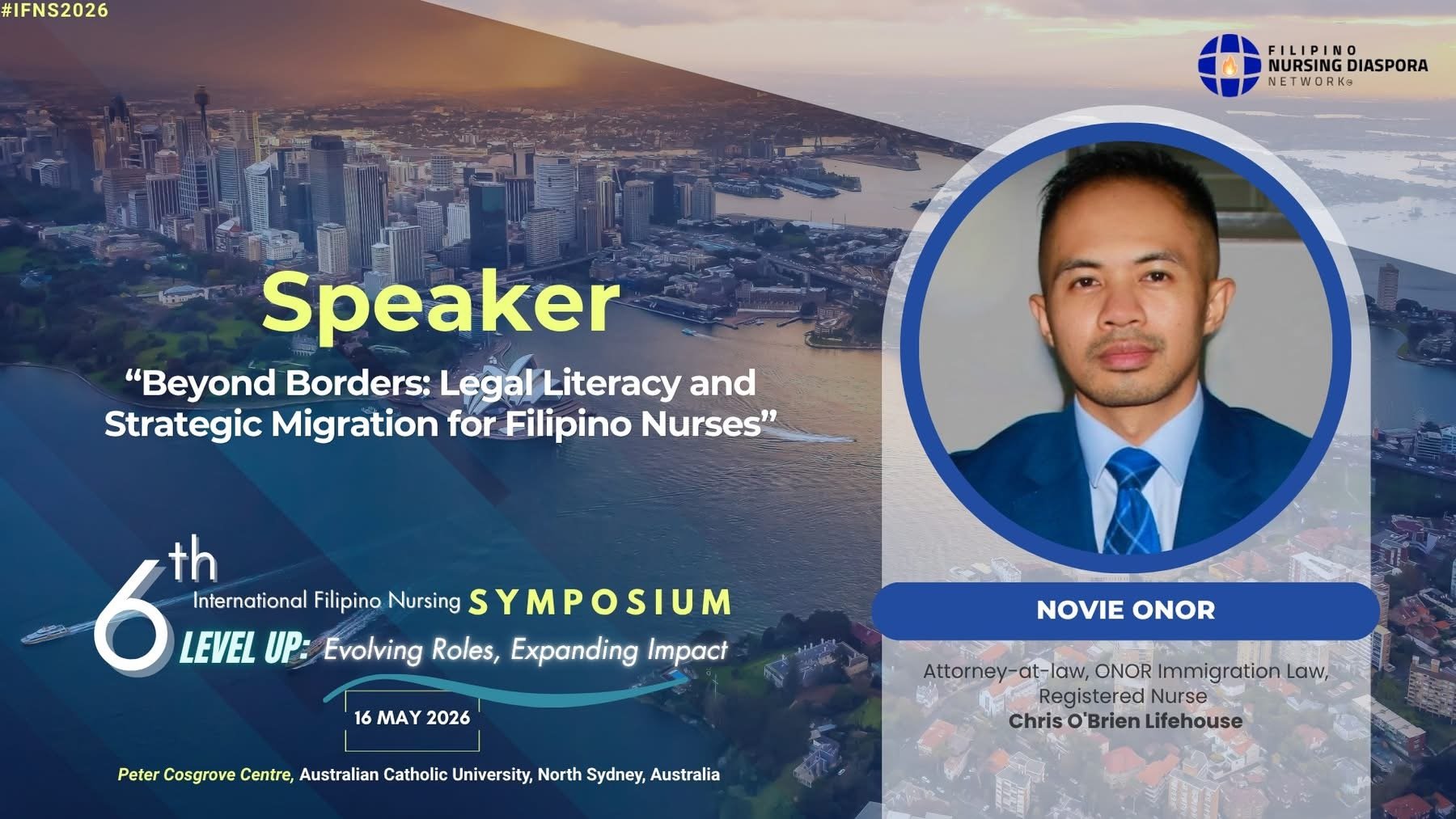
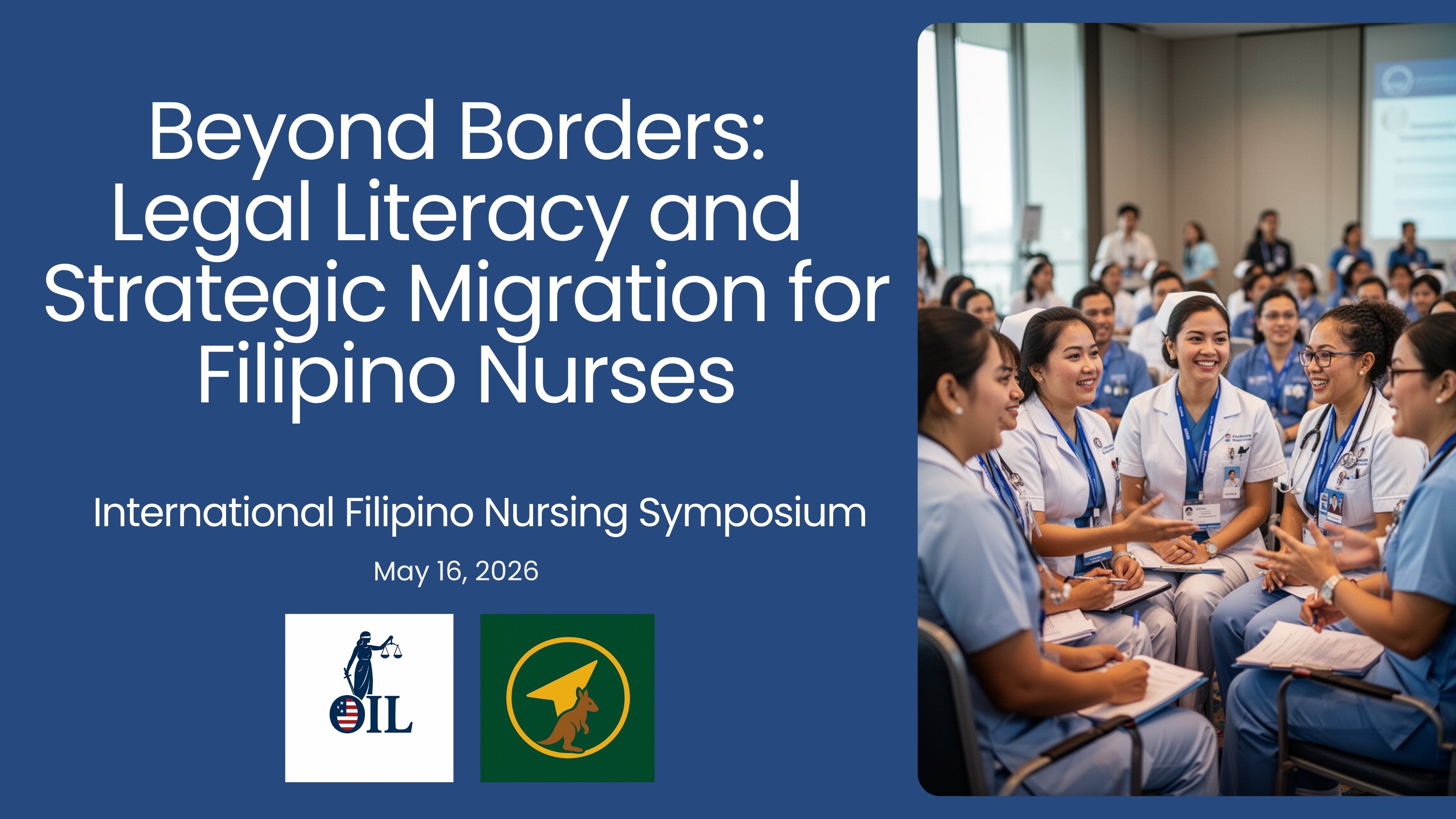
At the 6th International Filipino Nursing Symposium in Sydney, ONOR Immigration Law was honoured to present Beyond Borders: Legal Literacy and Strategic Migration for Filipino Nurses.

The session explored immigration strategy, ethical recruitment, employment contracts, professional licensing, regulatory compliance, and long-term career planning for nurses working across global healthcare systems.

One of the recurring themes throughout the discussion was that many highly skilled healthcare professionals receive little formal education about the legal and regulatory frameworks that govern international employment. Yet these systems often determine whether a migration journey becomes a lasting success or an avoidable setback. Legal literacy empowers professionals to make informed decisions, recognise potential risks before they arise, and protect the careers they have worked so hard to build.

The Filipino nursing diaspora continues to make extraordinary contributions to healthcare across Australia, the United States, New Zealand, Canada, the United Kingdom, the Middle East, and beyond. As global demand for healthcare professionals continues to grow, migration decisions have become increasingly complex. Immigration strategy, employment contracts, credential recognition, compliance obligations, and workforce planning now play an integral role in shaping long-term professional success.

For ONOR Immigration Law, supporting internationally educated healthcare professionals has always been about helping individuals and families navigate complex legal systems with clarity, confidence, and a long-term strategy that protects both their careers and their futures.

Equally meaningful was the opportunity to return to the Philippines and reconnect with where this journey first began.

Nearly twenty years ago, our Principal Attorney, Novie Onor, graduated as a young Filipino nurse with little certainty about what lay ahead. Like many newly qualified nurses, he travelled throughout Cebu and Manila submitting applications, hoping that someone would offer him an opportunity to begin his career. That opportunity eventually came through St. Luke's Medical Center, where the foundations of a lifelong journey in healthcare were established.

Nursing would ultimately open doors to opportunities in New Zealand and Australia, extensive travel throughout Europe and the United States, and eventually a second career in law focused exclusively on U.S. immigration. Along the way came invaluable mentors, lifelong friendships, and experiences that shaped both a professional career and a deeply personal understanding of international migration.

Returning to the Philippines in 2026 therefore carried special significance. This time, the journey was about sharing the lessons learned over two decades of working across healthcare, immigration law, and international professional mobility.

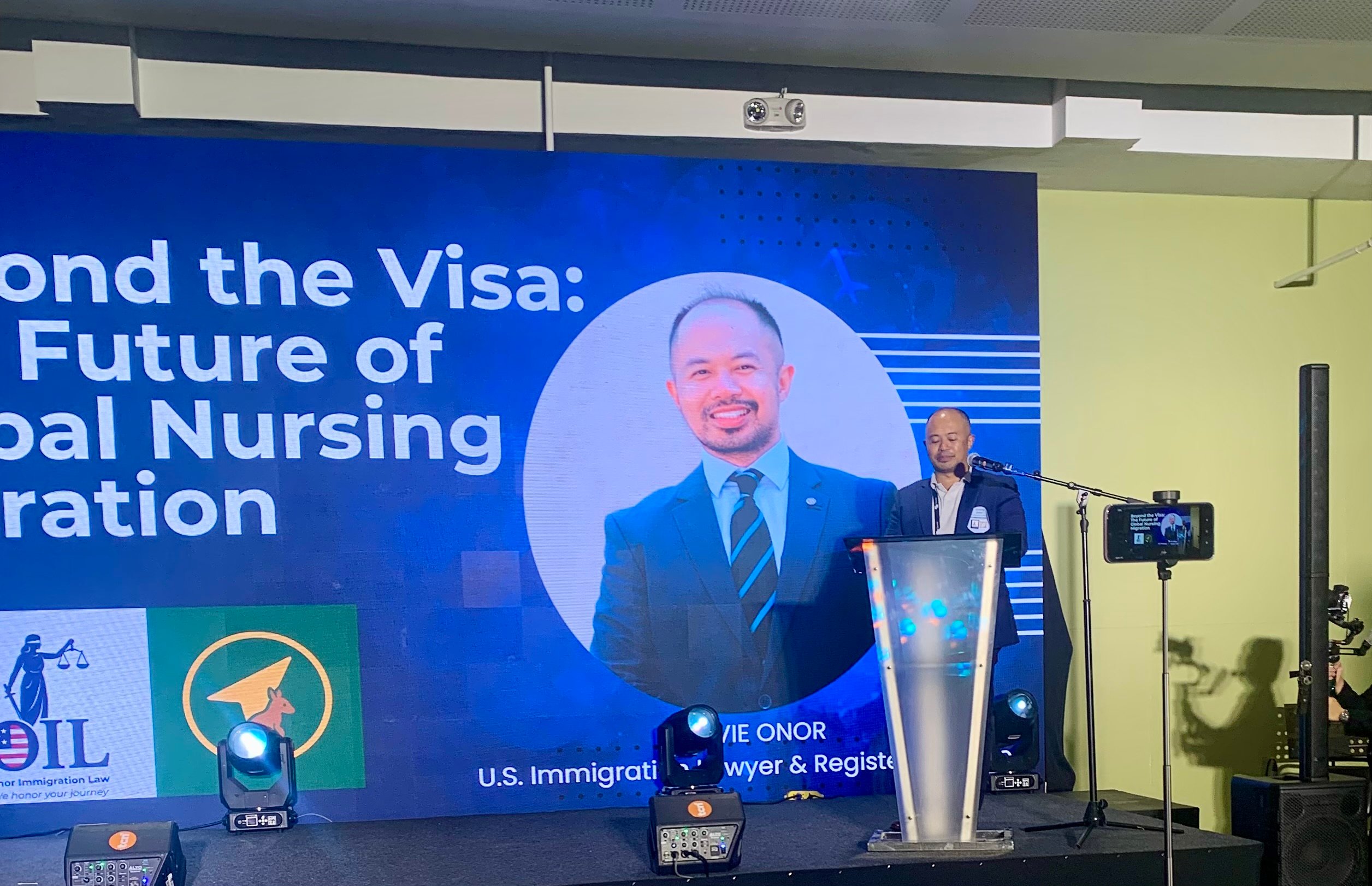
At NOW Expo Asia 2026 in Manila, ONOR Immigration Law and ONOR Advisory were honoured to present two sessions:

  • Beyond the Visa: The Future of Global Nursing Migration
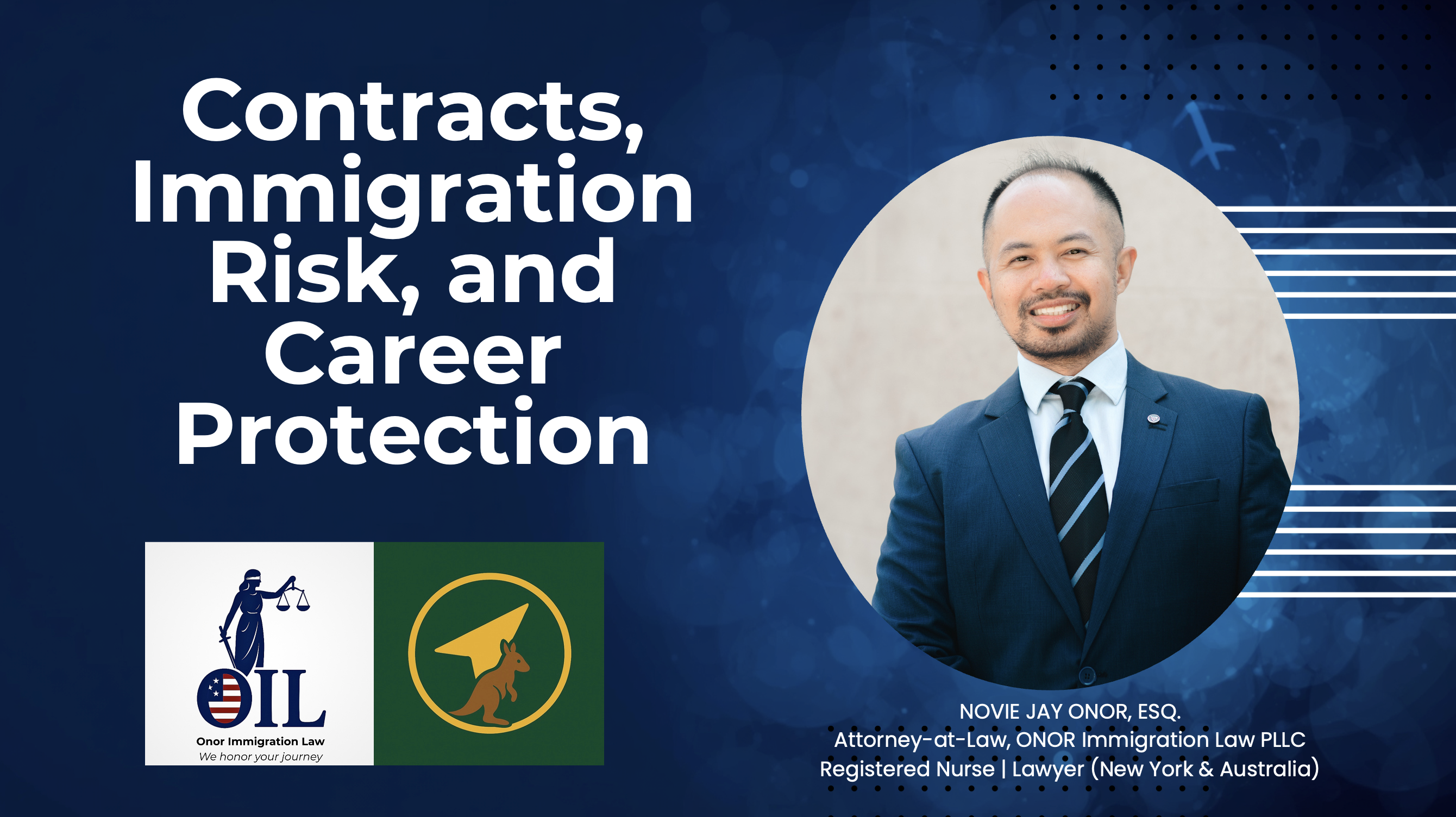
  • Contracts, Immigration Risk, and Career Protection

These presentations focused on practical strategies for internationally educated nurses, including emerging migration pathways, ethical recruitment practices, employment contract risks, licensing considerations, and the importance of long-term career planning beyond obtaining a visa.

Our hope is that every healthcare professional considering an international career understands that migration is about far more than moving from one country to another. It is about making informed decisions, protecting professional interests, managing legal risk, and creating opportunities that endure long after arrival.

As our firm continues to grow, our mission remains unchanged.

Whether we are advising healthcare professionals, families, employers, or businesses, we remain committed to providing strategic legal guidance that helps clients navigate complex immigration systems with confidence and clarity.

We are grateful to everyone who has supported ONOR Immigration Law throughout this journey and look forward to continuing our work in strengthening international professional mobility, advancing legal literacy, and serving communities across borders.

At ONOR Immigration Law, we work with professionals, families, and employers across borders to build strong immigration cases with clarity, structure, and long-term strategy.

Our role is to protect outcomes so that opportunities are not lost to preventable mistakes, poor timing, or weak legal positioning. In many cases, immigration outcomes are shaped long before a petition is ever filed. Strong results depend on building the right strategy from the very beginning, with clarity, preparation, and deliberate legal planning.

Warm regards,
The Onor Immigration Law Team

US IMMIGRATION LAW-1


WHO WE ARE

Onor Immigration Law is a U.S. immigration law firm built for a global, mobile world. We combine rigorous legal practice with lived understanding of migration to guide individuals, families, and organizations through an immigration system that is complex, fast-changing, and high-stakes.

We are a New York–registered law firm with a global perspective. Our work is grounded in clarity, credibility, and care, because immigration decisions shape lives, livelihoods, and long-term futures.


WHAT WE DO

We provide strategic U.S. immigration legal services across employment-based, family-based, and long-term immigration planning matters. Our work goes beyond filings. We help clients assess options, manage risk, anticipate change, and make informed decisions at every stage of the process.

From initial strategy to final adjudication, we focus on outcomes that are compliant, sustainable, and aligned with your broader goals.


WHO WE HELP

We work with individuals building careers across borders, families seeking stability and reunification, and employers navigating workforce mobility and compliance. Our clients span industries and continents, but they share a common need: trusted guidance in moments that matter.

Whether you are taking your first step or navigating a complex transition, we meet you where you are and help you move forward.


HOW WE HELP

We translate complexity into action. We plan carefully, communicate clearly, and execute precisely. We pay attention to timing, detail, and context, because small missteps can have lasting consequences.

At Onor Immigration Law, we are not just your lawyers. We are your partners in the journey. We walk beside you through uncertainty, advocate with integrity, and remain focused on what success truly looks like for you.

Our name reflects this commitment. ONOR honors the courage it takes to move across borders. IMMIGRATION LAW reflects the responsibility and authority of licensed U.S. practice. Together, they represent a promise: to guide you forward with professionalism, respect, and humanity.

IMG_6705

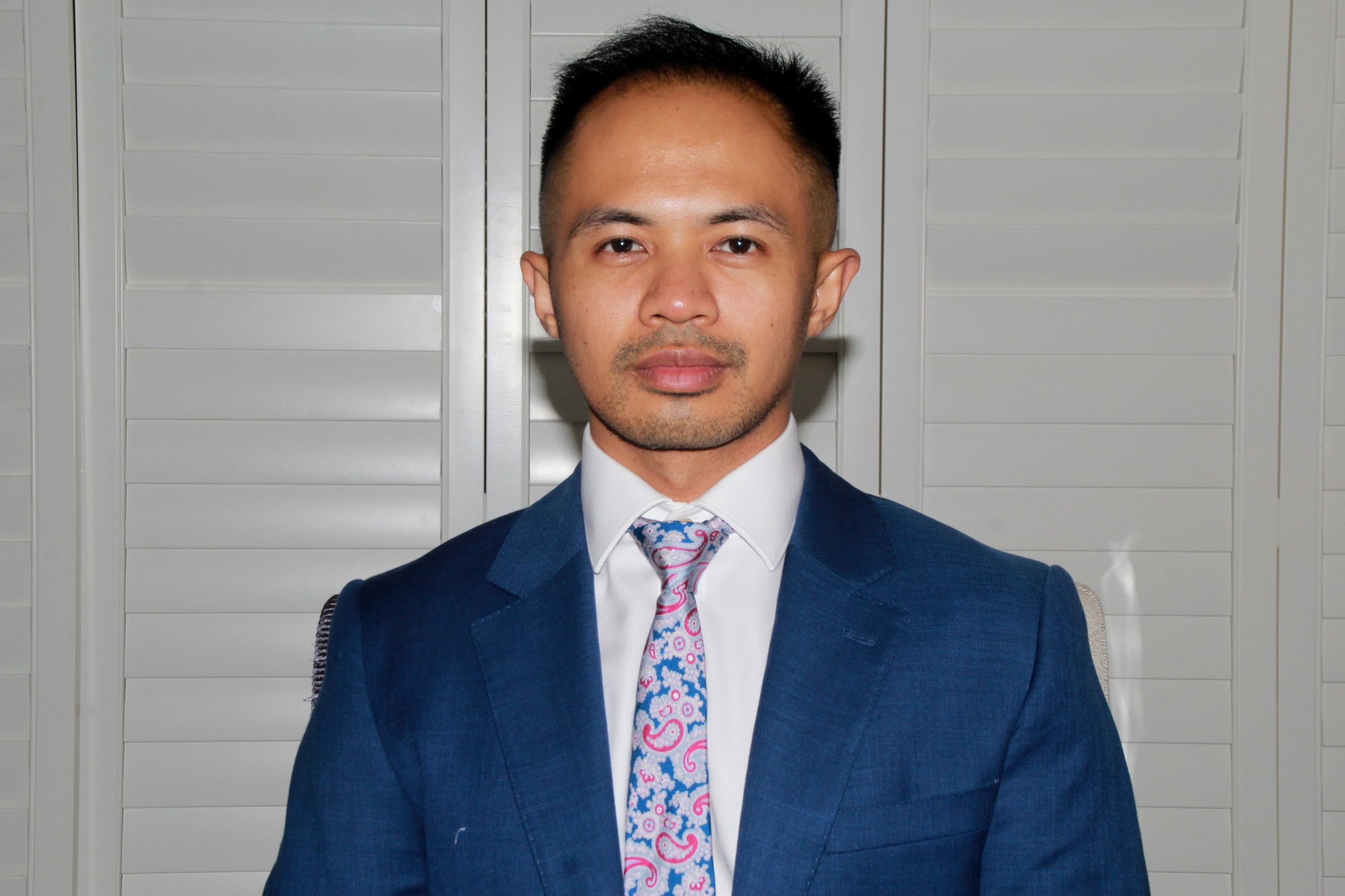
OUR LAWYER

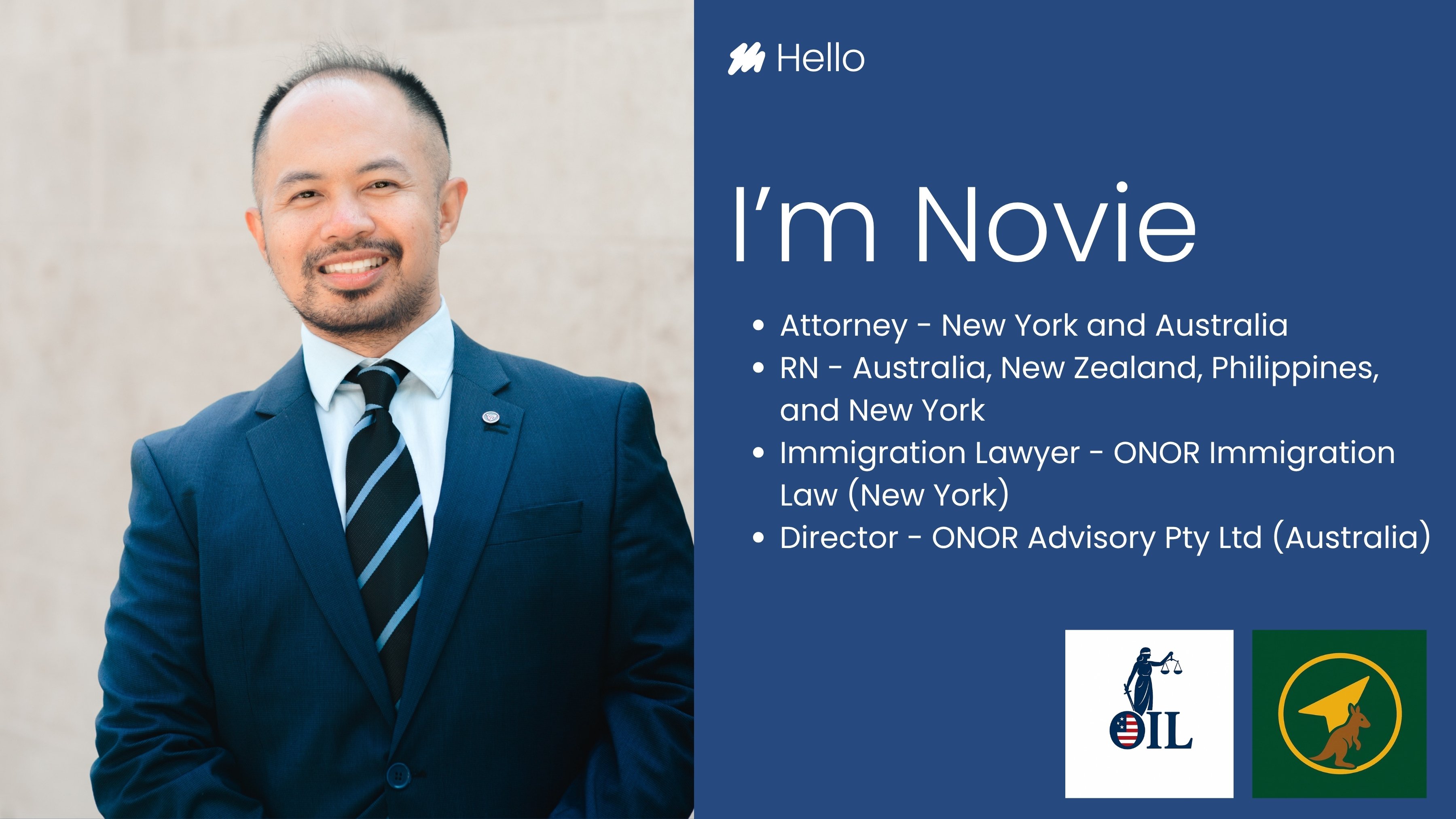
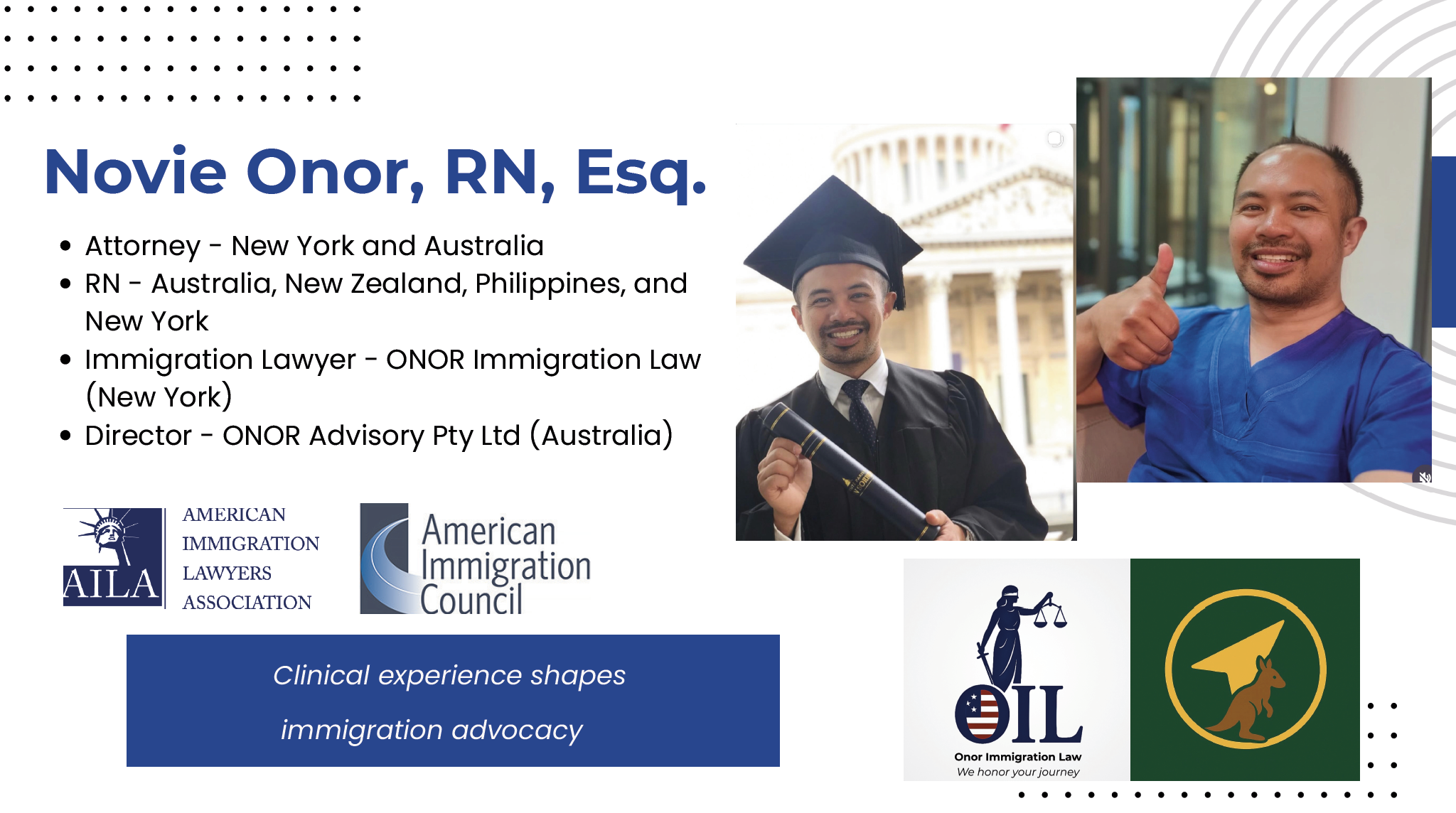
Novie Onor, Esq., is a U.S. immigration attorney licensed in New York and Australia and a registered nurse in New York, Australia and the Philippines. With professional and lived experience across the Philippines, New Zealand, Australia, France, Germany, and the United States, he understands the immigration journey from both a legal and personal lens.

Novie is dedicated to helping individuals and businesses thrive across borders, applying legal precision, cultural understanding and global insight to every matter. He holds an LLB from Queensland University of Technology and an LLM from Université Paris 1 Panthéon-Sorbonne in France.

OIL US Legal Services

US GREENCARD DEIDENTIFIED ARTISTIC IMAGE-1

Family-Based Immigration

We assist U.S. citizens and lawful permanent residents in sponsoring their loved ones to live in the United States. Services include:
• Marriage-based petitions and spouse visas
• Fiancé visas (K-1)
• Green cards for children, parents, and immediate relatives

We help families stay connected and build their lives together.

Employment-Based Immigration and Work Visas

We support employers, skilled professionals, and entrepreneurs across employment-based pathways, including:
• EB-1, EB-2, and EB-3 categories
• PERM labor certification
• Multinational manager and executive petitions

We work closely with employers and talent to navigate long-term immigration goals.

Non-Immigrant Visas (Temporary Work and Travel)

We represent individuals and organizations across temporary visa classifications, such as:
• B-1 and B-2 business and visitor visas
• H-1B specialty occupation
• E-3 Australian specialty occupation
• TN professionals under USMCA
• O-1 individuals of extraordinary ability
• L-1 intracompany transferees
• E-1 and E-2 treaty trader and investor visas
• J-1 exchange visitor visas

Whether you are pursuing professional opportunities, exploring business ventures, or traveling to the United States for a temporary purpose, we guide each step with strategic precision.

Adjustment of Status and Consular Processing

We assist clients filing from within the United States or abroad. Our representation covers:
• Adjustment of Status
• Consular processing
• Interview preparation
• Case monitoring and follow-through

We work to ensure your process is organized, compliant, and stress-managed from start to finish.

Naturalization and Citizenship

We guide lawful permanent residents through naturalization and citizenship preparation. Our service includes:
• Eligibility review
• Application filing
• Interview and civics exam preparation

We help you take your final step in the immigration journey with confidence.

General NY Law Services

We support clients navigating select New York legal matters connected to relocation, business setup, and professional transition. Our services include:
• New York entity formation and compliance
• Contract drafting and review
• Affidavits and notarized legal documents
• Professional licensing and regulatory guidance

We provide clear, strategic, and compliant support so your move into New York life and business is smooth, informed, and protected.

NOVIE ONOR, ESQ. and ONOR IMMIGRATION LAW participate in the

6th INTERNATIONAL FILIPINO NURSING SYMPOSIUM

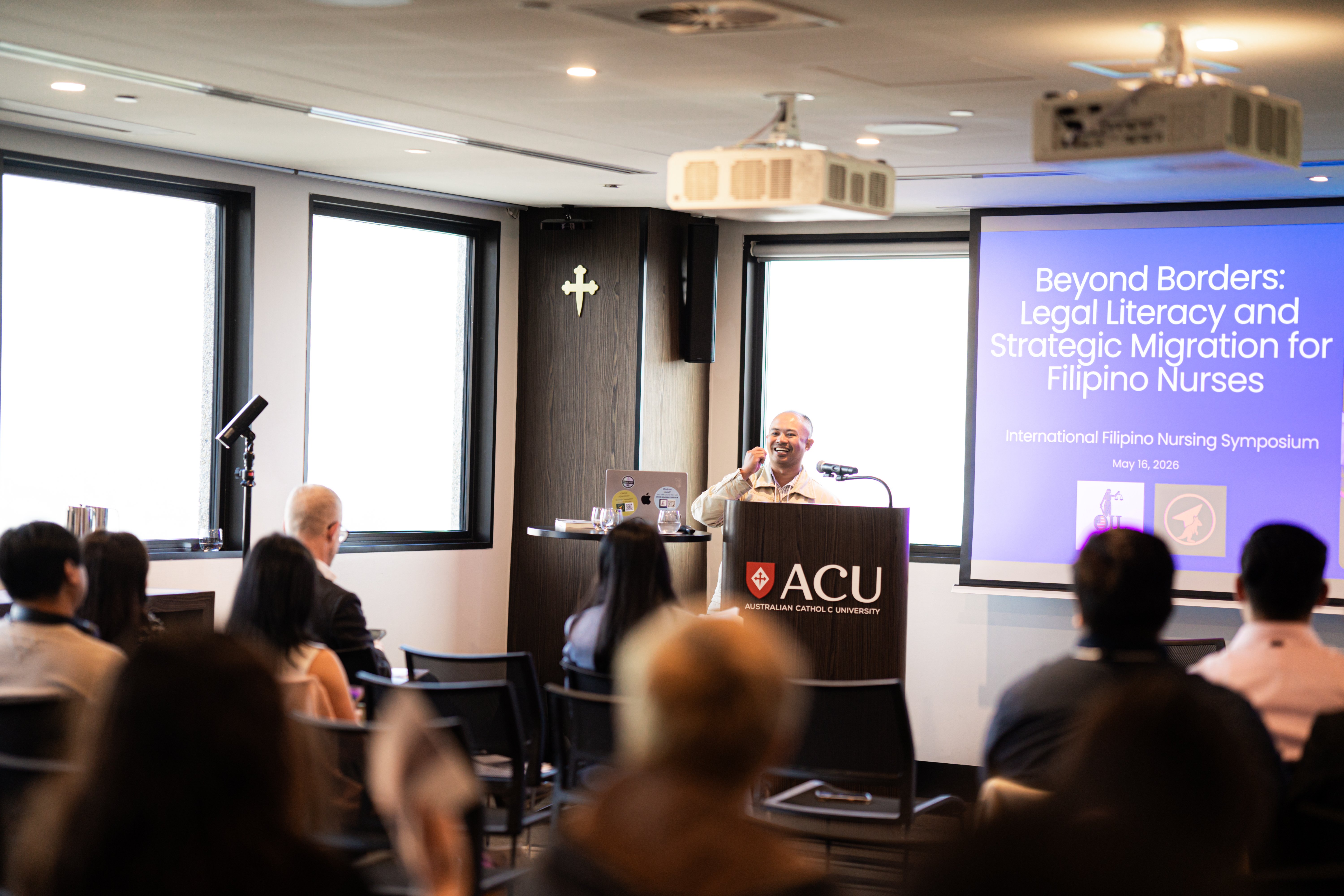
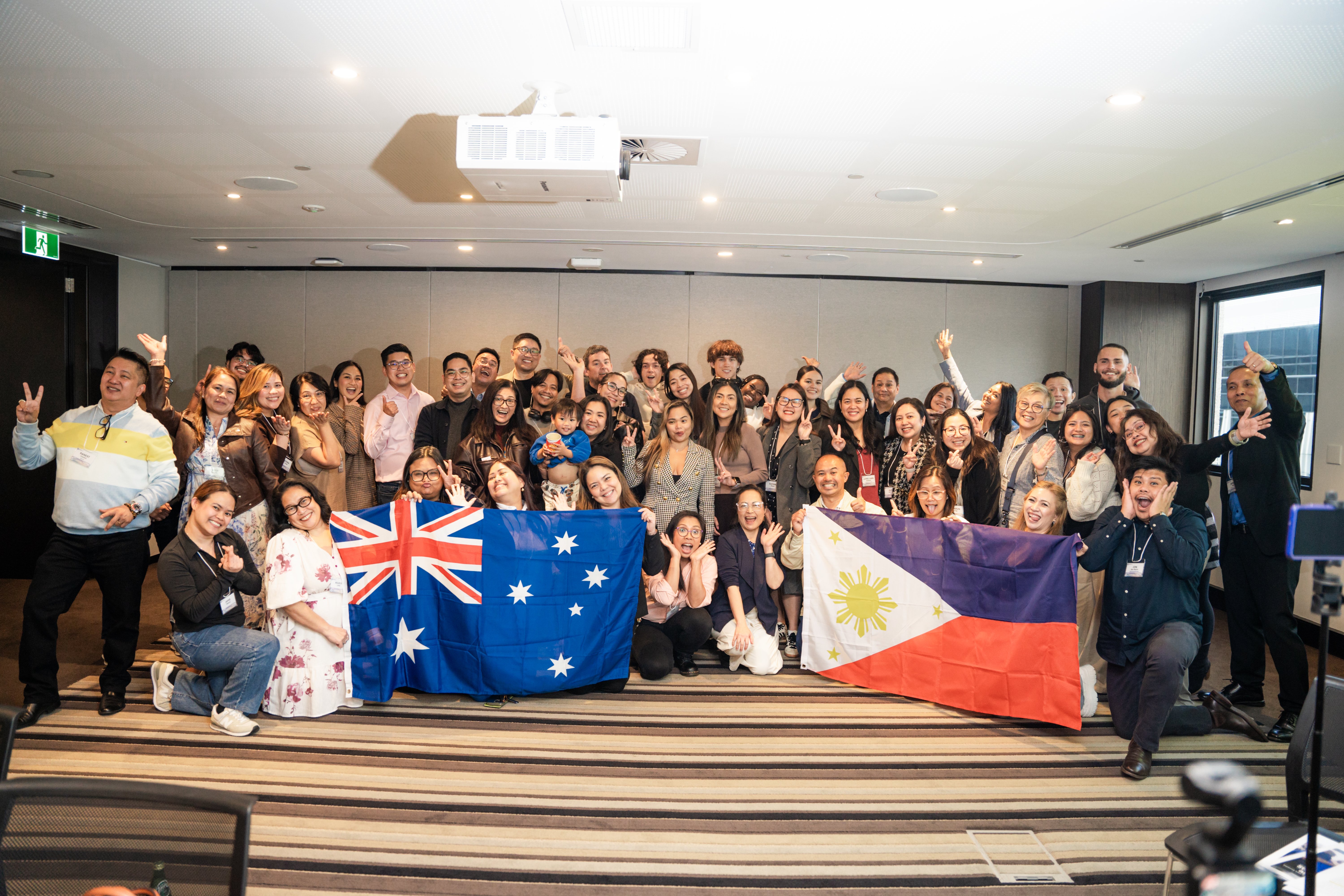
At ONOR Immigration Law, we are proud to have participated in the 6th International Filipino Nursing Symposium in Sydney on 16 May 2026 and stand alongside the Filipino nursing community in Australia.

IMG_2565
  
 
SV_05131
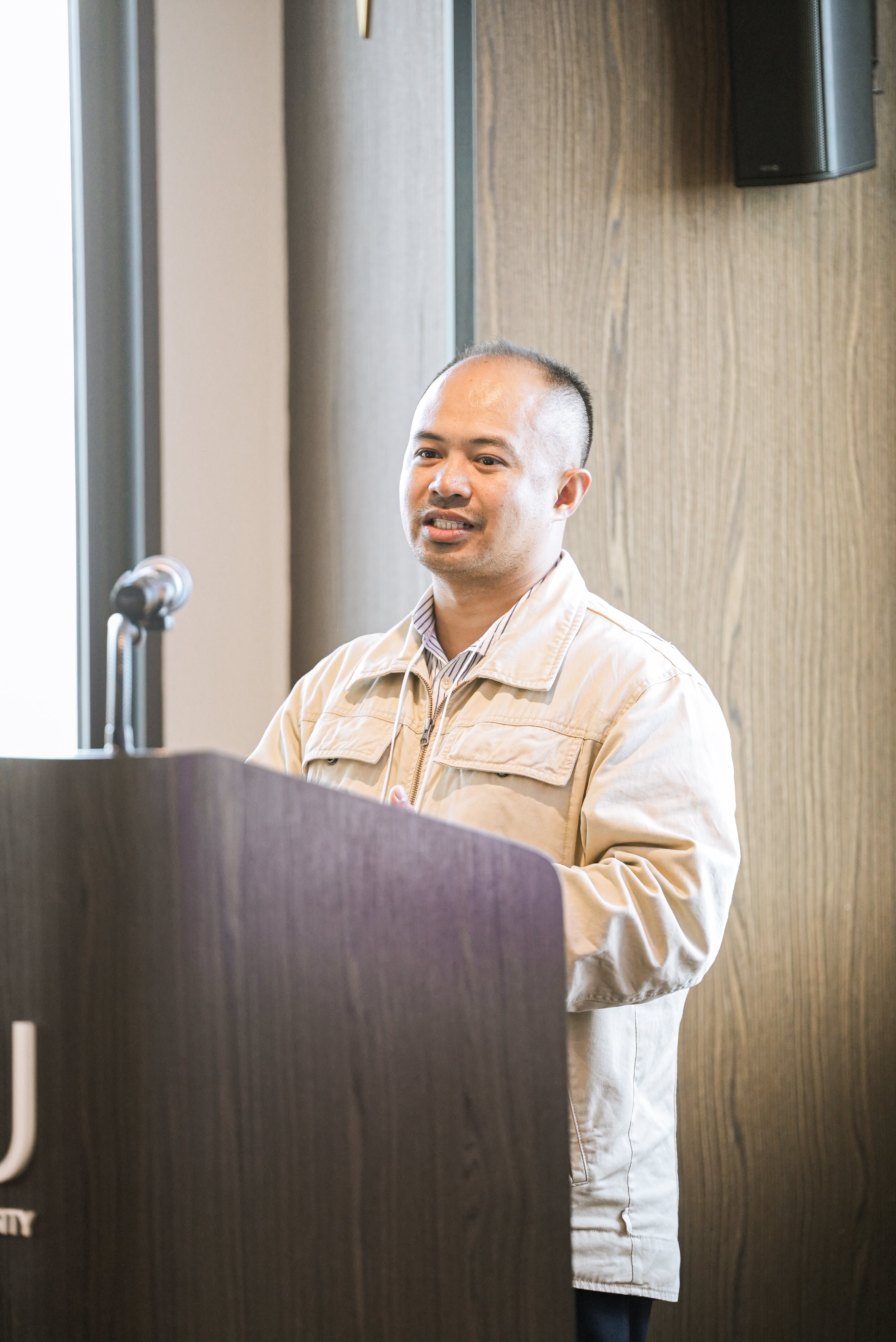
An honor to share my knowledge about US and international immigration law 
 

SV_05389With the event attendees from Australia and all over the world

DSC00632When talking about the law, I go a little serious =)

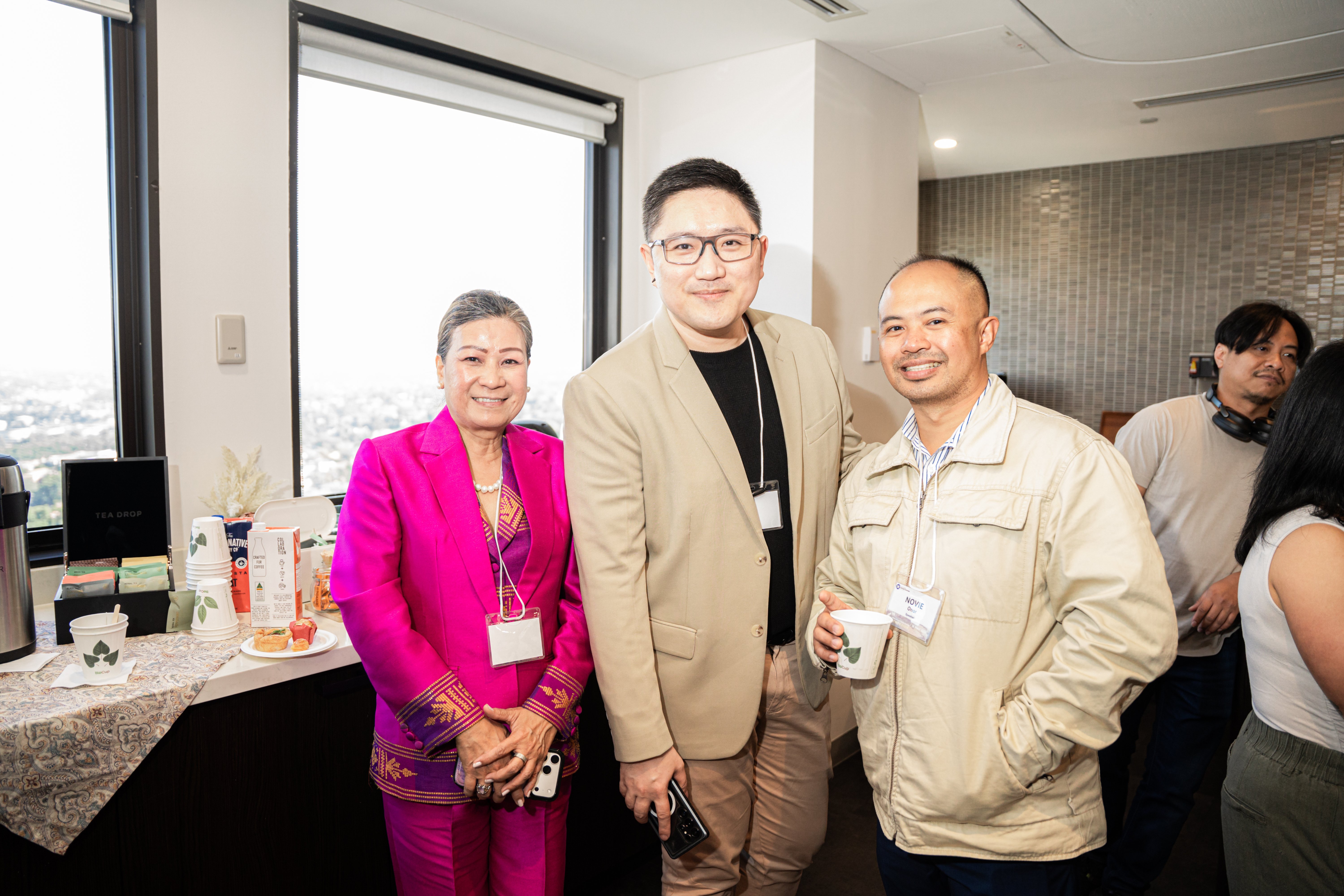
SV_05090With our international guests Benjamin Breboneria from Saudi Arabia and Guest Speaker Marife Aczon-Armstrong fro Hawaii, USA

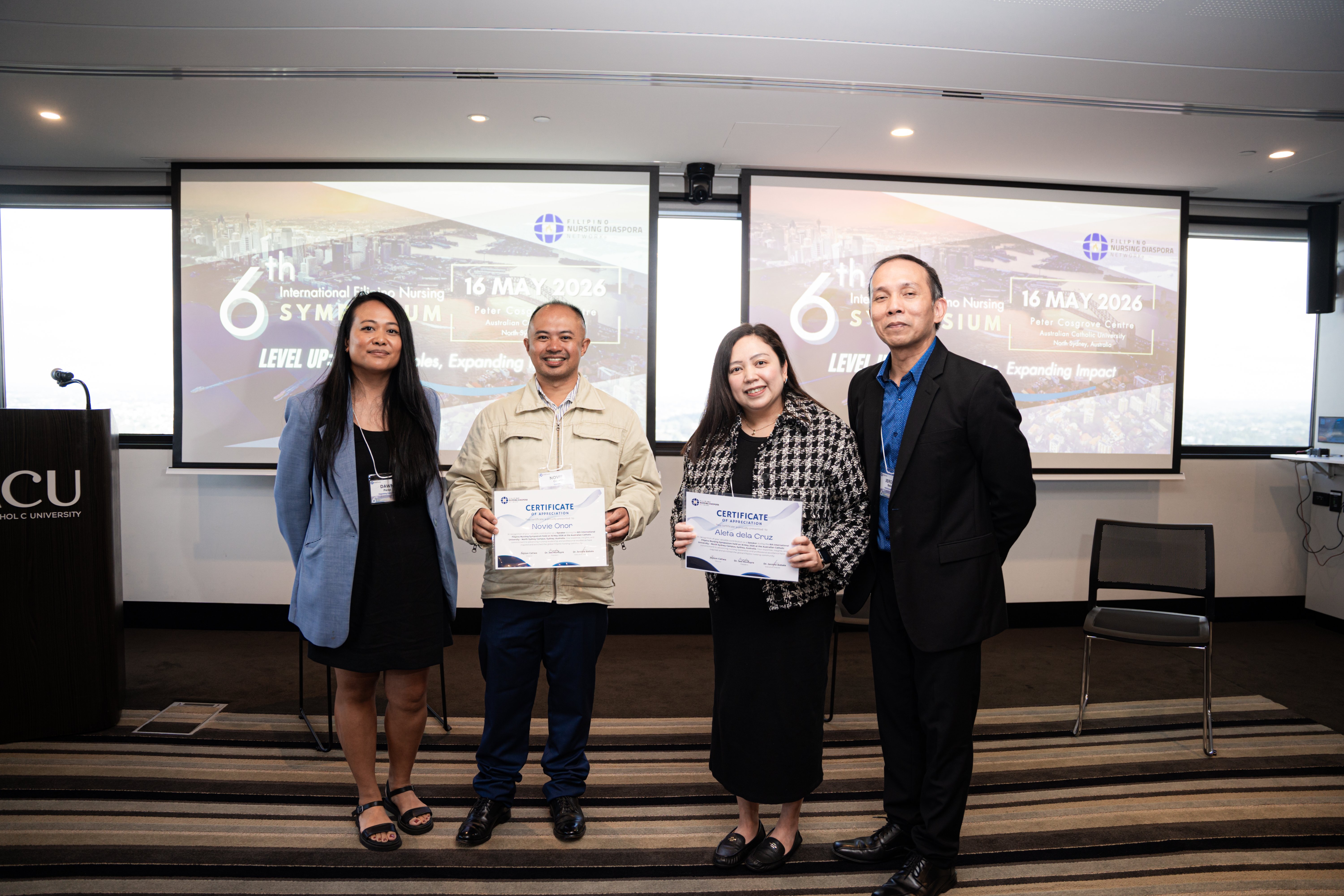
SV_05157With event organizers Dawn Perez and Sir Jerome Babate and fellow legal nurse Aleta dela Cruz

SPEECH: BEYOND BORDERS: LEGAL LITERACY AND STRATEGIC MIGRATION FOR FILIPINO NURSES

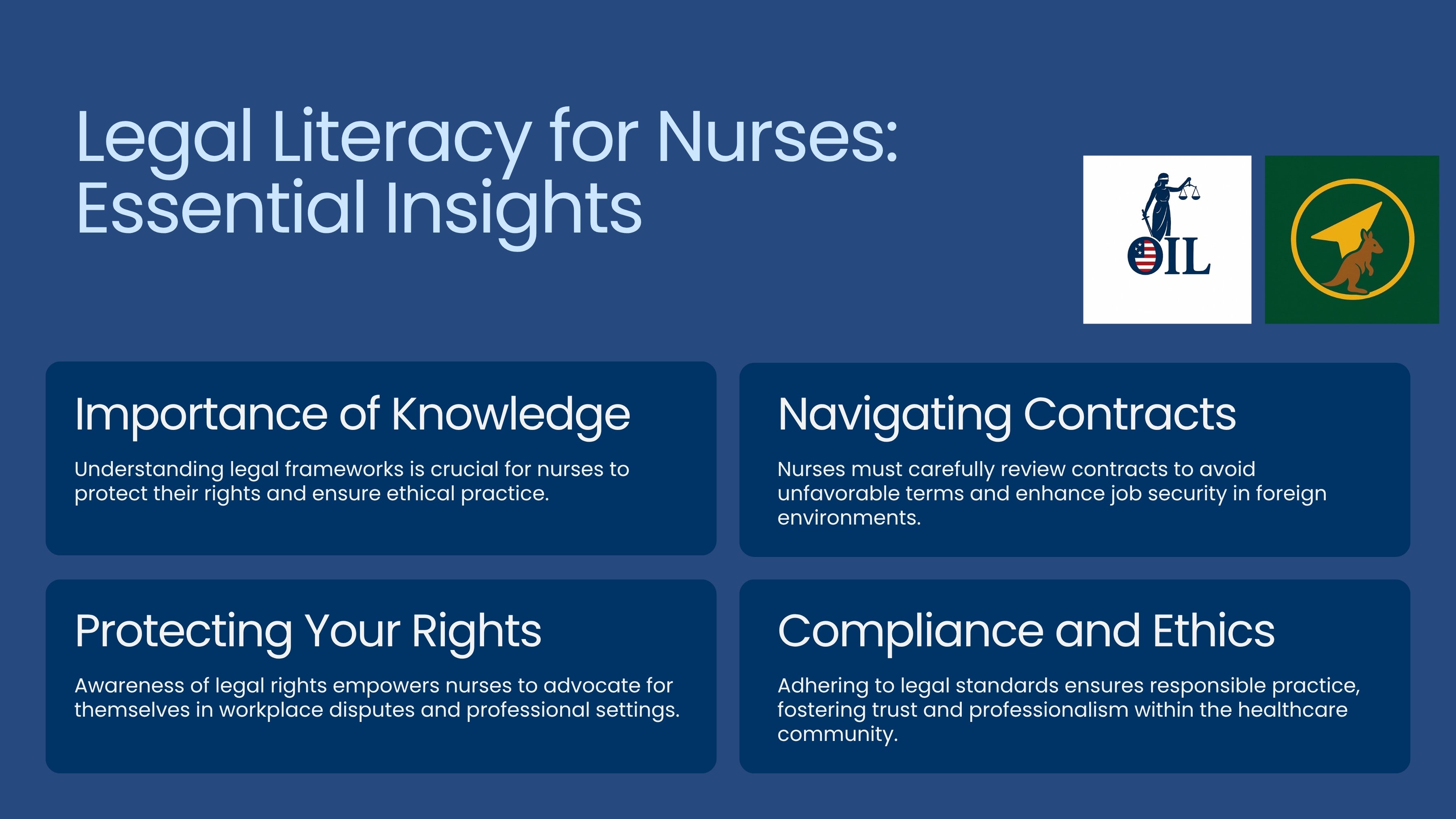
1We explored how legal literacy empowers nurses to make informed career decisions. Clinical competence opens doors but understanding the law helps keep them open.

2I introduced my journey as both a registered nurse and an immigration attorney, demonstrating how these two professions intersect to support internationally educated healthcare professionals. My goal is to bridge the gap between healthcare and law.

4Before discussing visas, we examined the broader legal landscape. Every international career is shaped by laws, professional regulations, contracts, and ethical obligations.

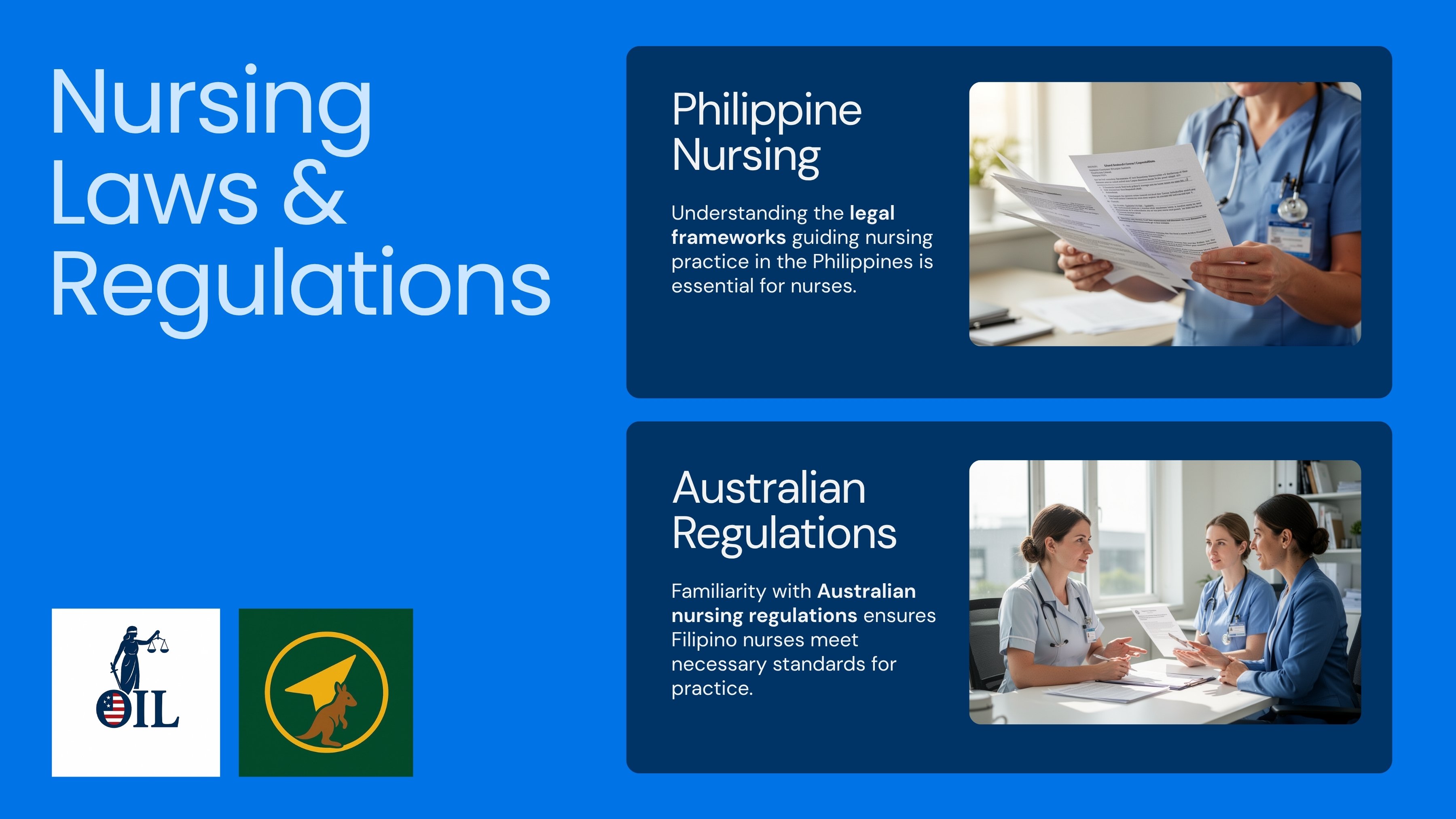
5Understanding professional regulation is the foundation of safe practice. Whether practising in the Philippines, Australia, or the United States, nurses must appreciate the legal framework governing their profession.

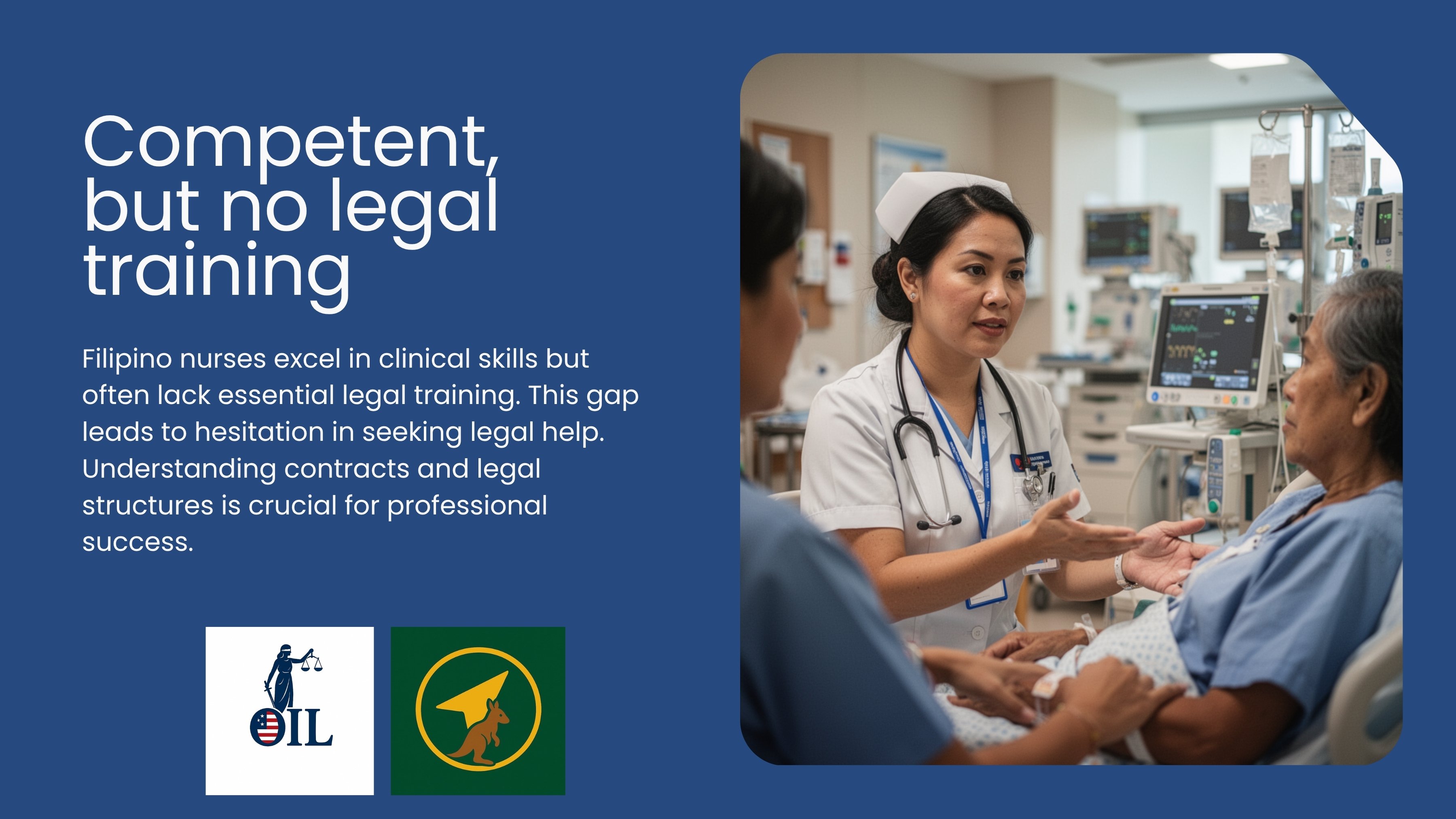
6Filipino nurses are among the world's most respected healthcare professionals. Yet many receive little formal education on employment law, immigration law, contracts, or workplace rights. Legal literacy should be viewed as an essential professional skill.

7Legal literacy is more than knowing the law. It is understanding how legal principles influence everyday professional decisions. From employment contracts to workplace rights, informed nurses are better equipped to protect their careers.

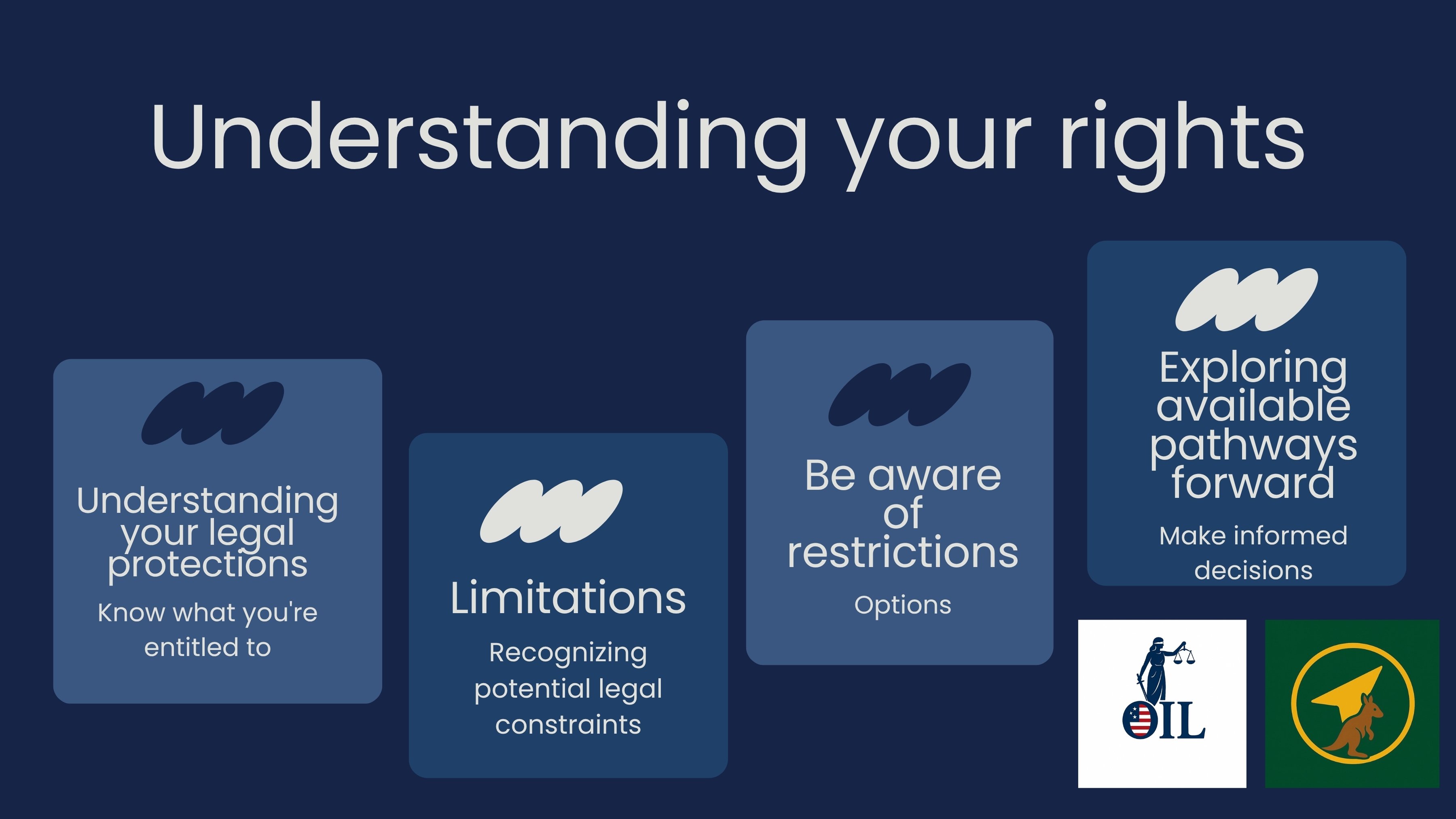
8Understanding your rights allows you to recognise opportunities, identify risks, and make informed decisions. Good legal advice should empower professionals and not simply solve problems after they arise.

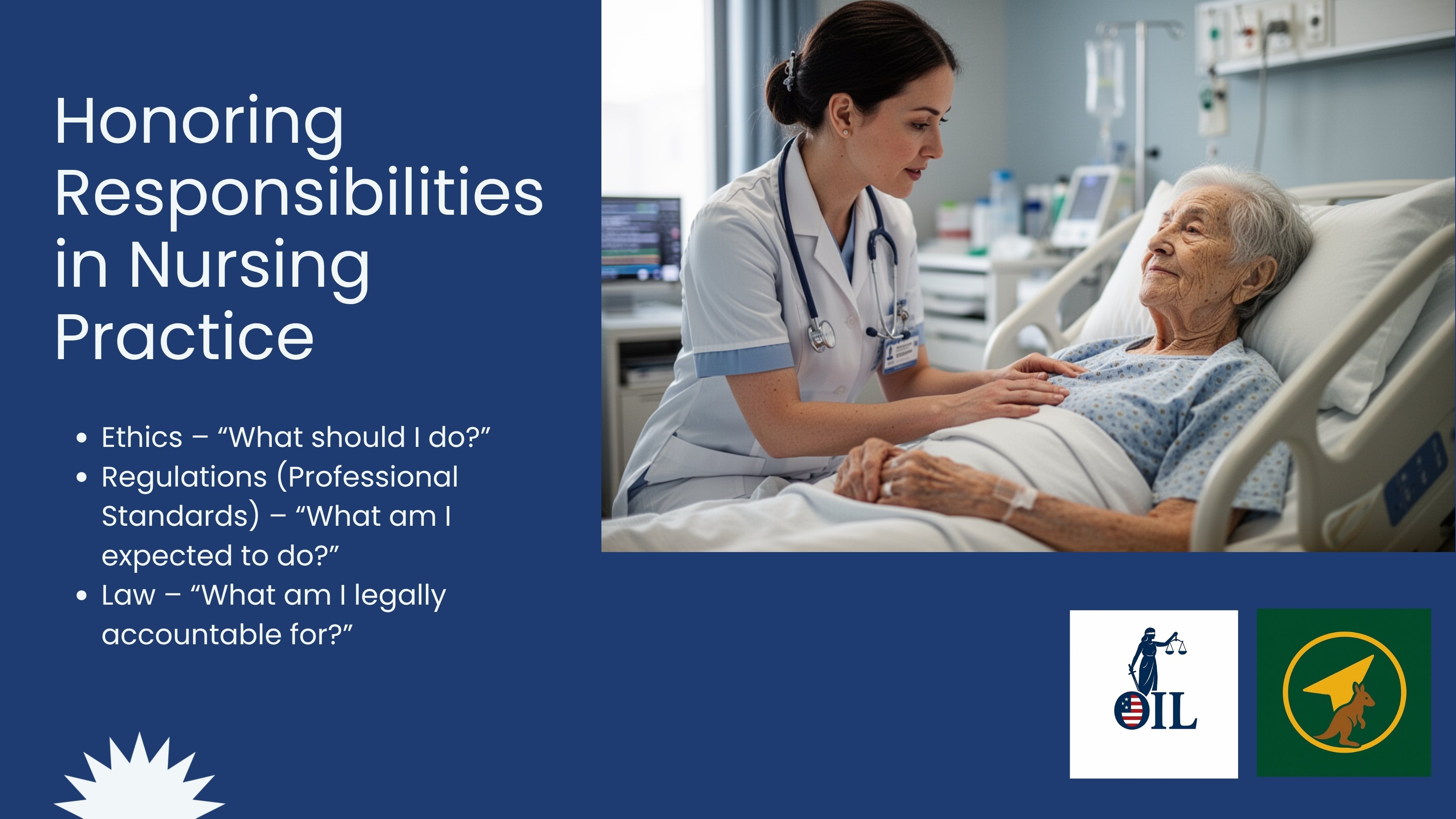
9Professional responsibility extends beyond clinical competence. Ethical principles, professional standards, and legal accountability work together to ensure safe and responsible nursing practice.

10One of the central messages of the presentation:
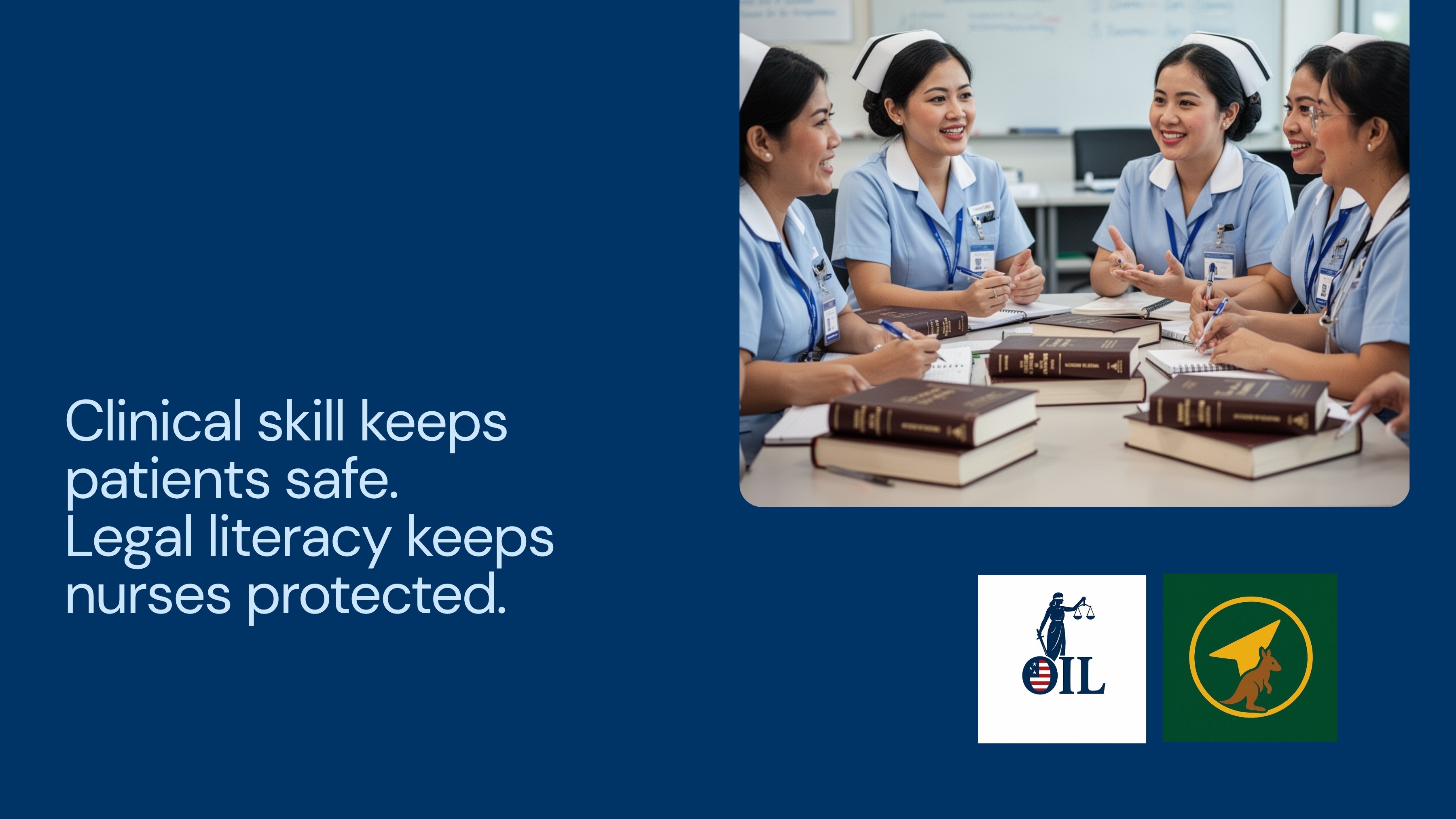
Clinical skill keeps patients safe. Legal literacy keeps nurses protected.
Both are essential for a successful international career.
 

11Migration should never be viewed simply as obtaining a visa. It is a long-term career strategy involving careful planning, professional development, family considerations, and informed legal decision-making.

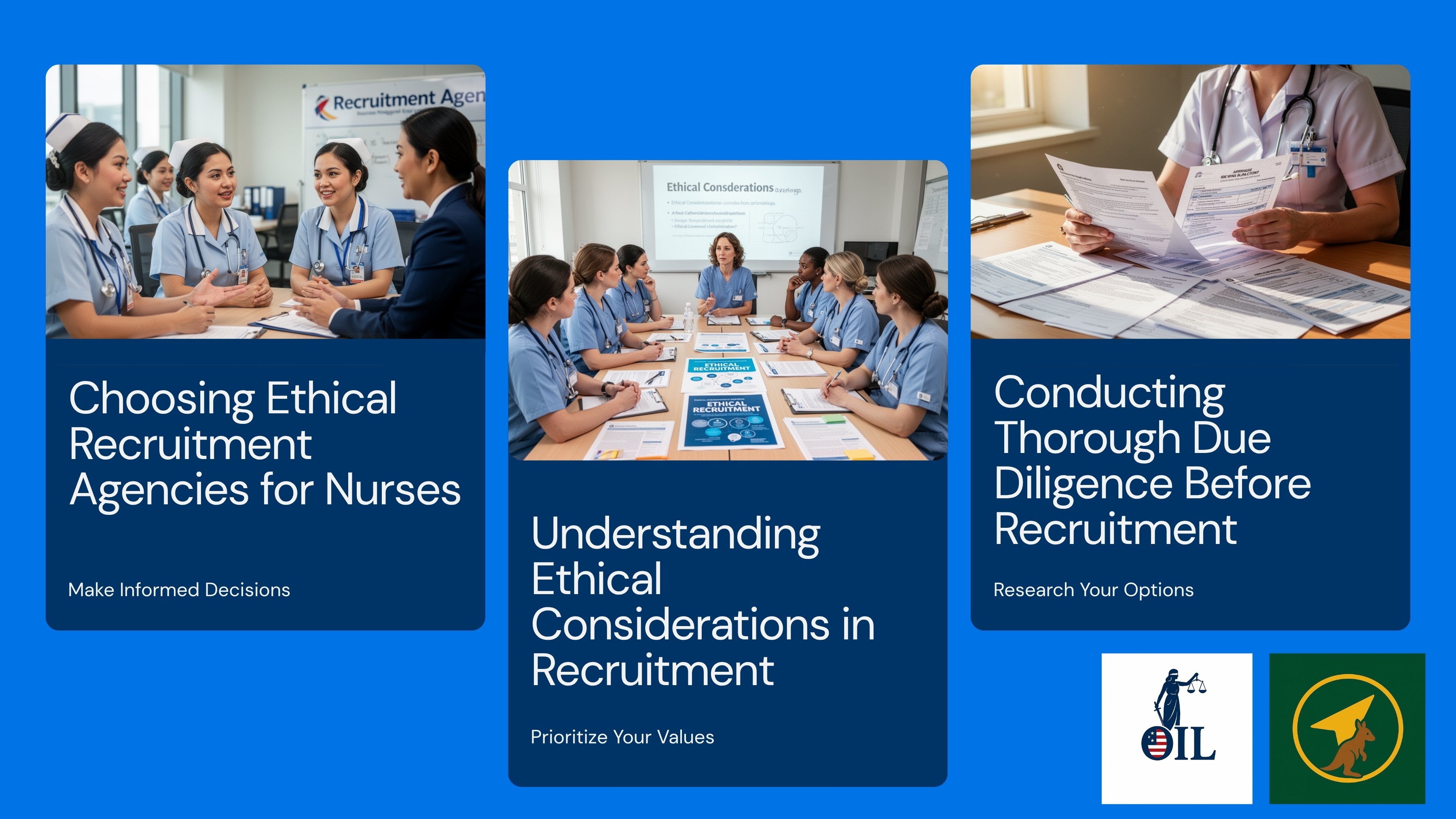
12Choosing the right recruitment agency can significantly affect a nurse's future. We discussed ethical recruitment practices, due diligence, and recognising warning signs before signing employment agreements.

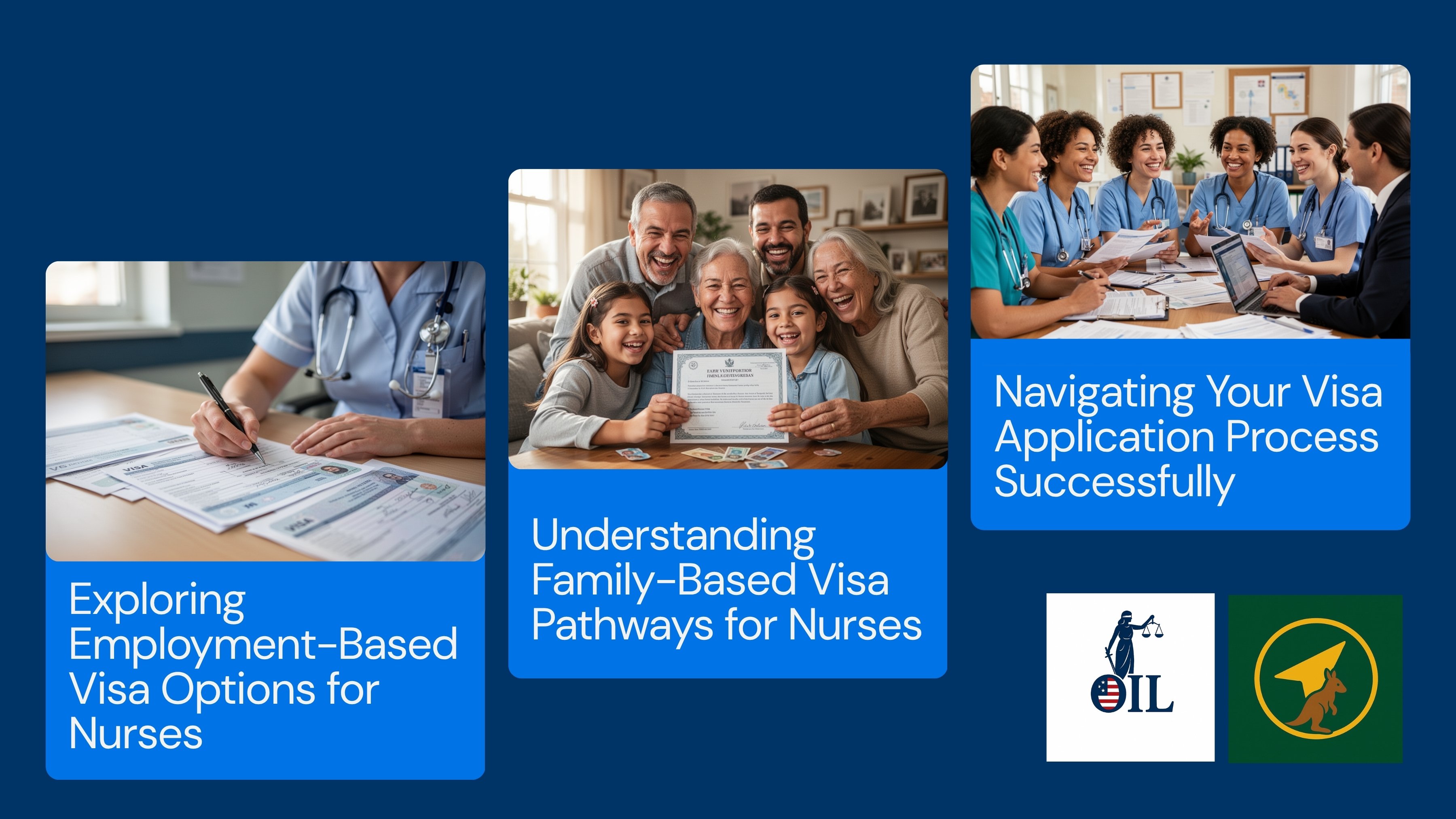
13There is no single pathway that suits every nurse. Employment-based visas, family sponsorship, and other immigration options each present unique opportunities and challenges that require strategic planning.

14International practice involves far more than obtaining a visa. Credential evaluations, licensing requirements, English language testing, and professional registration are all essential steps in the journey.

15I shared examples from my legal practice representing healthcare professionals worldwide, highlighting how strategic legal advice can help clients navigate complex immigration and employment issues before they become costly problems.

18The EB-3 immigrant visa continues to be one of the principal pathways for Filipino nurses seeking permanent residence in the United States. Strategic planning from the beginning of the process can make a significant difference.

17As an Australian citizen, I discussed the unique opportunities available through the E-3 visa: one of the most flexible employment visas available exclusively to Australian professionals seeking careers in the United States.

19Immigration options extend well beyond employment-based visas. Depending on individual circumstances, family sponsorship, investment, extraordinary ability, and other visa categories may offer more suitable pathways.

20The presentation concluded by encouraging nurses to take ownership of their professional development. Building an international career requires continuous learning, ethical decision-making, strong professional networks, and informed legal guidance.

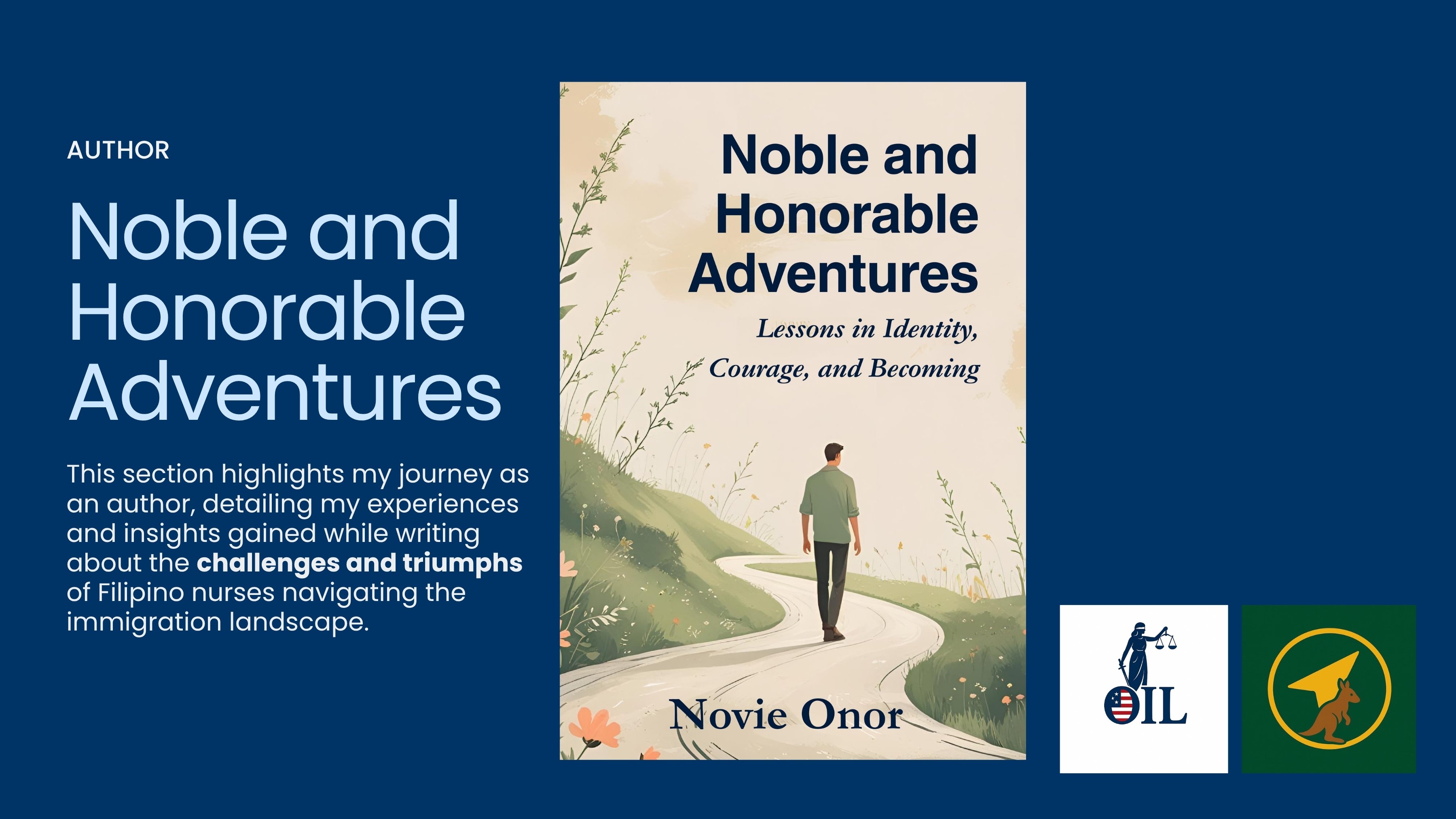
21This section highlights my journey as an author and the inspiration behind Noble and Honorable Adventures. Through personal stories and reflections, the book explores identity, courage, resilience, and the experiences of Filipino nurses building lives across borders.
 
The book is now available on Amazon:
 
22
It was a privilege to share my journey from Filipino nurse to international lawyer and to speak with fellow healthcare professionals about the importance of legal literacy in today's increasingly global profession.
 
Supporting internationally educated nurses has always been more than immigration law. It is about helping talented professionals protect their careers, understand their rights, and pursue international opportunities with confidence.

NOVIE ONOR, ESQ.

as FEATURED US IMMIGRATION LAWYER

in the

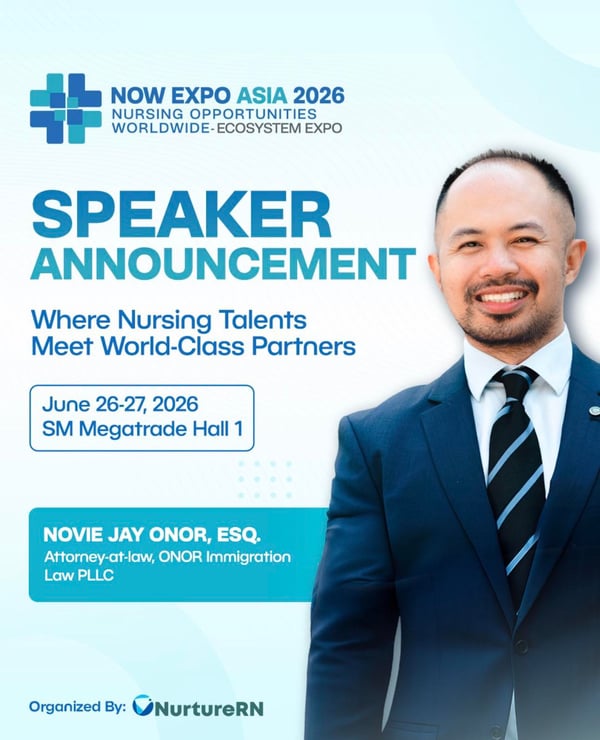
NOW EXPO ASIA 2026

Speaker Announcement - Now Asia

I am honored to have been invited as guest speaker at NOW (Nursing Opportunities Worldwide) Expo Asia 2026 in Manila and to have had the opportunity to connect with nurses and healthcare professionals from across the Philippines.

I discussed the legal landscape surrounding international migration, particularly the common immigration issues applicants face when pursuing career opportunities in the United States. Immigration involves timing, employer strategy, licensing, credentialing, compliance, family planning, and long-term professional positioning.

This invitation was especially meaningful to me because it brought me back to where much of my own journey began. I once worked as a nurse at St. Luke’s Medical Center, experiencing firsthand the realities familiar to many Filipino healthcare professionals: demanding hospital shifts, long commutes, licensing requirements, regulatory hurdles, and the uncertainty that often comes with building a career across borders.

That journey shaped not only my professional path, but also my purpose. Today, as both a migrant and a U.S. immigration lawyer, I work closely with nurses, healthcare professionals, and families navigating life-changing decisions involving relocation, employment-based immigration, and family reunification. I understand that behind every petition is a person, a family, and a future being built.

Through ONOR Immigration Law, we provide strategic U.S. immigration guidance with clarity, credibility, and care. Through Onor Advisory, we support professionals and organizations with cross-border planning and practical pathways for long-term success.

IMG_2449

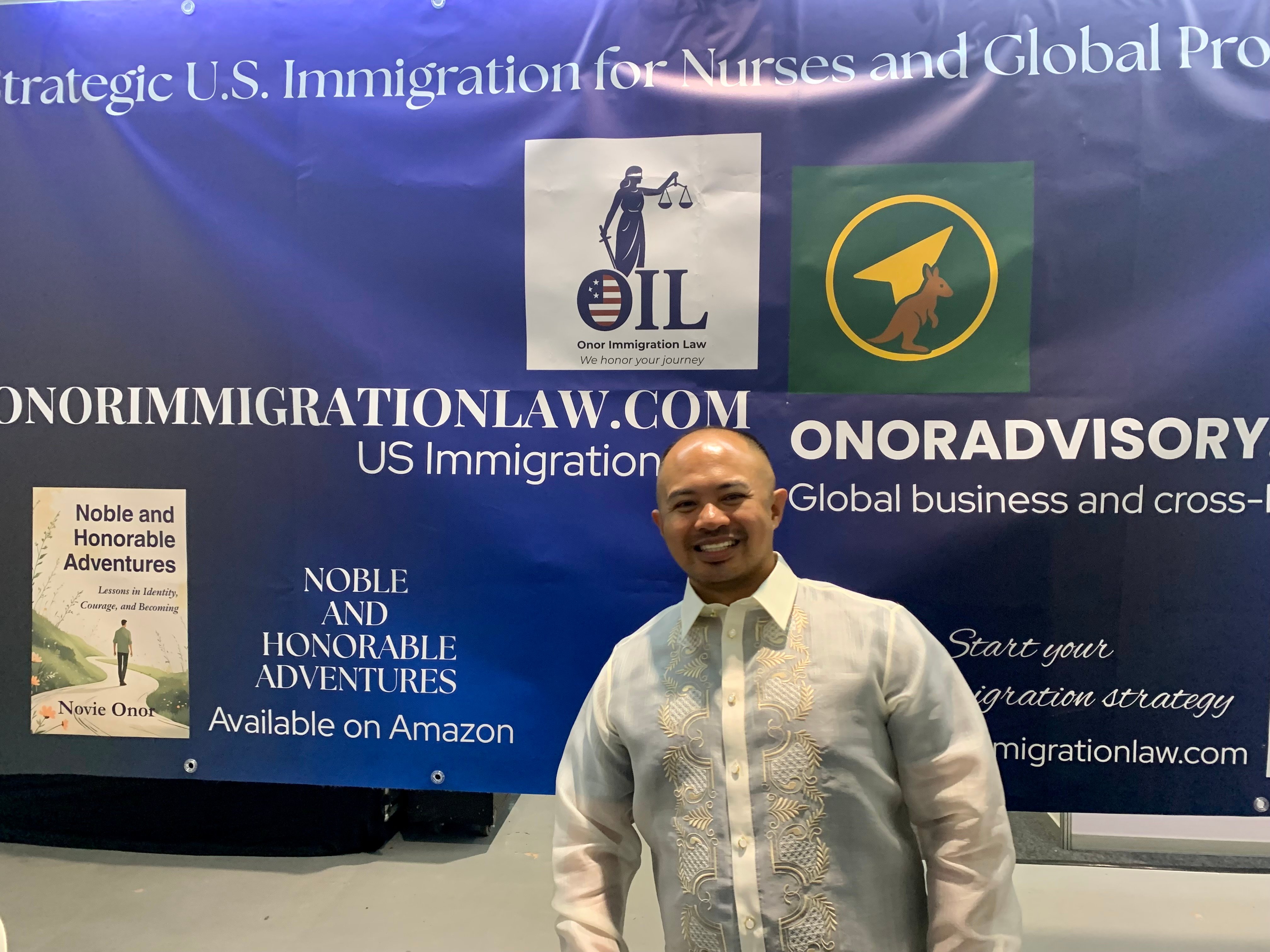
IMG_2469

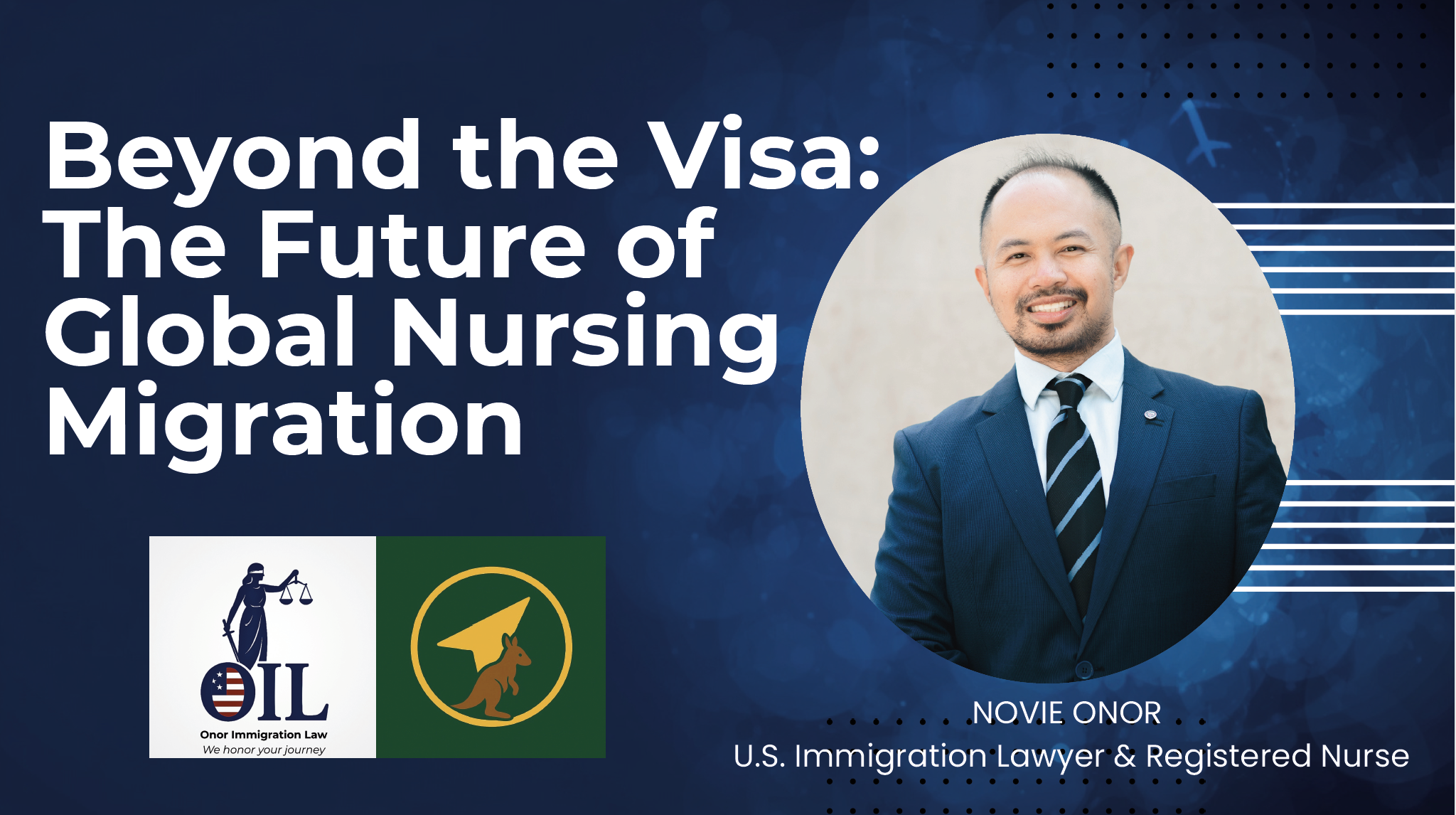
SPEECH: BEYOND THE VISA - THE FUTURE OF OF GLOBAL NURSE MIGRATION

NOW EXPO ASIA 2026

A1

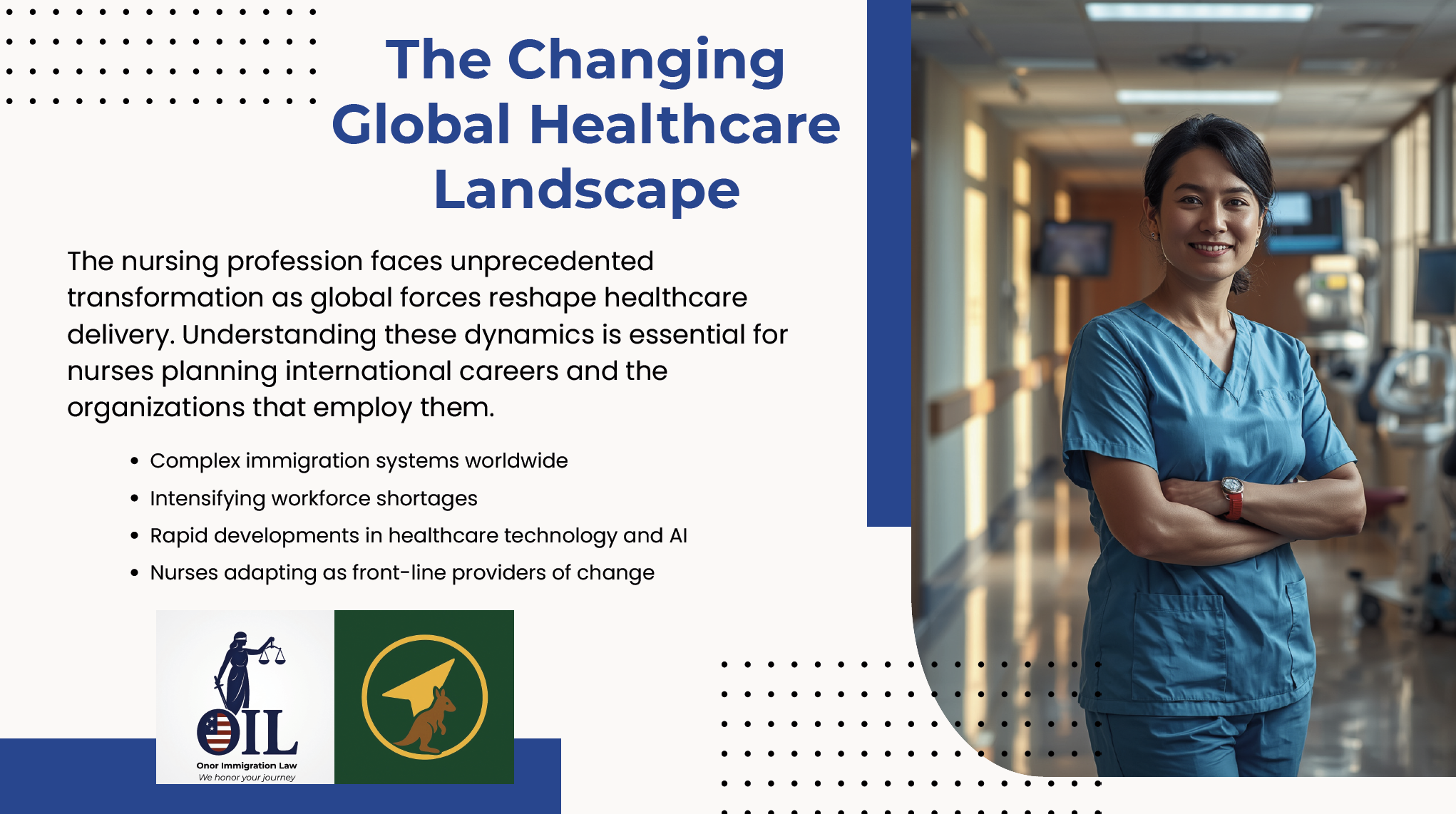
In the last decade, the global migration landscape has changed dramatically. Immigration systems have become more complex. Artificial intelligence is transforming industries. At the same time, the demand for skilled healthcare professionals continues to grow.

In this talk we explore what these changes mean for nurses, employers, and healthcare organizations and discuss why Filipino nurses continue to succeed on the global stage, why nursing remains one of the most future-resilient professions in the world, why the United States continues to be an important destination for healthcare professionals, and why strategic planning has become more important than ever for anyone considering an international career.

A2

I grew up in Magpet, a small town in the Philippines. Studied nursing at San Pedro College in Davao City and later pursued law, first in Australia, then in Europe, and eventually in the United States.

My career has taken a path that still surprises people. When I introduce myself, someone asks whether I am a nurse or a lawyer. The answer is both. I spent years caring for critically ill patients in intensive care units, and today I help individuals, families, healthcare professionals, and employers navigate immigration law.

The photographs on this slide capture those two worlds. On the left is my graduation from a master’s degree in law in Paris, France. On the right is me working as an intensive care nurse in Sydney. These careers may appear different, but they are connected by the purpose of helping people navigate uncertainty during some of the most consequential moments of their lives.

Nursing taught me lessons that continue to shape my legal practice today. Every patient has a story. Every challenge exists within a larger human context. Behind every visa petition, green card application, or citizenship case is a person pursuing opportunity, supporting family, building a future, or seeking a better life.

Having worked in both healthcare and law, I understand that migration is one of the most significant decisions a person or a family will ever make. The consequences affect careers, finances, relationships, identity, and future generations.

A3

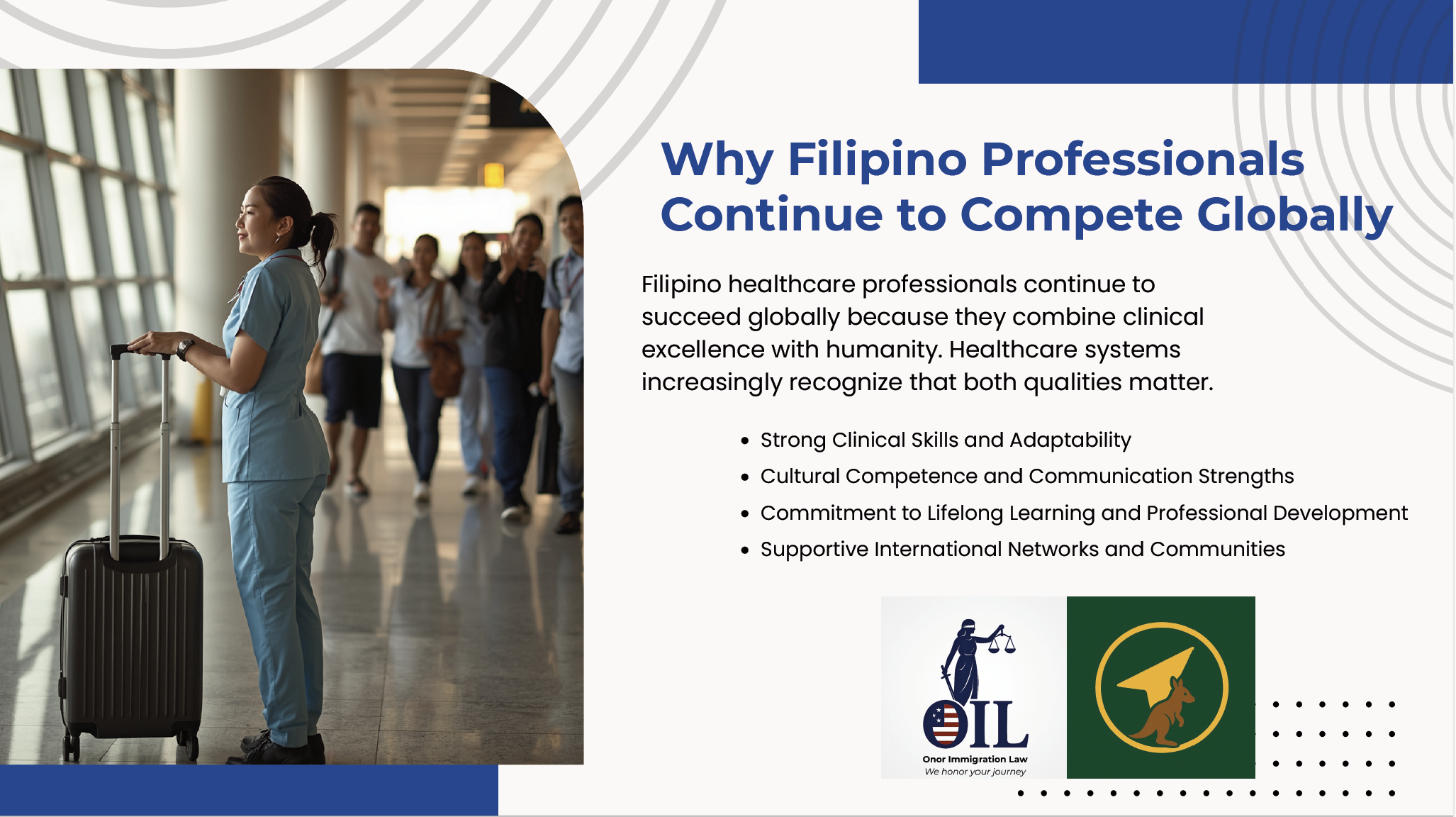
Hospitals around the world keep recruiting Filipino nurses. They know what they’re getting: competence, compassion, adaptability, and professionalism. Their success is the result of technical training and a reflection of their ability to work effectively across cultures, build trust with diverse patient populations, and thrive in demanding healthcare environments.

You might walk through a hospital corridor in a foreign country and suddenly hear someone speaking Tagalog or Cebuano or Kapampangan. In that moment, thousands of miles from home, the workplace feels a little more familiar. These support networks have become one of the strengths of the Filipino diaspora, helping professionals adapt, succeed, and support one another across generations and continents.

The global competitiveness of Filipino healthcare professionals is built on several factors. First, a strong clinical foundation developed through rigorous education and exposure to diverse patient populations. Second is cultural intelligence and communication. Third is a commitment to lifelong learning and professional development. Finally, the strength of community. Well-established Filipino professional networks around the world create pathways for mentorship, support, knowledge-sharing, and career advancement.

As healthcare becomes increasingly global and technology-driven, these qualities become even more valuable. Clinical skills can be taught, and technology can support healthcare delivery, but empathy, adaptability, teamwork, and cultural understanding remain fundamentally human strengths. These are qualities that Filipino professionals have demonstrated on the world stage for decades and will continue to bring to healthcare systems around the world in the years ahead.

A4

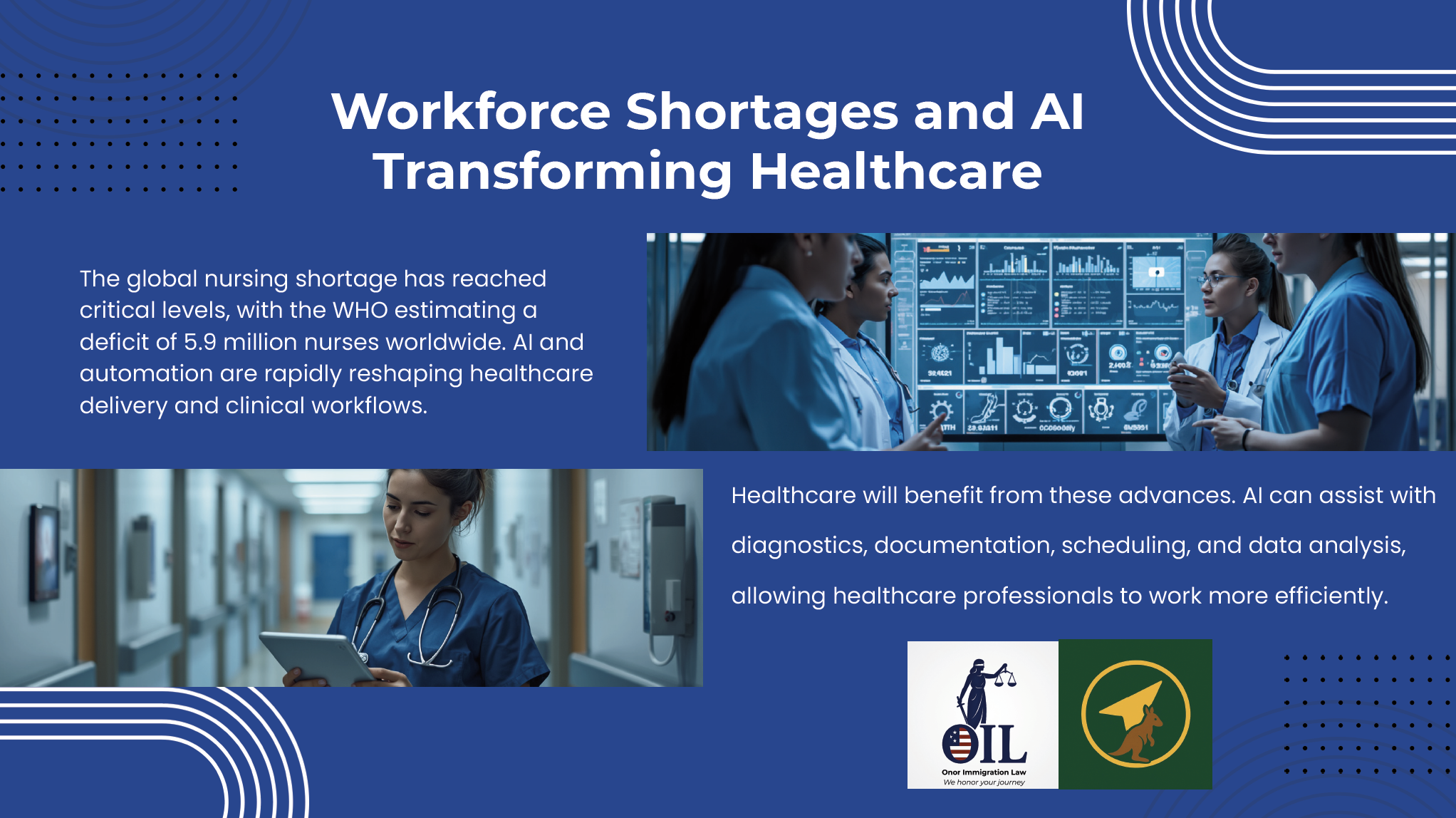
We are entering an era where artificial intelligence is transforming industries across the globe. Healthcare will undoubtedly benefit from these advancements, with AI increasingly supporting diagnostics, documentation, and data analysis, enabling healthcare professionals to work more efficiently and focus more time on patient care.

At the same time, the global nursing shortage remains a significant challenge. The World Health Organization estimates a worldwide deficit of approximately 5.9 million nurses, while growing healthcare demands continue to place pressure on healthcare systems. As AI and automation reshape clinical workflows, they are likely to augment rather than replace the human skills that define nursing: critical thinking, clinical judgment, empathy, communication, and compassionate care.

The future of healthcare will depend on how effectively skilled healthcare professionals leverage technology to deliver better outcomes for patients and communities. 

A5

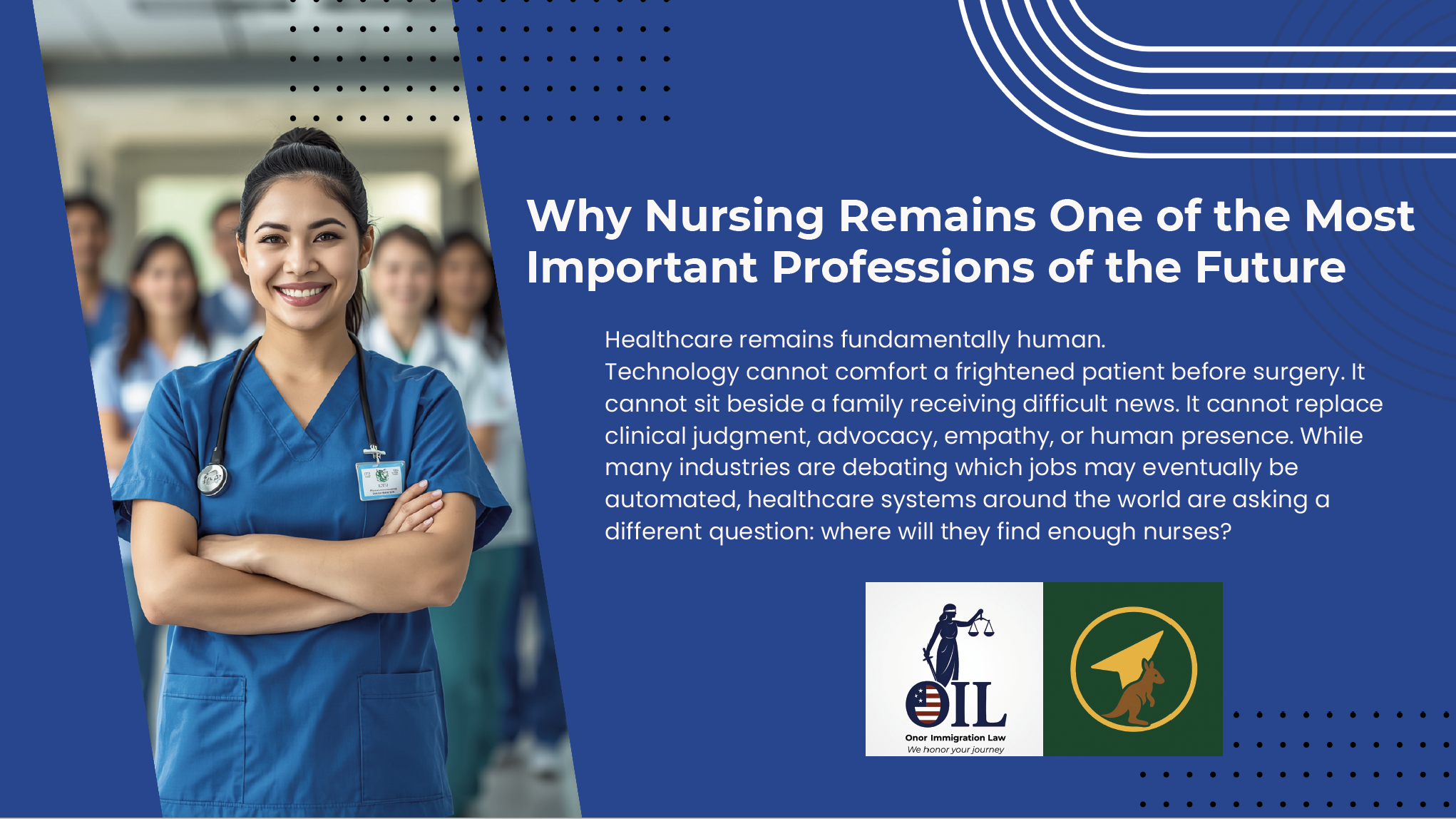
Healthcare remains fundamentally human. Technology cannot comfort a frightened patient before surgery. It cannot sit beside a family receiving difficult news. It cannot replace clinical judgment, advocacy, empathy, or human presence. While many industries are debating which jobs may eventually be automated, healthcare systems around the world are asking a different question: where will they find enough nurses?

Major workforce studies and business publications, including reporting by The Wall Street Journal, continue to identify nursing as one of the most growing professions in the modern economy. As populations age and healthcare demands increase, more skilled nurses are needed. In an increasingly automated world, caring for another human being remains one of the most valuable skills a person can possess. 

A6

The migration landscape today looks very different from what it did years ago. We are seeing visa backlogs, changing immigration policies, increased scrutiny, longer processing times, and growing compliance requirements across many countries.

Before, many people viewed migration as relatively straightforward. Today, the process often requires significantly more patience. For many healthcare professionals, immigration has become an unexpected lesson in resilience long before they ever step foot in their destination country.

Migration has become increasingly strategic. Timing matters. Documentation matters. Planning matters. The professionals who navigate international careers most successfully are often the ones who prepare deliberately rather than react when challenges arise. 

A7

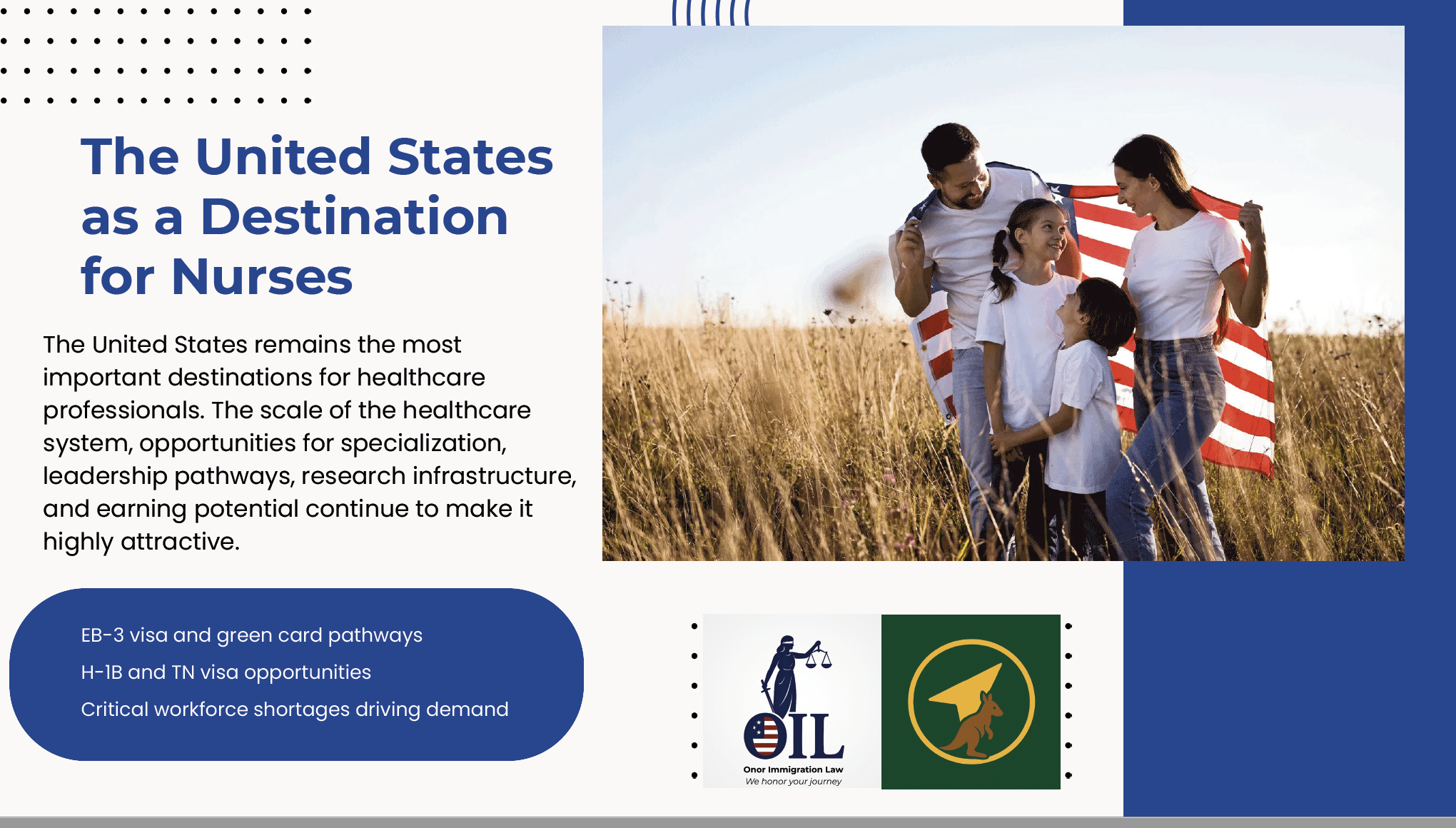
Despite political shifts and policy changes, the United States remains one of the most important destinations for healthcare professionals. The scale of the healthcare system, opportunities for specialization, leadership pathways, research infrastructure, and earning potential continue to make it highly attractive.

The United States spends more on healthcare than any country in the world. It has some of the largest hospital systems, leading research institutions, and one of the most sophisticated specialty-care environments globally.

The United States is not perfect, and migration should never be romanticized. However, from a professional standpoint, few countries offer the same breadth of opportunity. For many nurses, experience in the U.S. healthcare system creates long-term opportunities for healthcare professionals willing to invest in their careers. 

A8

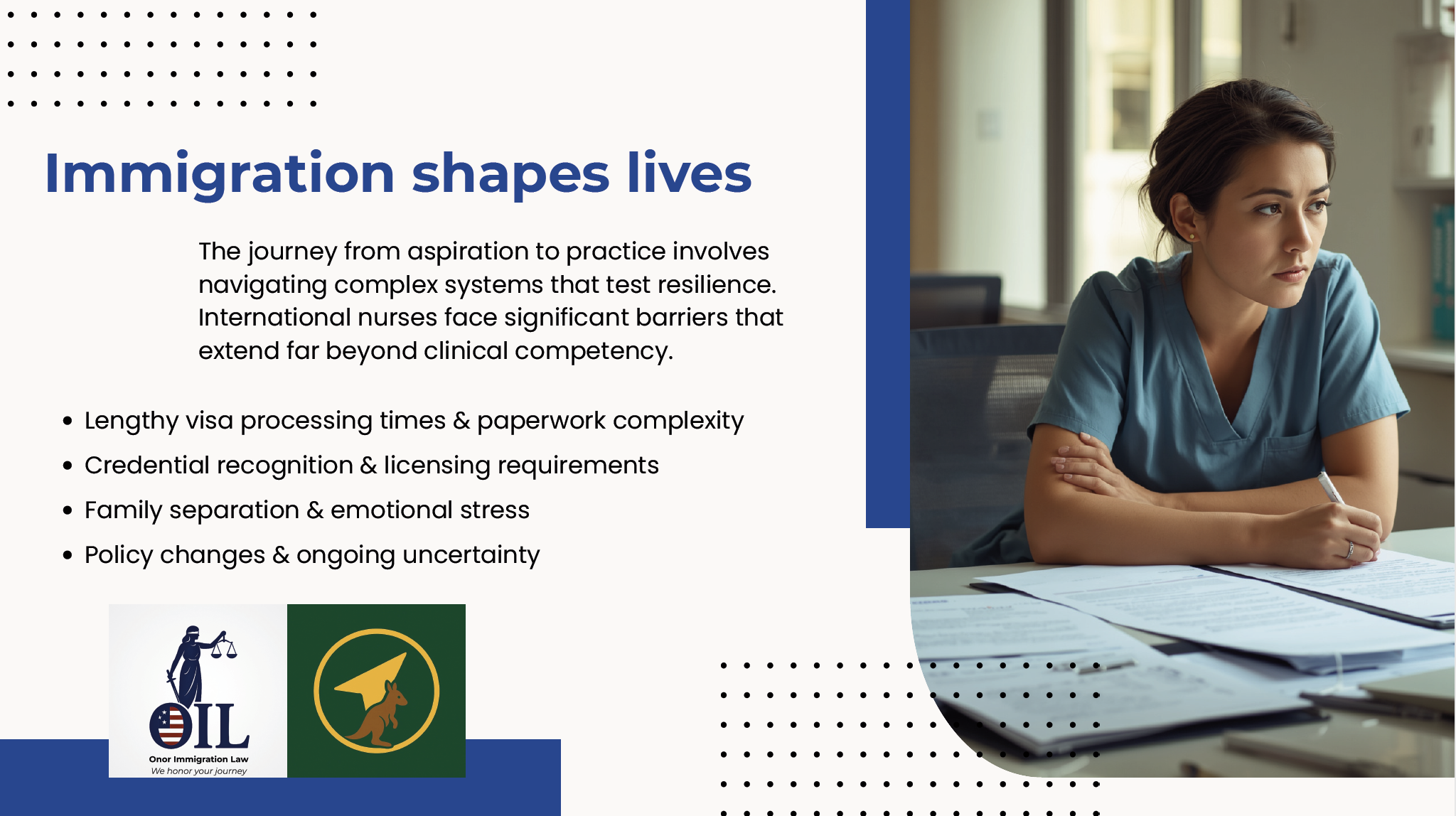
For many international nurses and professionals, the journey from aspiration to practice involves navigating complex systems that test patience and determination. Long visa processing times, extensive paperwork, credential recognition requirements, licensing hurdles, family separation, emotional strain, policy changes, and ongoing uncertainty can all become part of the migration journey.

The impact of immigration reaches into almost every aspect of a person’s life. Immigration decisions influence when people resign from their jobs, whether spouses and children relocate together, how families plan financially, where they live, how they manage travel, and the long-term stability of their future. What may appear to be a visa application on paper is often a series of deeply personal decisions that affect careers, relationships, and life trajectories.

A nurse receives her immigrant visa after years of waiting. She resigns from her job, says goodbye to her parents, books her flight, and then receives a request for additional documentation two weeks before departure. Suddenly a visa process becomes a family crisis, a financial challenge, and an emotional rollercoaster. That’s why immigration is an important life plan.

Because of this, migration should never be approached casually or based solely on information gathered from social media, online forums, or anecdotal experiences. Every case carries its own opportunities, risks, and strategic considerations. Decisions of this magnitude deserve thoughtful planning, reliable information, and a clear understanding of the broader implications. The choices made today can shape opportunities for years to come. 

A9

Global demand for nurses create unprecedented opportunities for healthcare professionals to build rewarding international careers. Successful migration today requires understanding licensing requirements, employer expectations, career progression, and the realities of practicing in a new healthcare system.

As Filipinos, we like social media and many migration decisions are influenced by posts, Facebook groups, and well-meaning advice from friends and colleagues. These communities can be helpful for sharing experiences and providing support, but every immigration journey is unique. Life-changing decisions involving visas, licensure, employment, and relocation deserve more than crowd-sourced opinions.

The nurses who achieve the strongest outcomes are the most prepared. They take the time to understand their options, build the right credentials, seek reliable guidance, and make decisions aligned with their long-term goals. In an increasingly competitive global market, preparation is professional advantage.

The future of nursing migration is about expanding opportunities, advancing professionally, supporting families, and contributing to healthcare on a global scale. Filipino nurses have repeatedly demonstrated that they can thrive and lead in healthcare systems around the world. The opportunities exist. The question now is: Are we prepared to seize them? 

A10

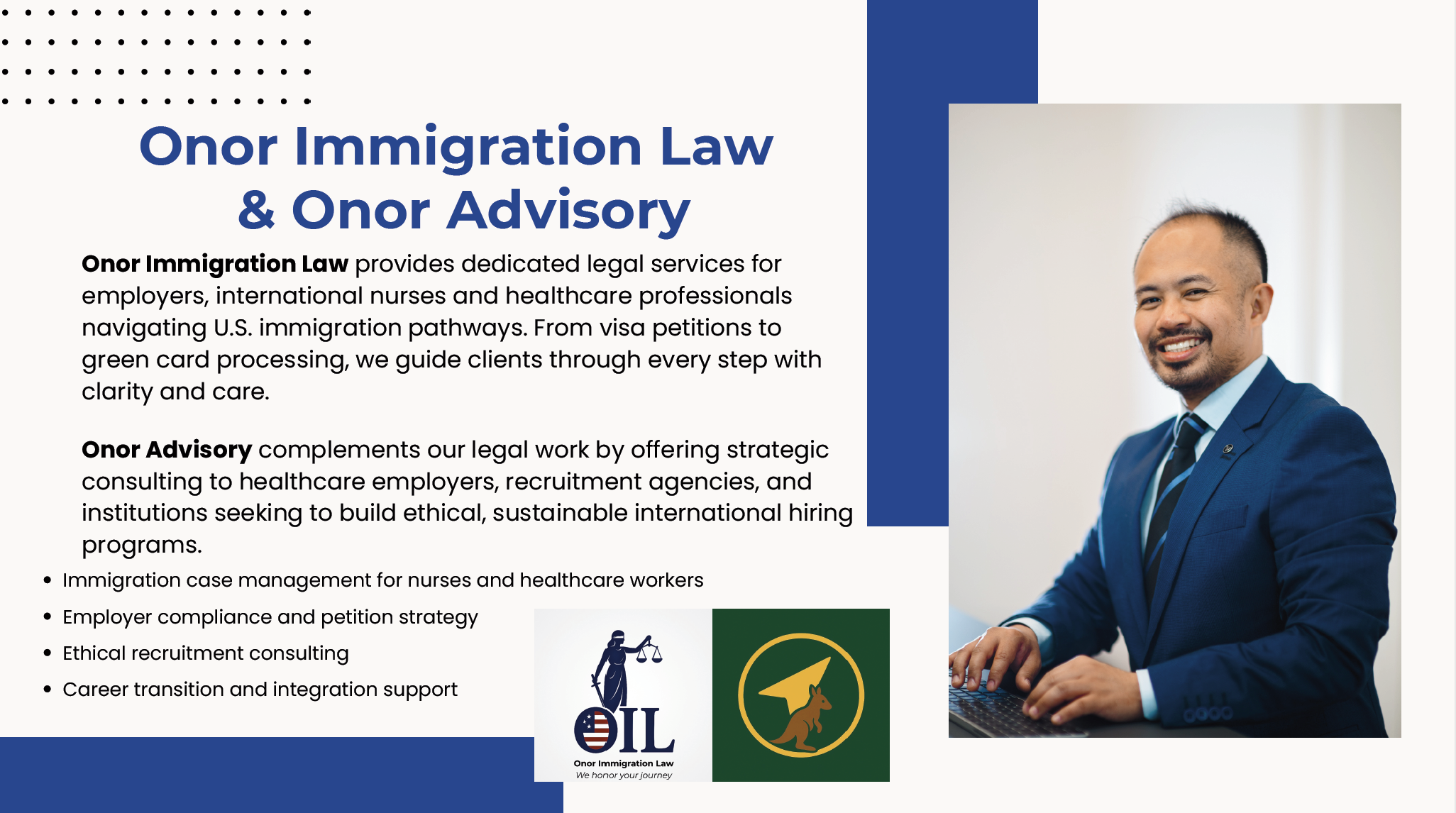
These observations eventually led me to build ONOR Immigration Law and ONOR Advisory. As a U.S. immigration lawyer and registered nurse myself, I understand both sides of that journey. The legal requirements, but also the realities of healthcare work, professional licensing, credentialing, and the sacrifices that many internationally educated nurses make to pursue opportunities abroad.

Alongside the law firm, ONOR Advisory works with healthcare employers, recruiters, and institutions that are building international workforce programs. We focus on strategy, compliance, ethical recruitment, and sustainable workforce planning. The goal is to move people across borders while creating programs that benefit employers, healthcare systems, and the professionals who place their trust in those opportunities.

Together, our work covers immigration case management, employer compliance and petition strategy, ethical recruitment consulting, and career transition support. Whether we are helping an individual nurse pursue a U.S. opportunity or helping an organization develop an international hiring program, our focus remains the same: creating pathways that are legally sound, ethically responsible, and designed for long-term success.

At the heart of both organizations is a simple belief: talent is everywhere, but opportunity is not always equally distributed. Our mission is to help bridge that gap. 

A11

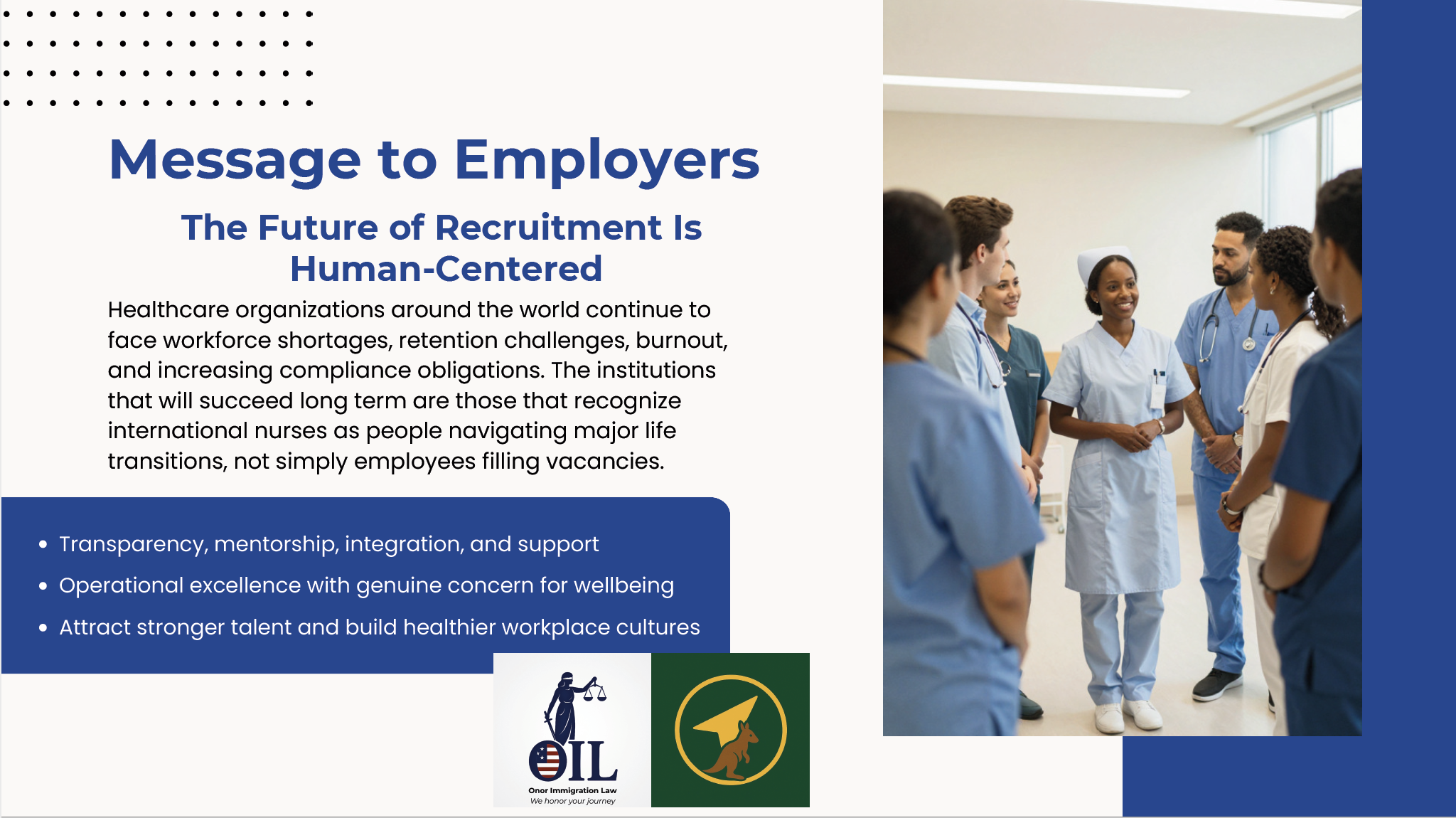
Healthcare organizations around the world continue to face workforce shortages, retention challenges, burnout, and increasing compliance obligations. The institutions that will succeed long term are those that recognize international nurses as people navigating major life transitions, not simply employees filling vacancies.

Recruitment today requires transparency, mentorship, integration, and support. Employers who combine operational excellence with genuine concern for the wellbeing of their workforce will ultimately attract stronger talent, build healthier workplace cultures, and create more sustainable organizations.

A12

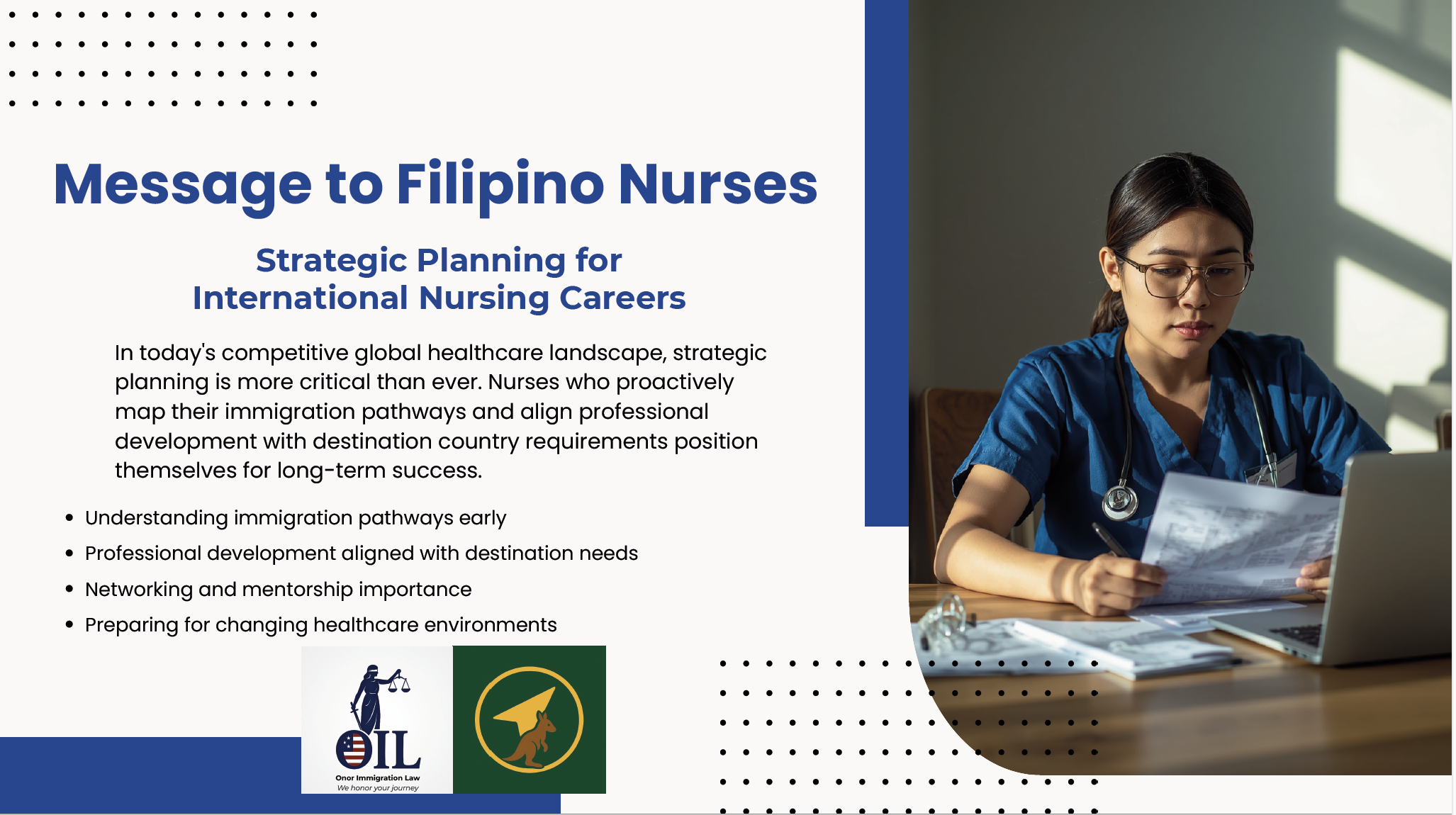
In today’s competitive global healthcare landscape, strategic planning is more critical than ever. Nurses who proactively map their immigration pathways and align professional development with destination country requirements position themselves for long-term success.

Filipino nurses are respected globally because of their professionalism, adaptability, resilience, and commitment to patient care. At the same time, many of you carry responsibilities that few people see. You support parents, siblings, children, and extended family members while adapting to new countries, new workplaces, and entirely new healthcare systems.

Filipino nurses possess a remarkable ability to adapt. We learn new systems quickly, work across cultures comfortably, and somehow manage to survive night shifts, holidays, staffing shortages, and homesickness while continuing to care for others. Many of us have spent years building careers far from home while remaining deeply connected to the people we left behind.

Every NCLEX pass, every licensing milestone, every visa approval, and every successful migration journey represents years of effort, persistence, and sacrifice. Never underestimate what you have already accomplished.

A14

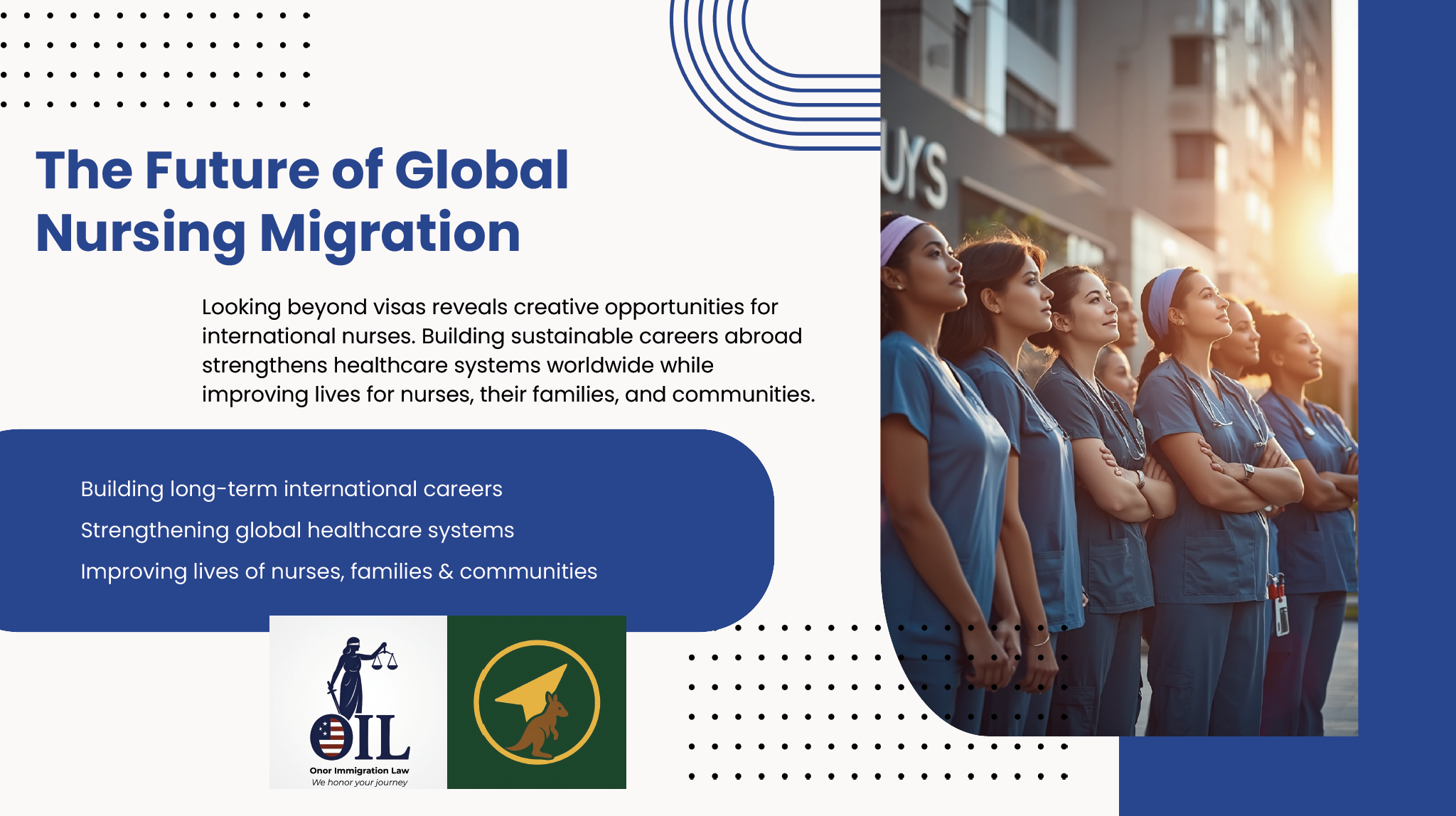
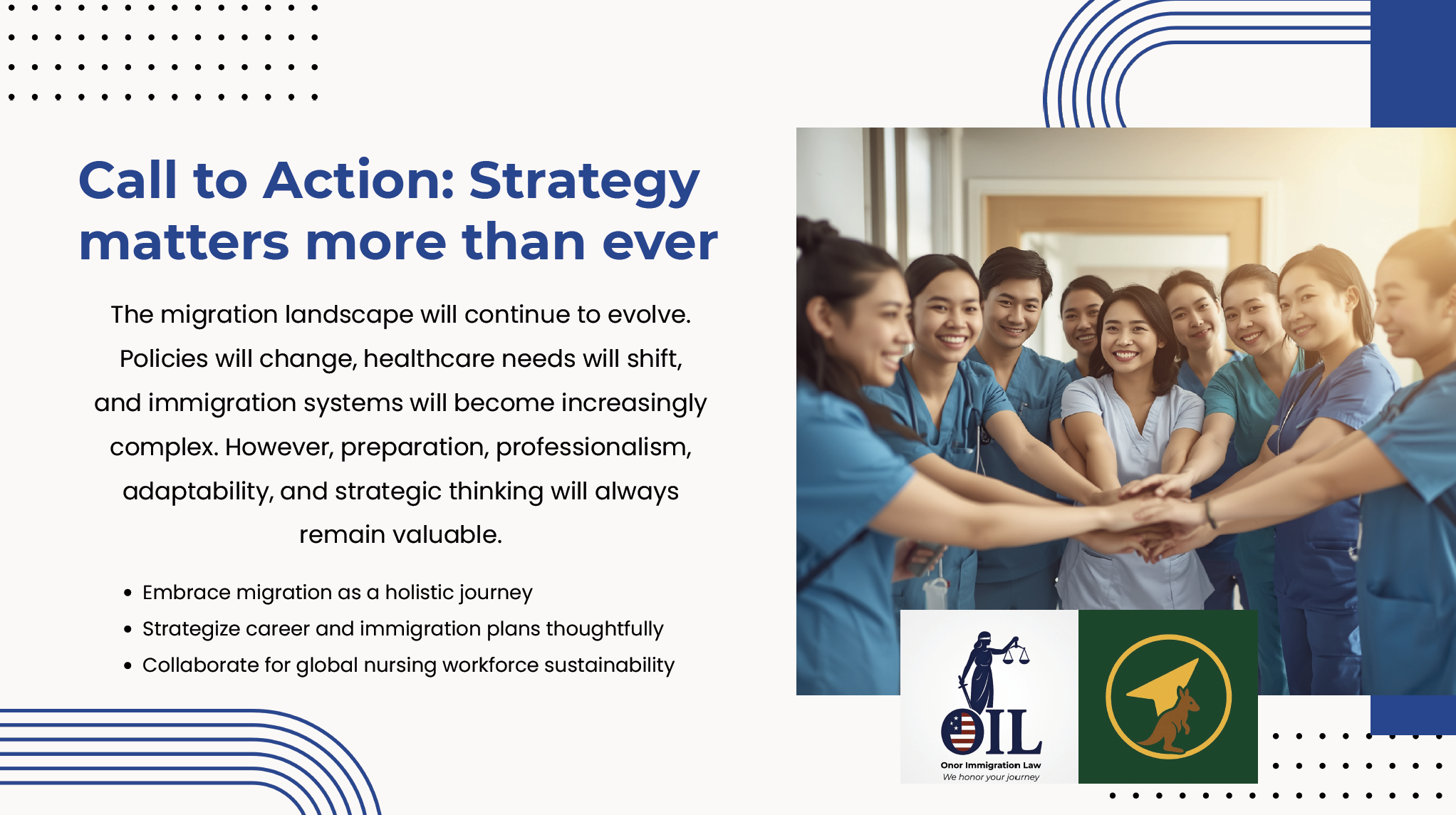
The migration landscape will continue to evolve. Policies will change, healthcare needs will shift, and immigration systems will become increasingly complex. However, preparation, professionalism, adaptability, and strategic thinking will always remain valuable.

As a nurse, I learned that caring for people can change lives. As a lawyer, I learned that opportunity can change lives. What I eventually realized is that migration sits at the intersection of both. It is about people pursuing a better future for themselves and the people they care about.

For generations, Filipino nurses have helped care for the world. Looking at the talent, determination, and resilience in this room today, I have every reason to believe the next generation will do even more. The future of global healthcare will continue to be shaped by the compassion, resilience, and professionalism that Filipino nurses bring wherever they go.

SPEECH: CONTRACTS, IMMIGRATION RISK, and CAREER PROTECTION

NOW EXPO ASIA 2026


B1

When I first left the Philippines, I thought the hard part would be becoming a good nurse. Later, when I went to law school, I thought the hard part would be becoming a lawyer. What I eventually learned is that the hardest part was often navigating uncertainty. Not knowing whether opportunities would arrive. Not knowing whether sacrifices would pay off. Not knowing whether I was making the right decision.

I still remember arriving in New Zealand as a young nurse. As a first time OFW, everything looked familiar enough to function, yet unfamiliar enough to remind me I was far from home. I remember adjusting to a different healthcare system, learning a new workplace culture, and wondering whether I had made the right decision. Years later, I experienced many of those same feelings again when I entered the legal profession. Looking back, I realize those questions were never really about migration or careers. They were about identity. They were about belonging. They were about becoming.

That uncertainty is something many internationally educated professionals understand deeply. Every major career move involves risk. Every migration journey involves risk. The question is not whether risk exists, but whether we understand it well enough to make informed decisions.

Migration challenges occur because immigration systems, employment arrangements, and professional licensing requirements intersect in ways that are not always obvious. As both a nurse and an immigration lawyer, I have had the opportunity to see these challenges from multiple perspectives. I understand the excitement that comes with receiving a job offer overseas. I also understand how quickly that excitement can turn into uncertainty when unexpected legal, employment, or licensing issues emerge.

My own journey has taken me from a small town in Mindanao to intensive care units in New Zealand and Australia, to law schools and law firms across Australia, France, Germany, and the United States. Along the way, I learned that talent opens doors, but preparation keeps them open. Today, I want to share how nurses and employers can better understand risk, protect themselves, and position themselves for long-term success.  
B2

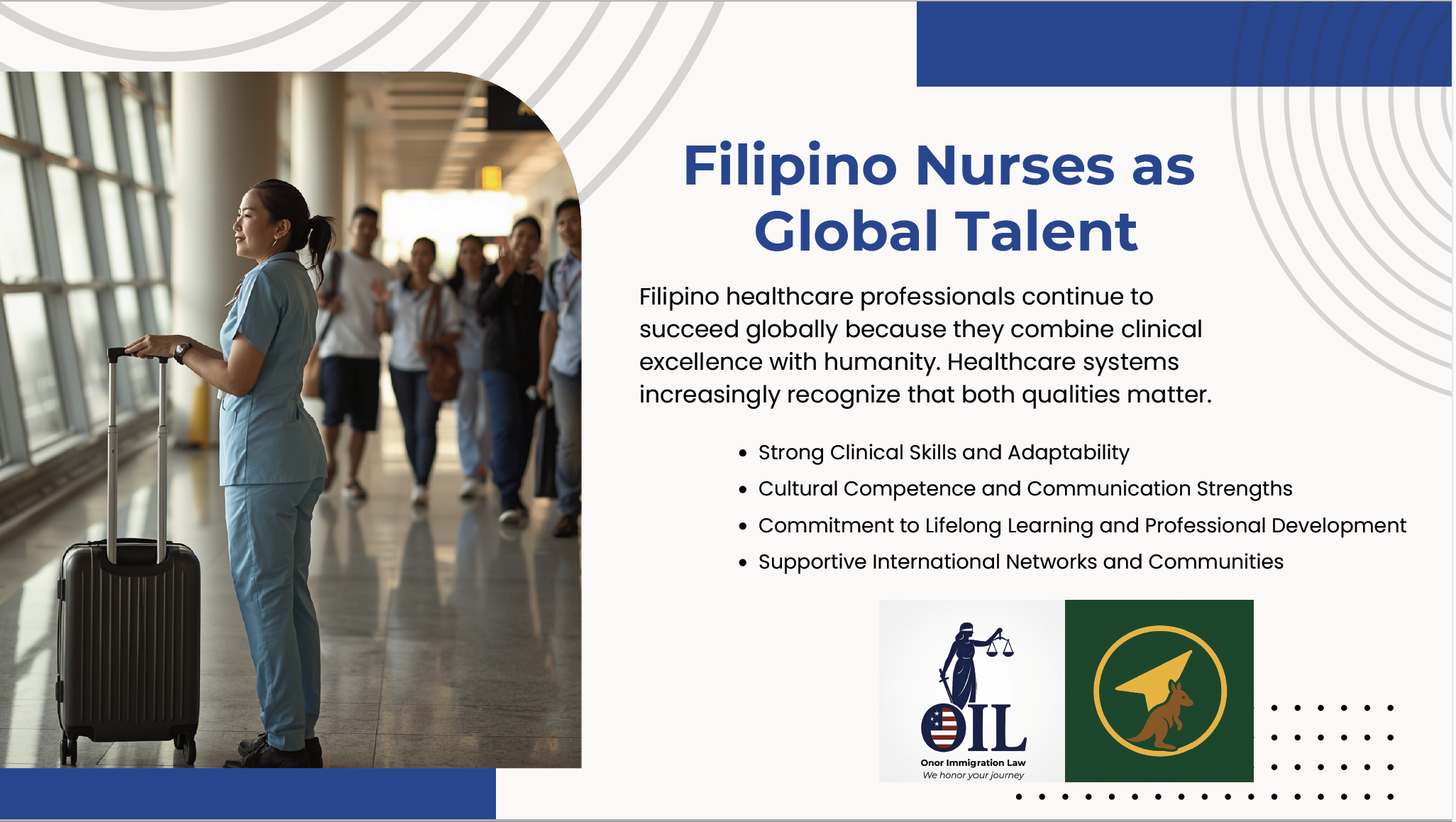
Hospitals across the world continue to recruit Filipino healthcare professionals. They know what they are getting: competence, adaptability, professionalism, resilience, and compassion. Filipino nurses have built a global reputation for thriving in complex healthcare environments and caring for diverse patient populations.

The Filipino nursing diaspora has become one of the strongest professional support networks in healthcare. We mentor one another, advocate for one another, and create pathways for those who come after us.

What makes Filipino nurses globally competitive is not only our clinical skills. What remains difficult to teach is empathy, cultural intelligence, adaptability, communication, and the ability to build trust across cultures. As healthcare becomes increasingly global and increasingly technological, these human qualities become even more valuable. They are qualities Filipino nurses have demonstrated on the world stage for decades and will continue to bring to healthcare systems around the world.
B3

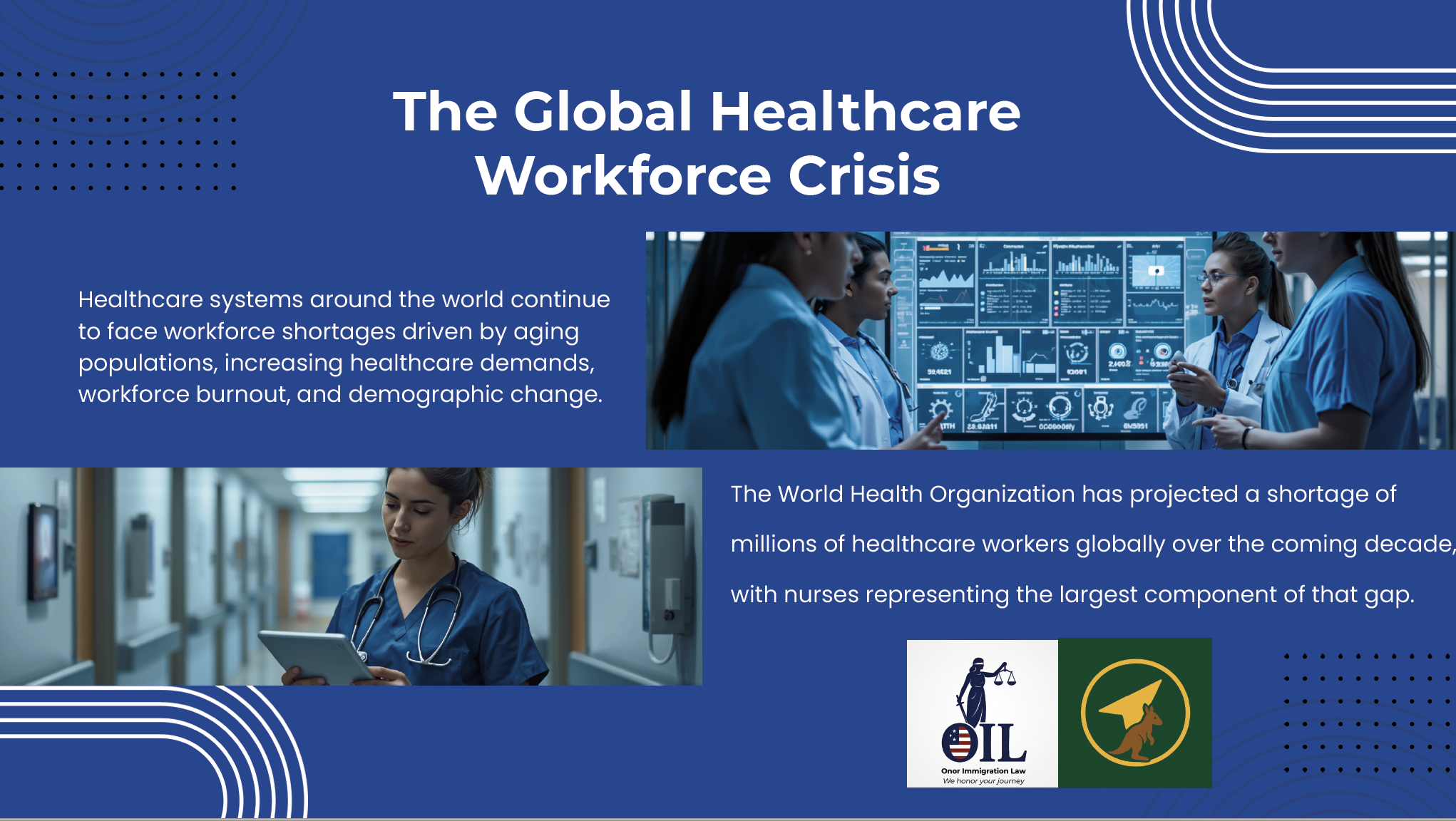
The demand for nurses has never been greater. Healthcare systems around the world continue to face workforce shortages driven by aging populations, increasing healthcare demands, workforce burnout, and demographic change. The World Health Organization has projected a shortage of millions of healthcare workers globally over the coming decade, with nurses representing the largest component of that gap. Virtually every developed healthcare market is competing for the same limited pool of qualified healthcare professionals.

While many industries are debating how artificial intelligence will reshape the workforce, healthcare systems are asking a very different question: where will we find enough qualified nurses? Technology will undoubtedly improve healthcare. It will improve diagnostics, streamline workflows, and enhance efficiency. However, technology cannot replace empathy, critical thinking, clinical judgment, patient advocacy, or the ability to comfort a family during the most difficult moments of their lives.

Healthcare remains fundamentally human, and that is why nurses will remain indispensable for decades to come.
B4

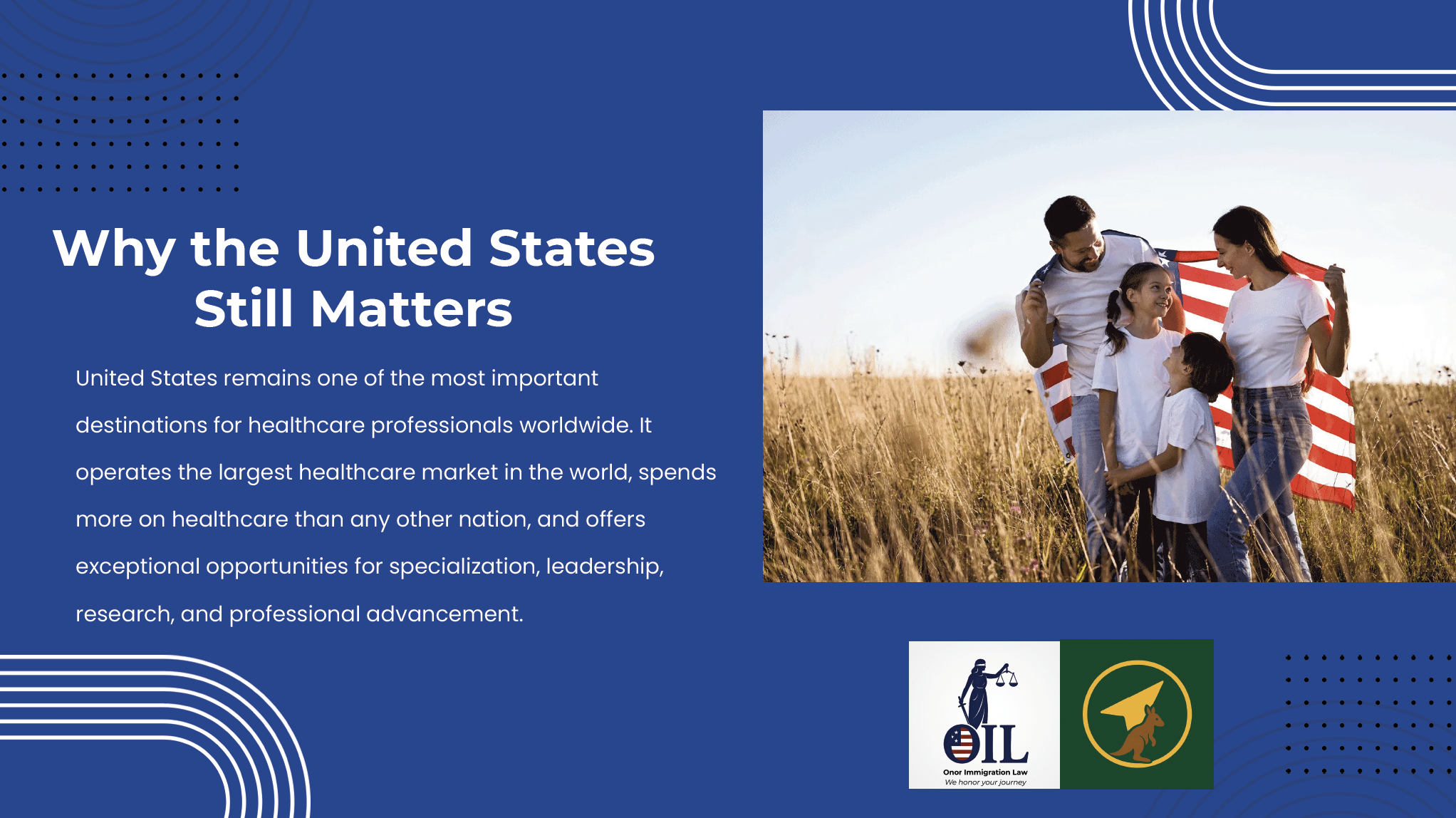
Despite political shifts, policy changes, and the endless headlines predicting the rise or decline of one country or another, the United States remains the most important destination for healthcare professionals worldwide. It operates the largest healthcare market in the world, spends more on healthcare than any other nation, and offers exceptional opportunities for specialization, leadership, research, and professional advancement.

The United States is not perfect. No healthcare system is. Every country has strengths and weaknesses. However, from a professional standpoint, few countries offer the same breadth of opportunity. For many nurses, U.S. experience becomes a platform that opens doors to advanced specialties, leadership positions, graduate education, and long-term career mobility. For many families, it becomes a pathway to opportunities that extend beyond a single generation.

Migration should never be romanticized. It involves sacrifice, uncertainty, and adjustment. Yet for many healthcare professionals, the opportunities available within the U.S. healthcare system continue to make that journey worthwhile.
B5

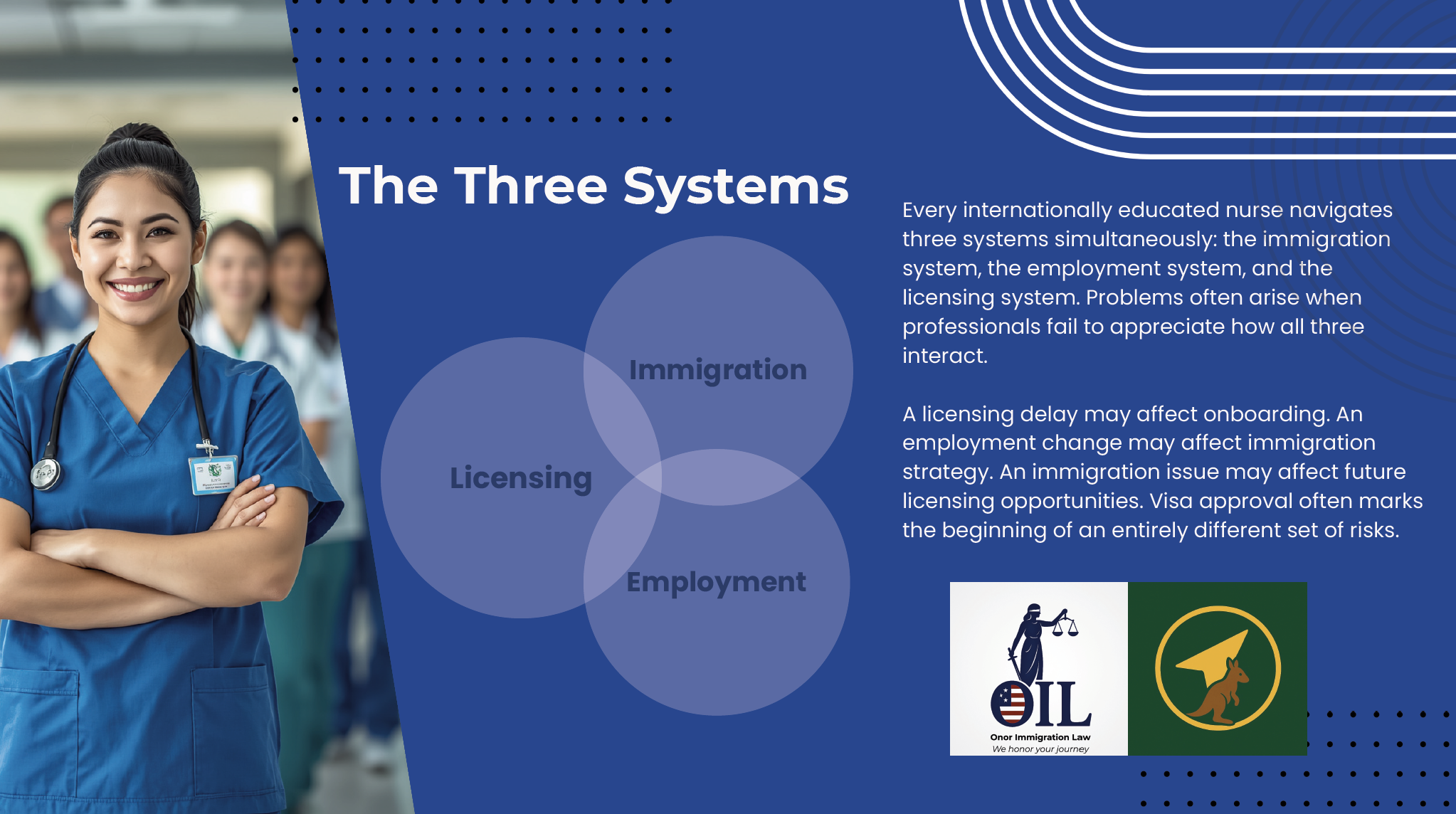
One of the most important concepts I share with clients is that every internationally educated nurse is navigating three systems simultaneously: the immigration system, the employment system, and the licensing system.

One of the biggest misconceptions I encounter is the belief that immigration, employment, and licensing are separate conversations. They are not. A licensing delay may affect onboarding. An employment change may affect immigration strategy. An immigration issue may affect future licensing opportunities.

In fact, one of the most common mistakes I see is assuming that a visa approval marks the end of immigration risk. In reality, visa approval often marks the beginning of a different set of risks involving employment relationships, licensing obligations, credentialing requirements, workplace compliance, and long-term career planning. Many of the most significant career decisions occur after the visa has already been approved.

Understanding the three systems is the difference between a smooth transition and a costly mistake. The most successful international professionals are often the ones who understand how these systems work together.
B6

Contracts are often the most important risk-management documents in the entire migration process. Long before a nurse boards a plane, starts orientation, or receives a first paycheck, the contract is already shaping rights, obligations, expectations, and potential liabilities.

After years of education, NCLEX preparation, English language testing, credential evaluations, and waiting, receiving a job offer can feel like the finish line. But it’s only a start. The contract frequently governs issues far beyond salary. It may affect immigration sponsorship, deployment timelines, housing arrangements, relocation assistance, reimbursement obligations, training commitments, termination rights, repayment provisions, and future mobility.

What makes these agreements particularly complex is that they often operate across multiple jurisdictions. A nurse may reside in the Philippines, be recruited by an agency, be sponsored by a healthcare employer in the United States, and simultaneously navigate professional licensing requirements imposed by multiple organizations. Most disputes arise when assumptions were made. The nurse believes one thing. The employer understands another. The recruiter communicated something slightly differently. Months later, everyone is surprised when conflict emerges.

Before signing any international employment contract, I encourage healthcare professionals to understand three things clearly. First, what happens if deployment is delayed. Second, what financial obligations may exist if the employment relationship ends earlier than expected. Third, how the agreement interacts with immigration sponsorship, credentialing requirements, and professional licensing obligations.

Asking questions before signing is a sign of professionalism. The strongest employment relationships begin with transparency and shared expectations. The weakest often begin with assumptions. Reviewing a contract after signing it is a little like reading the instructions after assembling furniture. It may still be useful, but ideally you would have looked at them earlier. 
B7

After years of working with healthcare professionals, recruiters, and employers, I have noticed that disputes tend to arise from a remarkably consistent set of issues. The countries change. The employers change. The facts change. The themes remain remarkably similar.

One common issue involves timing. I recently encountered a situation where a healthcare professional resigned from an existing role after receiving an anticipated deployment timeline. The visa was eventually approved, but credentialing delays pushed the start date back several months. Nobody acted improperly. Nobody made a mistake. Yet what began as an exciting transition quickly became a period of financial uncertainty. That experience reinforced that immigration timelines are estimates, not guarantees. Career decisions should always be made with contingencies rather than assumptions.

Another recurring issue involves reimbursement obligations and financial commitments. International recruitment requires substantial investment from employers. Legal fees, immigration filings, credential evaluations, relocation assistance, onboarding, training, and workforce integration all require significant resources. Healthcare organizations are often portrayed as the powerful party in migration discussions. The reality is far more complicated.

A hospital may invest tens of thousands of dollars recruiting a single international nurse. If a deployment is delayed or a candidate withdraws late in the process, the consequences extend beyond budgets. They affect staffing ratios, workforce planning, patient care, and the workload of the nurses already on the floor.

Understanding that reality recognizes that sustainable workforce programs require both sides to succeed. Most employers are seeking stability. Most nurses are seeking opportunity. The strongest workforce programs are built when both sides understand the pressures facing the other. 
B8

Timing and documentation are often underestimated until problems emerge. I have seen situations where a missed deadline, an overlooked email, inconsistent records, or incomplete documentation created months of delay and uncertainty. Immigration systems rely heavily on evidence, consistency, and credibility. Small administrative details can have surprisingly large consequences.

Documentation may feel tedious when everything is going well. It becomes extraordinarily valuable when things stop going well. Good records create credibility, options, and protection.

Therefore, the best time to prepare for a problem is before the problem exists. Strong preparation early in the process is almost always more effective than attempting to solve problems after they arise.
B9

These observations ultimately led me to establish ONOR Immigration Law and ONOR Advisory. Throughout my career, I repeatedly saw a gap between the legal realities of immigration and the practical realities of healthcare. Most immigration lawyers understand immigration law. Most healthcare leaders understand healthcare operations. Very few professionals have spent years working inside both worlds.

Before becoming a lawyer, I was a nurse. I understand what it means to work night shifts, navigate professional licensing requirements, manage critically ill patients, and build a career far from home. I also understand the legal and regulatory frameworks governing international mobility because I have spent years practicing law across multiple jurisdictions.

There are thousands of immigration lawyers in the United States. There are excellent recruiters, consultants, and healthcare leaders throughout the world. Very few professionals have personally navigated international nursing, international legal practice, professional licensing, workforce mobility, and cross-border regulation.

That perspective allows us to identify risks that may be invisible when viewed through only one lens. When clients engage ONOR Immigration Law, they are not receiving advice from someone observing healthcare from the outside. They are working with someone who has lived many of the same transitions they are experiencing.
B10

We often tell clients that immigration problems rarely begin as communication problems, planning problems, employment problems, licensing problems, or documentation problems that eventually become immigration problems. By the time the issue reaches an immigration lawyer, the underlying challenge has often existed for months. Our goal is to help clients identify and manage risk before it becomes a crisis.

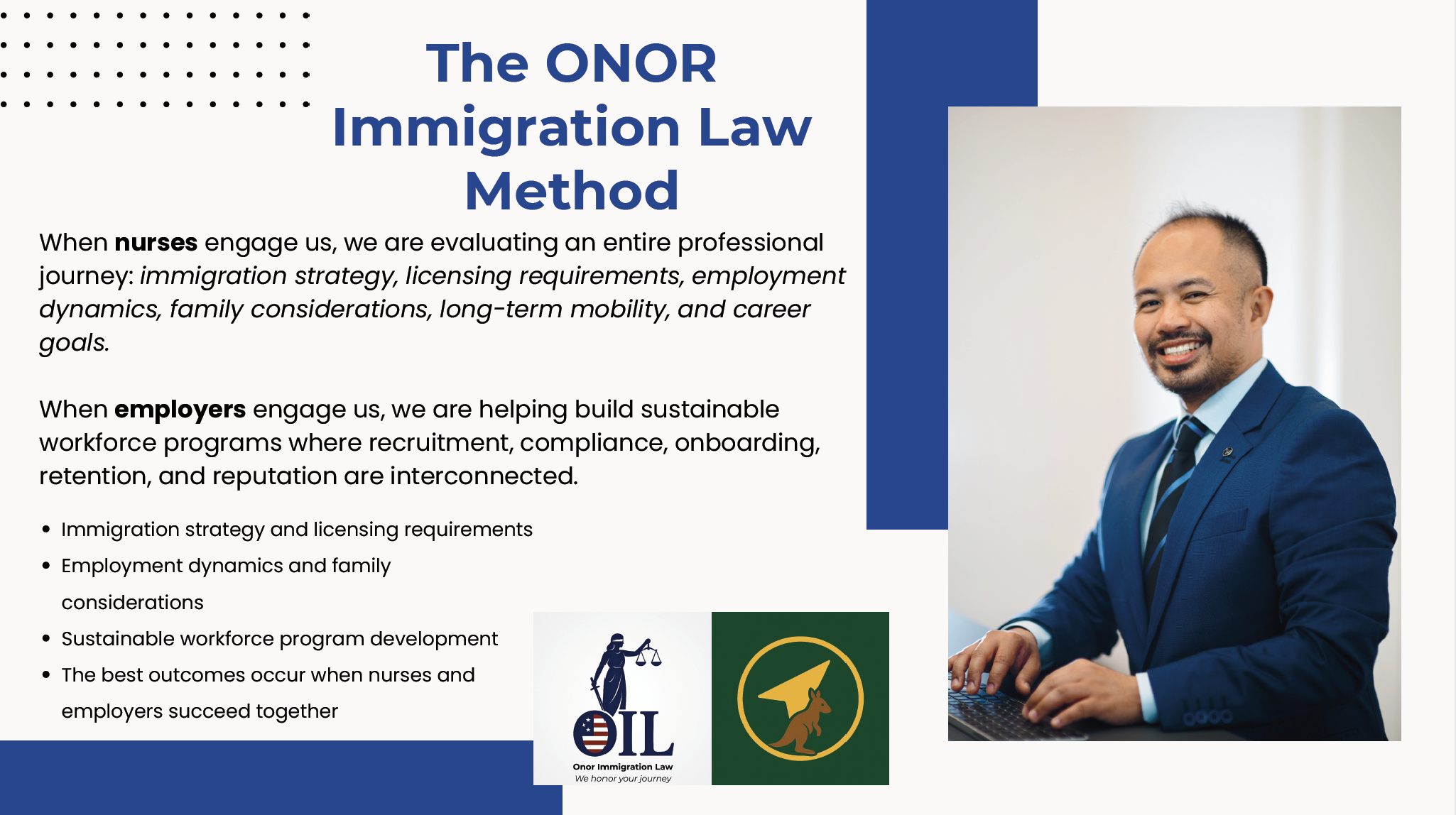
When nurses engage us, we are evaluating an entire professional journey. We consider immigration strategy, licensing requirements, employment dynamics, family considerations, long-term mobility, and career goals.

Likewise, when employers engage us, we are helping build sustainable workforce programs. We understand that recruitment, compliance, onboarding, retention, workforce planning, and reputation are interconnected.

What distinguishes ONOR Immigration Law is our ability to understand all sides of the equation. We understand immigration. We understand healthcare. We understand workforce strategy. Most importantly, we understand the human realities that sit between them. Our philosophy is simple: the best outcomes occur when nurses succeed and employers succeed together. 
B11

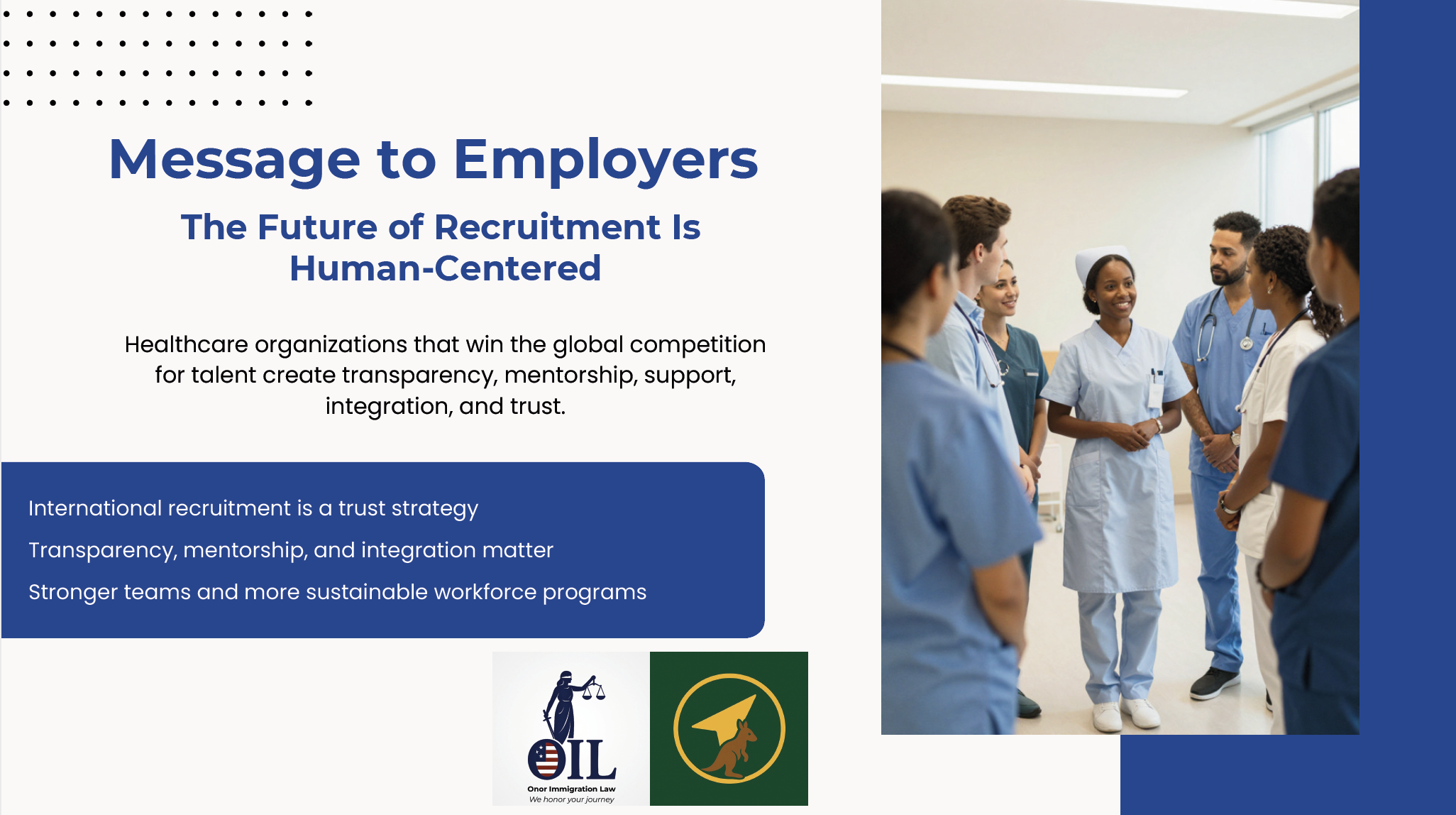
International nurses are making some of the most significant decisions of their lives when they relocate abroad. They leave families, communities, support systems, and familiar environments behind.

The organizations that ultimately win the global competition for talent are not necessarily those offering the highest salaries. They are the organizations that create transparency, mentorship, support, integration, and trust.

The healthcare organizations that understand this reality will build stronger teams, stronger reputations, and more sustainable workforce programs. Compliance matters. Operational efficiency matters. Human relationships matter as well.
B12

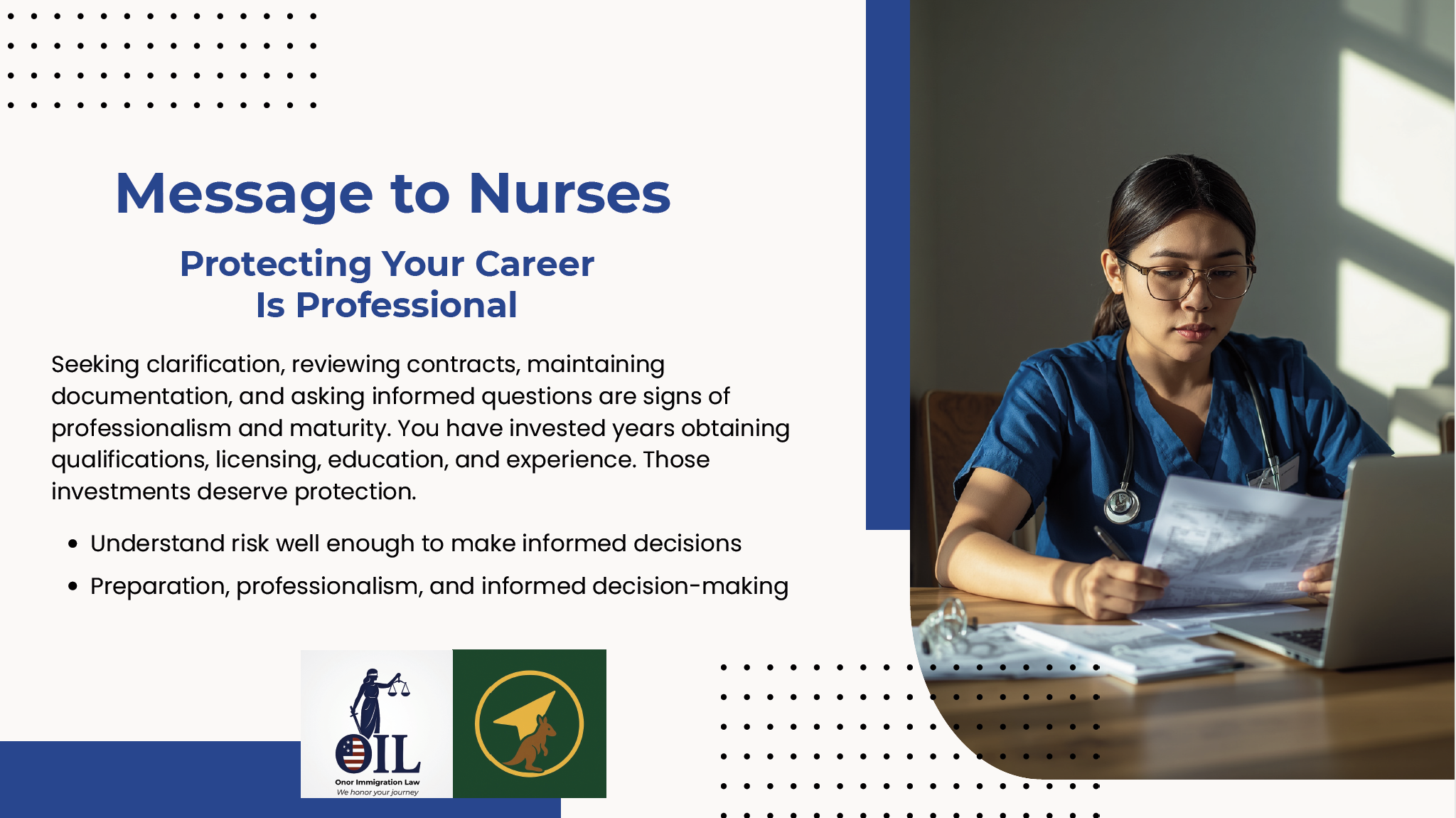
Protecting yourself professionally should never be viewed negatively. Seeking clarification, reviewing contracts, maintaining documentation, and asking informed questions are signs of professionalism and maturity.

You have invested years obtaining qualifications, licensing, education, and experience. Those investments deserve protection. The most successful international professionals are not necessarily those who take the biggest risks. They are often the ones who understand risk well enough to make informed decisions.

A successful international career is not built through optimism alone. It is built through preparation, professionalism, and informed decision-making.
B14

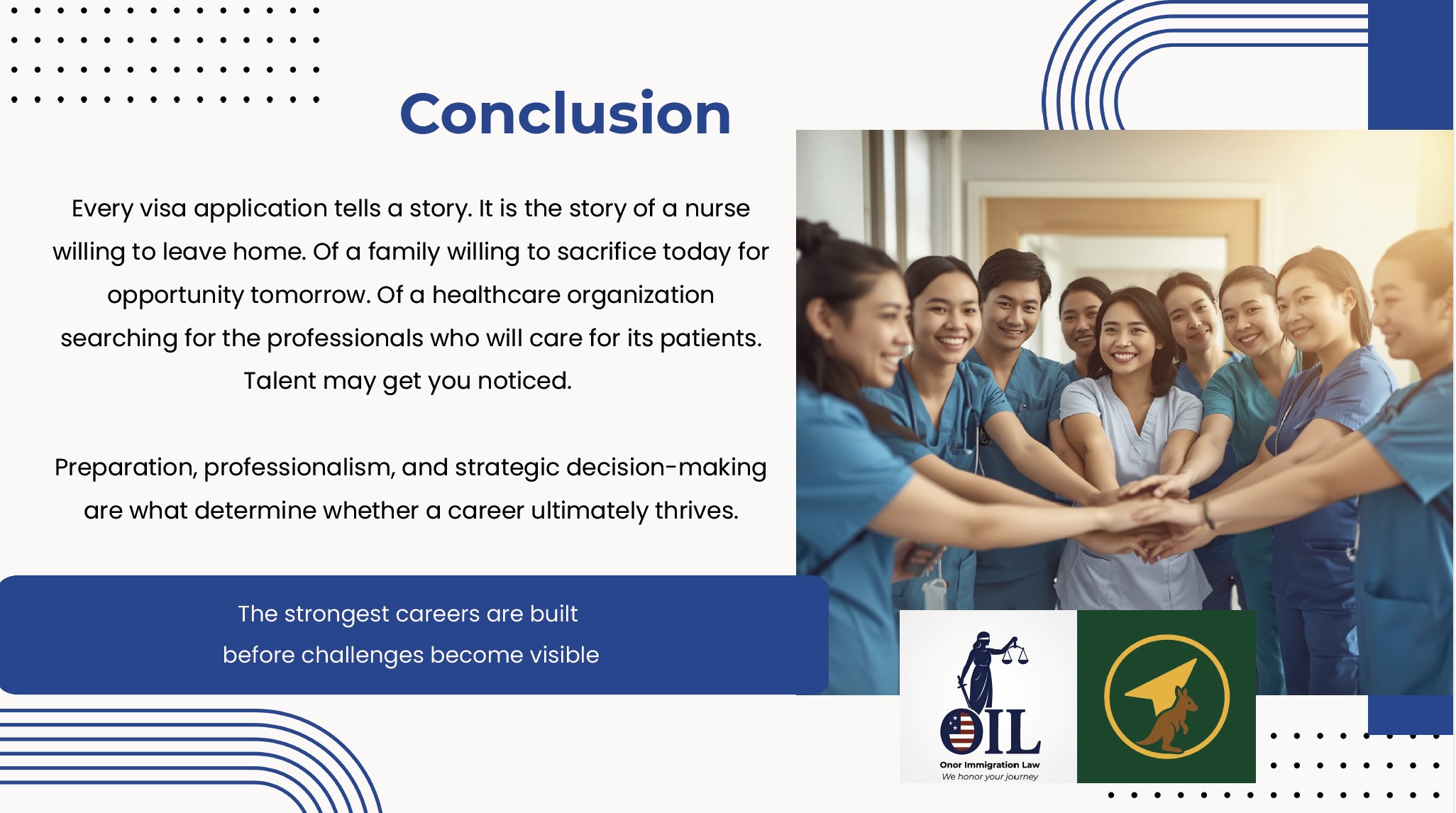
Every visa application tells a story. A nurse willing to leave home. A family willing to sacrifice today for opportunity tomorrow. A healthcare organization searching for the professionals who will care for its patients.

Behind every application is a human story about courage, ambition, sacrifice, and hope. In today’s healthcare market, opportunity is abundant. The more important question is whether we are prepared when that opportunity arrives.

Talent may get you noticed. Credentials may get you shortlisted. A job offer may open the door. But preparation, professionalism, and strategic decision-making are what determine whether a career ultimately thrives.

The future of healthcare will depend on people willing to leave home, learn new systems, adapt to unfamiliar environments, and care for communities far from where they started. Many of those people are sitting in this room today. The opportunities ahead of you are extraordinary. Make sure your preparation is just as extraordinary. Thank you very much.
IN FOCUS: The EB-3 VISA

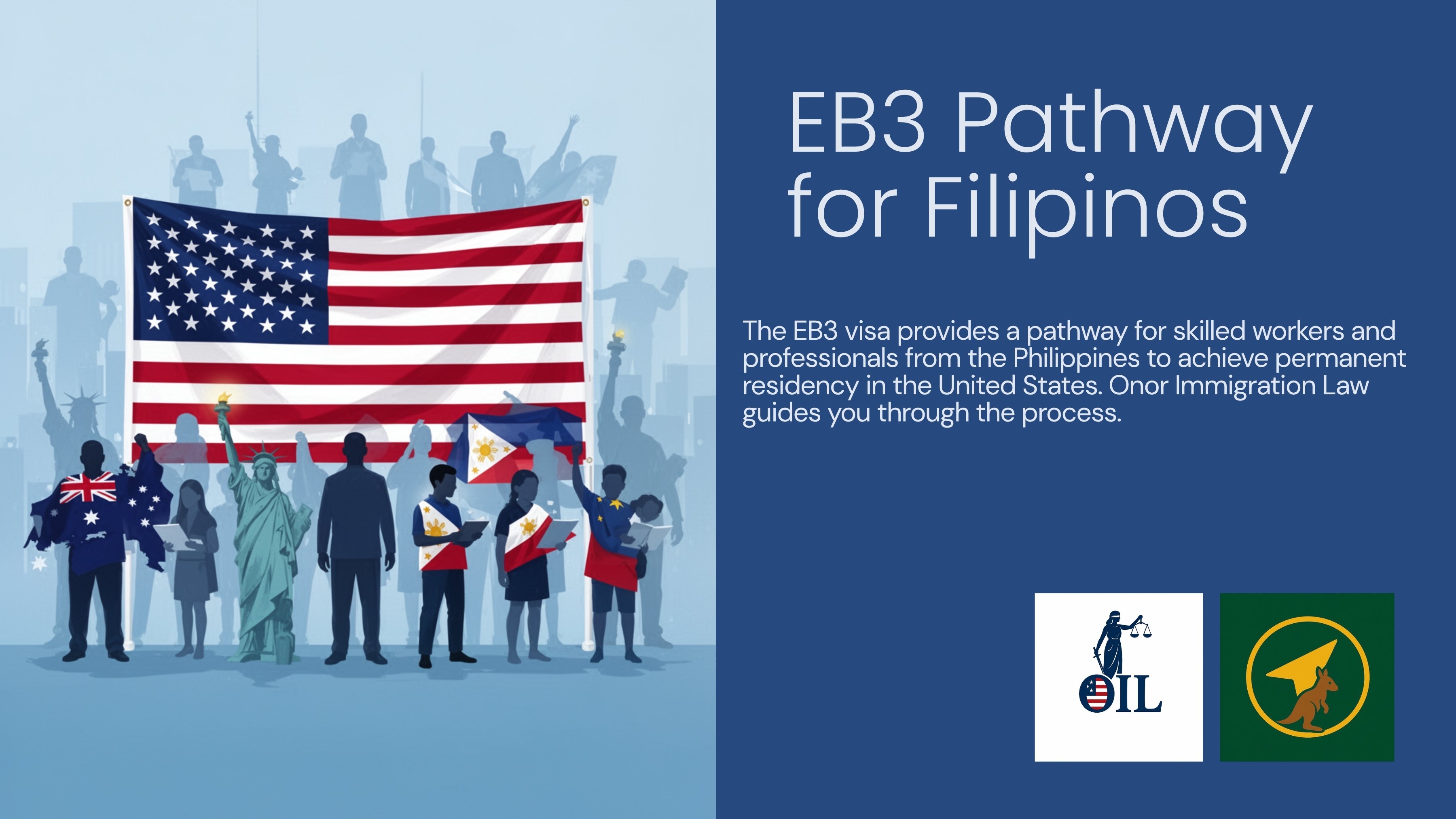
Employment-Based Immigration (Instagram Post (45))

EB-3 Employment-Based Immigration remains one of the most practical pathways to U.S. permanent residence for many skilled professionals, including nurses, healthcare workers, and other qualified employees.

Unlike EB-1A, the EB-3 category generally requires a permanent full-time job offer from a U.S. employer and an approved labor certification (PERM), unless an exemption applies. Your priority date, the Visa Bulletin, and your country of chargeability will determine when you can move forward with your immigrant visa or adjustment of status.

Many EB-3 cases encounter unnecessary delays not because the applicant lacks qualifications, but because of avoidable issues with employer sponsorship, documentation, timing, or long-term immigration strategy. A well-prepared case requires careful coordination between the employee, employer, recruitment process, and USCIS requirements.

Because visa availability and processing times can change, timing matters. Decisions made early in the process, such as selecting the right employer, maintaining eligibility, and planning for priority date movement, can have a significant impact on the overall outcome.

If you are considering the EB-3 pathway, the key questions are whether you qualify for sponsorship, whether your employer is prepared to meet the legal requirements, and whether your case is positioned strategically from the outset.

LEARN MORE: novie@onorimmigrationlaw.com

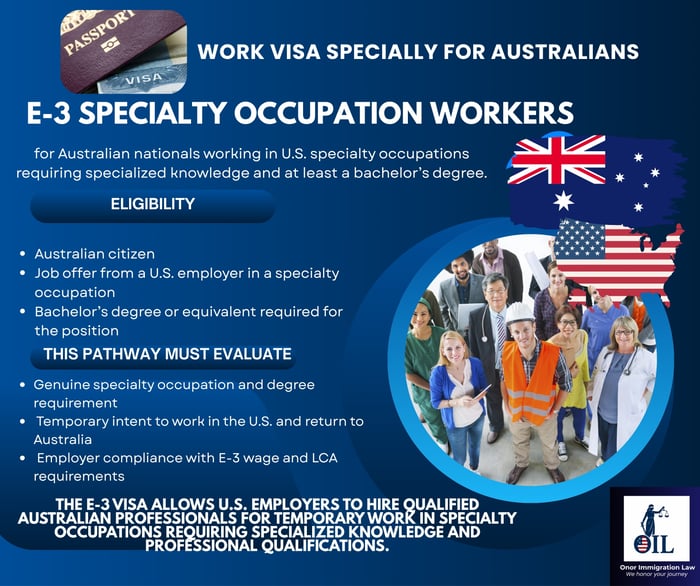
IN FOCUS: The E-3 VISA

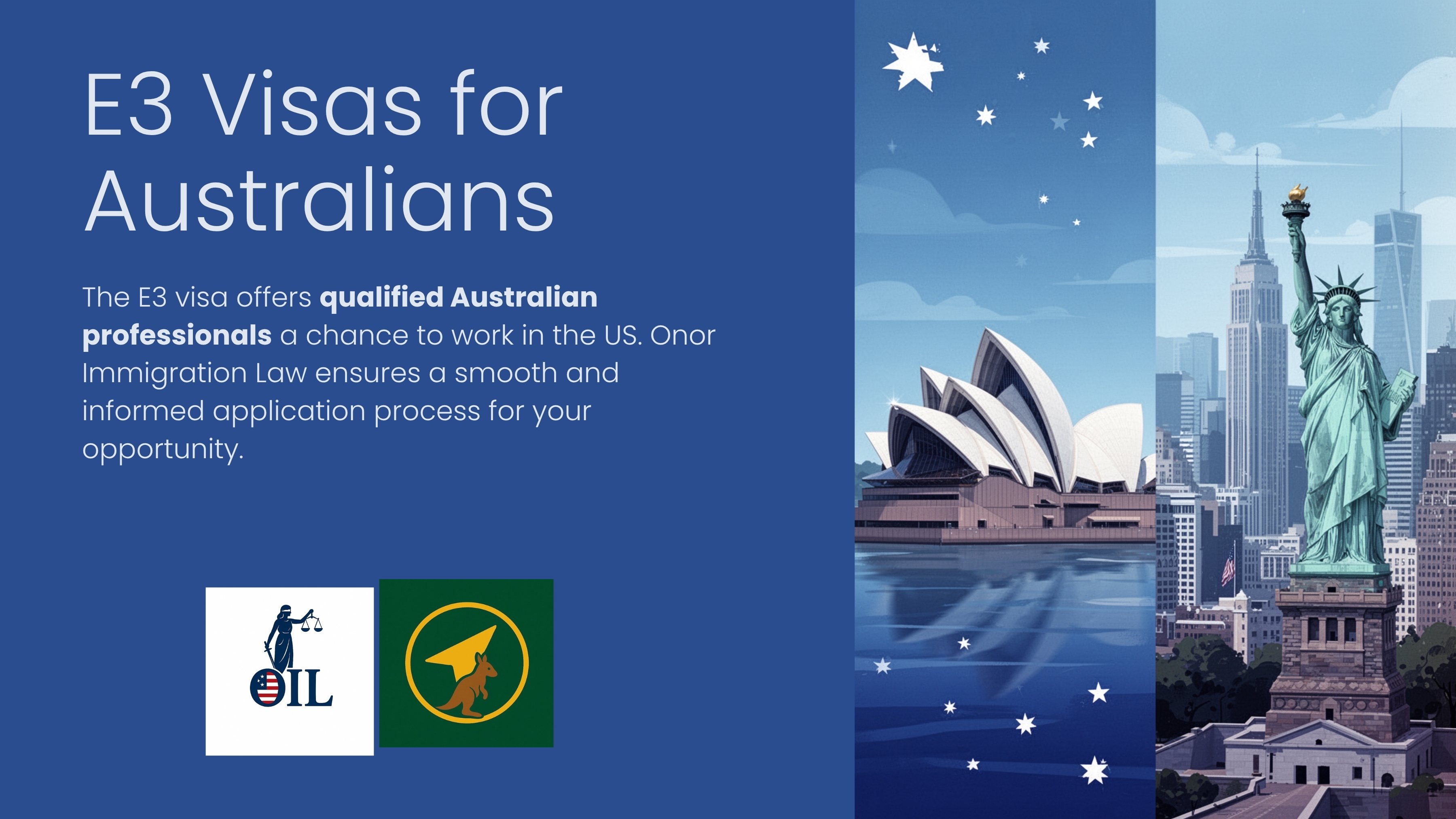
E3 Visa for Australians

Australian professionals are uniquely positioned when it comes to U.S. work opportunities, yet many overlook one of the strongest visa options available to them: the E-3 visa.

Created exclusively for Australian nationals, the E-3 visa allows qualified professionals to work in the United States in specialty occupations requiring specialized knowledge and at least a bachelor’s degree or equivalent. This includes industries such as healthcare, law, engineering, finance, technology, education, and other professional sectors where expertise matters.

Compared to other employment-based visa pathways, the E-3 often offers greater flexibility, a more efficient process, and a practical route for professionals seeking to establish or advance their careers in the U.S.

What determines success is not simply the visa category itself, but the strength of the position offered, the employer’s compliance obligations, degree alignment, Labor Condition Application requirements, wage considerations, and long-term immigration planning. Timing and strategy matter.

Many avoidable problems arise because decisions are made too late, documentation is prepared too narrowly, or the broader immigration picture is ignored.

As a U.S. immigration lawyer admitted in New York, an Australian solicitor, and a registered nurse, I work closely with professionals and employers navigating complex cross-border transitions. My focus is building strong legal positioning from the outset so that opportunities are protected and long-term pathways remain open.

For Australians considering employment in the United States, the E-3 visa can be one of the most valuable and underutilized pathways available.

LEARN MORE: novie@onorimmigrationlaw.com

NOBLE AND HONORABLE ADVENTURES

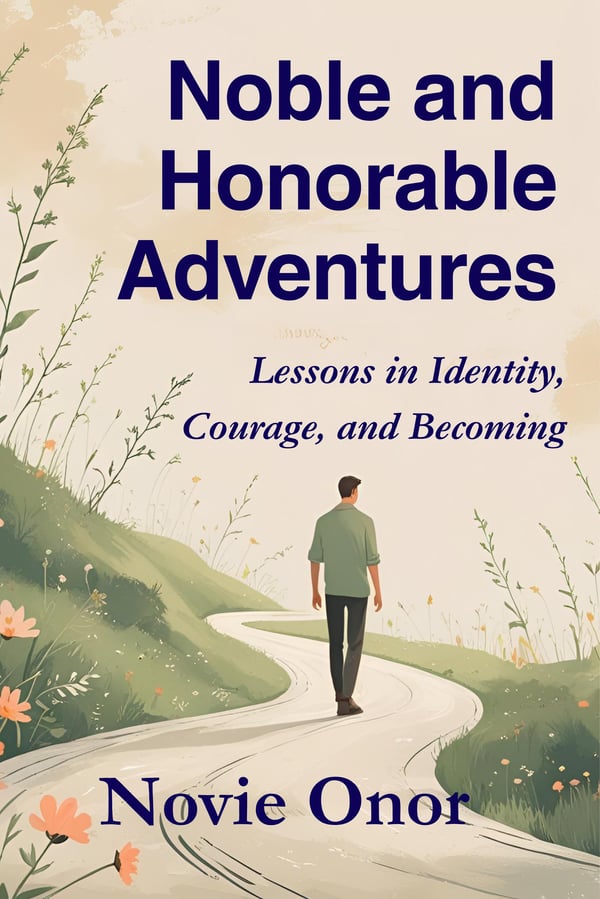
Final Front Cover

At ONOR Immigration Law, we believe immigration is never purely administrative. Behind every petition, every visa strategy, and every relocation decision is a person navigating identity, sacrifice, uncertainty, and the pursuit of a better future.

This same philosophy extends across the broader ONOR ecosystem: ONOR Immigration Law for U.S. immigration legal services, ONOR Advisory Pty Ltd for cross-border strategy and professional transition support, and Noble and Honorable Adventures as the personal narrative that gives meaning to the work behind both.

Facebook Banner

More than a memoir, Noble and Honorable Adventures reflects the lived realities of migration, reinvention, and building a life across borders. Through experiences spanning the Philippines, New Zealand, Europe, Australia, and the path toward the United States, it explores ambition, resilience, identity, and the quiet cost of becoming.

For nurses, professionals, families, and migrants navigating change, this book is part of the same mission: helping people move forward with clarity, courage, and strategy. It reminds us that migration is not only a legal process or a professional decision. It is a human journey.

Because behind every visa is a life being rebuilt, and behind every journey is the deeper work of becoming.

Noble and Honorable Adventures now on Amazon:

https://www.amazon.com/dp/1764280709

photographic Demand for nurses across the United States remains strong but opportunity varies significantly between statesSome states absorb internati

Nursing Across America: Not One Market, Fifty Markets

Demand for nurses across the United States remains strong, but opportunity varies significantly between states.

Some states absorb internationally trained nurses more quickly because of population growth or healthcare expansion.

States such as Texas, Florida, Arizona, Nevada, and parts of the Midwest often experience continuous demand due to hospital growth and demographic changes.

Other locations move more slowly because of licensing board timelines, unionized labor environments, or hospital policies requiring local experience.

For many international nurses, the most strategic first job in the United States is not necessarily the one offering the highest salary.

It is the state that allows licensing, employment, and professional stability to occur as quickly as possible.


photographic Many professionals encounter the Visa Bulletin and assume it is impossibly complexIn reality three concepts explain most of itThe priorit-1

Understanding the Visa Bulletin

Many professionals encounter the Visa Bulletin and assume it is impossibly complex.

In reality, three concepts explain most of it.

The priority date represents your place in the immigration queue. The final action date indicates when a visa number becomes available for approval. The date for filing indicates when certain documentation can be submitted earlier in the process.

If a priority date is earlier than the date listed in the bulletin, the case is considered current. If it is later, the applicant must wait even if all other steps have been completed.

Three misconceptions appear frequently.

First, a job offer does not accelerate visa availability. Second, changing employers does not reset the waiting line. Finally, family members share the same visa quota as the principal applicant.

The Visa Bulletin functions primarily as a system of capacity control rather than processing speed.

photographic A growing portion of our work now involves individuals managing careers across multiple countriesThese include nurses working between Aus

The Rise of Cross-Border Immigration Cases

A growing portion of our work now involves individuals managing careers across multiple countries.

These include nurses working between Australia, the Philippines, and the United States, entrepreneurs exploring U.S. market entry, families maintaining ties in multiple jurisdictions, and professionals relocating gradually rather than immediately.

These cases rarely fit simple templates. They require strategic positioning that considers employment timelines, immigration pathways, and long-term residence planning across jurisdictions.

As global mobility increases, immigration cases are becoming less transactional and more strategic.


photographic Another timing issue that frequently arises in familybased immigration is the Child Status Protection Act commonly known as CSPAMany fami

Understanding the Child Status Protection Act (CSPA)

Another timing issue that frequently arises in family-based immigration is the Child Status Protection Act, commonly known as CSPA. Many families worry that their children will “age out” of eligibility while waiting for visas to become available.

Under U.S. immigration law, a child is generally defined as an unmarried person under the age of 21. Because visa waiting lines can last many years, Congress created CSPA to prevent children from losing eligibility simply because of government processing delays.

CSPA works by adjusting a child’s immigration age. The law subtracts the time that the immigrant petition was pending with immigration authorities from the child’s biological age when a visa number becomes available.

Because of the complexity of visa queues and family-based categories, CSPA calculations often require careful analysis of priority dates, petition approval timelines, and visa availability. For many families, understanding these timelines early can prevent unexpected age-out problems years later.

IMMIGRATION TIP OF THE MONTH: Monitor the Visa Bulletin and not just your case status.

An approved petition is only one step in the immigration process. For many employment-based and family-based applicants, you cannot move forward until your priority date becomes current under the U.S. Department of State's Visa Bulletin. Understanding your priority date and tracking monthly Visa Bulletin updates can help you anticipate the next stage of your case, avoid unnecessary delays, and prepare the required documentation in advance.

OUR COMMITMENT TO YOU

At Onor Immigration Law, we are more than a legal service provider. We are your partner in every step of your immigration journey.

We are committed to delivering:

Responsive Communication – Prompt updates and answers to your questions.
 
Transparent Guidance – Clear explanations of every process and option.
 
Personalized Support – A team that listens, understands, and works toward your goals.

Our vision is simple: to make the immigration process easier, clearer, and more human.

LET’S STAY CONNECTED

We value your trust and partnership. For questions, consultations, or future newsletter topics, feel free to reach out.

📧 Email: novie@onorimmigrationlaw.com
🌐 Website: www.onorimmigrationlaw.com
📱 Follow us: Facebook | LinkedIn | Instagram

At ONOR Immigration Law, we honor your journey.

Next Issue — September 2026

Join our community!

ONOR Immigration Law practices exclusively U.S. immigration law and New York state law. We do not provide legal advice on Australian or other non-U.S. laws. Where appropriate, we may refer clients to independent professionals in those jurisdictions.

© 2026. All rights reserved.