ONOR IMMIGRATION LAW

OFFICIAL LOGO Onor Immigration Law We honor your journey-1

Newsletter • Fourth Edition • May 2026

A MESSAGE FROM OUR TEAM

Welcome to the 4th edition of the ONOR Immigration Law Newsletter.

In this edition, we examine the current pressure points in U.S. immigration and highlight key developments shaping the legal and practical landscape for employers, professionals, and families navigating the system.

Over the past several months, there has been a clear shift in how U.S. immigration matters are being assessed and processed.

Demand for the United States remains strong, particularly across healthcare and other skilled sectors. At the same time, adjudications have become less forgiving of delay, inconsistency, weak documentation, and poor case preparation. Matters that may have progressed with minimal difficulty a few years ago are now subject to closer review, longer processing times, and greater evidentiary expectations.

Across the matters coming into our office, we continue to see that timing failures are often mistaken for legal failures. Employers move too late. Applicants rely on incomplete advice. Important strategic decisions are made without understanding the long-term immigration consequences.

The result is avoidable delay, unnecessary expense, and, in some cases, the loss of opportunities that could have been preserved with proper planning.

This environment requires more than form preparation. It requires legal judgment, strategic positioning, and a clear understanding of how immigration law operates in practice.

At ONOR Immigration Law, that is the standard we bring to every matter. We work with professionals, families, and employers across borders to build strong immigration cases with clarity, structure, and long-term strategy.

Our role is to protect outcomes so that opportunities are not lost to preventable mistakes, poor timing, or weak legal positioning. In many cases, immigration outcomes are shaped long before a petition is ever filed. Strong results depend on building the right strategy from the very beginning, with clarity, preparation, and deliberate legal planning.

Warm regards,
The Onor Immigration Law Team

US IMMIGRATION LAW-1


WHO WE ARE

Onor Immigration Law is a U.S. immigration law firm built for a global, mobile world. We combine rigorous legal practice with lived understanding of migration to guide individuals, families, and organizations through an immigration system that is complex, fast-changing, and high-stakes.

We are a New York–registered law firm with a global perspective. Our work is grounded in clarity, credibility, and care, because immigration decisions shape lives, livelihoods, and long-term futures.


WHAT WE DO

We provide strategic U.S. immigration legal services across employment-based, family-based, and long-term immigration planning matters. Our work goes beyond filings. We help clients assess options, manage risk, anticipate change, and make informed decisions at every stage of the process.

From initial strategy to final adjudication, we focus on outcomes that are compliant, sustainable, and aligned with your broader goals.


WHO WE HELP

We work with individuals building careers across borders, families seeking stability and reunification, and employers navigating workforce mobility and compliance. Our clients span industries and continents, but they share a common need: trusted guidance in moments that matter.

Whether you are taking your first step or navigating a complex transition, we meet you where you are and help you move forward.


HOW WE HELP

We translate complexity into action. We plan carefully, communicate clearly, and execute precisely. We pay attention to timing, detail, and context, because small missteps can have lasting consequences.

At Onor Immigration Law, we are not just your lawyers. We are your partners in the journey. We walk beside you through uncertainty, advocate with integrity, and remain focused on what success truly looks like for you.

Our name reflects this commitment. ONOR honors the courage it takes to move across borders. IMMIGRATION LAW reflects the responsibility and authority of licensed U.S. practice. Together, they represent a promise: to guide you forward with professionalism, respect, and humanity.

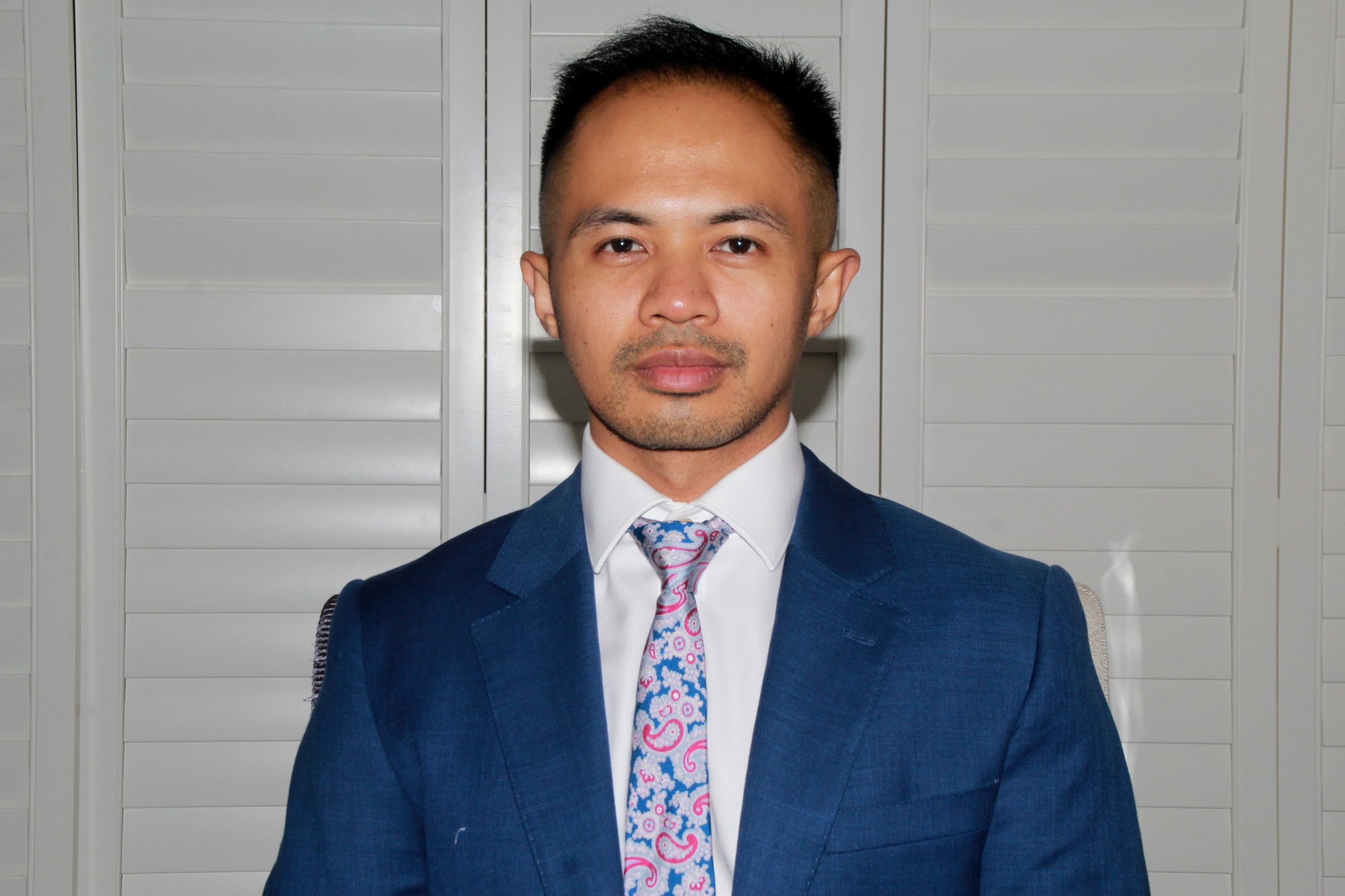
IMG_6705

OUR LAWYER

Novie Onor, Esq., is a U.S. immigration attorney licensed in New York and Australia and a registered nurse in New York, Australia and the Philippines. With professional and lived experience across the Philippines, New Zealand, Australia, France, Germany, and the United States, he understands the immigration journey from both a legal and personal lens.

Novie is dedicated to helping individuals and businesses thrive across borders, applying legal precision, cultural understanding and global insight to every matter. He holds an LLB from Queensland University of Technology and an LLM from Université Paris 1 Panthéon-Sorbonne in France.

OIL US Legal Services

US GREENCARD DEIDENTIFIED ARTISTIC IMAGE-1

Family-Based Immigration

We assist U.S. citizens and lawful permanent residents in sponsoring their loved ones to live in the United States. Services include:
• Marriage-based petitions and spouse visas
• Fiancé visas (K-1)
• Green cards for children, parents, and immediate relatives

We help families stay connected and build their lives together.

Employment-Based Immigration and Work Visas

We support employers, skilled professionals, and entrepreneurs across employment-based pathways, including:
• EB-1, EB-2, and EB-3 categories
• PERM labor certification
• Multinational manager and executive petitions

We work closely with employers and talent to navigate long-term immigration goals.

Non-Immigrant Visas (Temporary Work and Travel)

We represent individuals and organizations across temporary visa classifications, such as:
• B-1 and B-2 business and visitor visas
• H-1B specialty occupation
• E-3 Australian specialty occupation
• TN professionals under USMCA
• O-1 individuals of extraordinary ability
• L-1 intracompany transferees
• E-1 and E-2 treaty trader and investor visas
• J-1 exchange visitor visas

Whether you are pursuing professional opportunities, exploring business ventures, or traveling to the United States for a temporary purpose, we guide each step with strategic precision.

Adjustment of Status and Consular Processing

We assist clients filing from within the United States or abroad. Our representation covers:
• Adjustment of Status
• Consular processing
• Interview preparation
• Case monitoring and follow-through

We work to ensure your process is organized, compliant, and stress-managed from start to finish.

Naturalization and Citizenship

We guide lawful permanent residents through naturalization and citizenship preparation. Our service includes:
• Eligibility review
• Application filing
• Interview and civics exam preparation

We help you take your final step in the immigration journey with confidence.

General NY Law Services

We support clients navigating select New York legal matters connected to relocation, business setup, and professional transition. Our services include:
• New York entity formation and compliance
• Contract drafting and review
• Affidavits and notarized legal documents
• Professional licensing and regulatory guidance

We provide clear, strategic, and compliant support so your move into New York life and business is smooth, informed, and protected.

NEWS UPDATES AND WHY THESE MATTER

U.S. immigration law is federal, but outcomes are rarely decided by forms alone. Most cases are shaped much earlier by timing, preparation, documentation, and judgment. By the time a petition reaches USCIS, many of the decisions that determine success have already been made.

That is why Visa Bulletin movement, employer hiring patterns, licensing timelines, and policy changes matter. They affect when opportunities open, how long they remain available, and how much room there is to respond. Immigration moves alongside labor shortages, visa quotas, agency backlogs, and changing government priorities.

Good cases are built in advance. Applicants who pay attention to these developments can prepare documents, complete licensing steps, and position themselves properly before filing becomes possible. In many cases, timing is not a secondary issue. It is the difference between moving forward and being left behind.

USCIS EmploymentBased I485 Filing Action Dates

USCIS Requires Final Action Dates for Employment-Based I-485 Filings

For May 2026, USCIS confirmed that all employment-based adjustment of status applicants must use the Final Action Dates chart, rather than the Dates for Filing chart, to determine eligibility for filing Form I-485.

This is one of the most significant procedural updates this month because it directly affects who may proceed with adjustment of status inside the United States. Applicants who may have been eligible to file in prior months may now face additional waiting time before they can move forward.

This impacts not only green card strategy, but also access to Employment Authorization Documents (EAD), Advance Parole (AP), dependent spouse and child planning, and employer workforce retention.

In many cases, immigration outcomes are determined by timing and not just eligibility.

EB3 Philippines Final Action Date 2023

EB-3 Philippines Final Action Date Remains at 01 August 2023

The May 2026 Visa Bulletin confirms that the EB-3 Philippines Final Action Date remains at 01 August 2023, with no forward movement.

This remains highly relevant for nurses and healthcare professionals pursuing permanent residence through employer sponsorship, particularly under the Schedule A pathway.

Many applicants assume that I-140 approval means they are close to receiving permanent residence, but immigrant visa availability still depends on the priority date becoming current. Until that happens, consular processing or adjustment of status cannot proceed.

This makes employer readiness, prevailing wage validity, and case preparation critical. Delays on the employer side can become costly when visa bulletin movement is already limited.

Approval is not the same as readiness.

Employer Branding Strategy with AIGenerated Image Elements

Employer Strength Is Now Central to Sponsorship Strategy

Across employment-based immigration matters, employer quality has become one of the most important factors in case success.

USCIS continues to closely review employer legitimacy, ability to pay, prevailing wage compliance, the genuineness of the offered role, and whether sponsorship is financially and operationally sustainable over the long term.

This is not a new law, but it is the clear reality of current adjudications. Cases that may have progressed smoothly several years ago are now facing Requests for Evidence, closer financial review, and stronger scrutiny of sponsorship structure.

For applicants, the strength of the employer can be just as important as the strength of the beneficiary.

Choosing the wrong employer can often create more immigration risk than choosing the wrong visa category.

EB2 Remains Current

EB-2 Remains Current

For May 2026, the EB-2 category remains current under the Visa Bulletin, meaning qualified applicants are not presently restricted by visa bulletin backlog.

This creates an important strategic opportunity for professionals who may qualify under either EB-2 or EB-3 classification. Many applicants default to EB-3 without fully assessing whether they may qualify under an advanced degree pathway or the National Interest Waiver framework.

For professionals in healthcare, business, engineering, academia, and other skilled sectors, category selection can significantly affect processing timelines and long-term immigration planning.

Choosing the right category early often prevents years of unnecessary delay.


E3 Visa Option for Australian Travelers

E-3 Visa Remains One of the Strongest U.S. Options for Australians

While there has been no recent rule change, the E-3 visa remains one of the strongest and most underused U.S. immigration options available to Australian professionals.

Created exclusively for Australian nationals, the E-3 applies to specialty occupations requiring professional qualifications and a qualifying U.S. employer. Compared to other work visa pathways, it often offers greater flexibility, lower procedural burden, and more efficient processing.

Many professionals pursue slower or more restrictive visa options without first properly assessing whether the E-3 provides a cleaner route.

The issue is often not eligibility itself, but specialty occupation structure, degree alignment, Labor Condition Application compliance, wage considerations, and long-term green card planning.

The best visa option is often the one people fail to assess early enough.


USCIS Immigration Screening Vetting Process

USCIS Tightens Immigration Screening and Vetting Measures

Executive Order 14161 and related presidential proclamations have introduced stricter review standards, entry restrictions, and heightened scrutiny involving 39 countries identified as high-risk. The move signals a stronger shift toward tighter immigration enforcement and deeper background checks.

USCIS stated that previous vetting measures for green card and naturalization applicants were found to be inadequate, resulting in approvals that should not have been granted. In response, the agency placed holds on certain asylum applications, Diversity Visa adjustment cases, and benefit requests involving applicants from designated high-risk countries.

New measures now include shorter EAD validity periods, stronger biometric verification, expanded social media and financial checks, additional interviews, and deeper background reviews through Operation PARRIS. USCIS is also requiring final criminal and security checks before adjudication to strengthen fraud detection and national security protections.


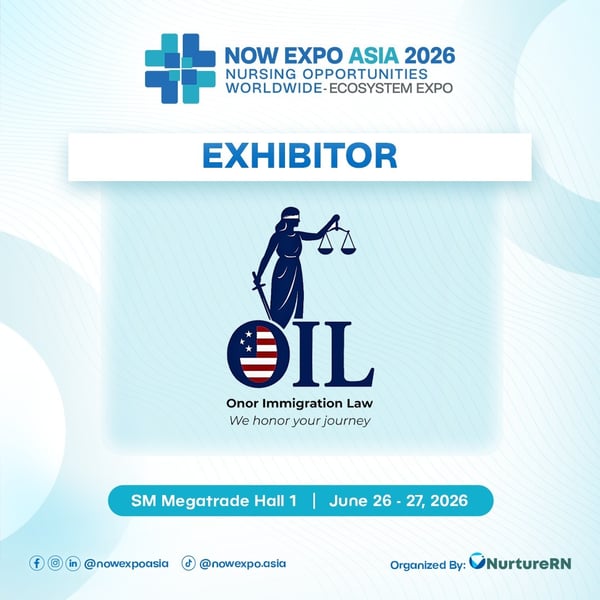
ONOR IMMIGRATION LAW

as EXHIBITOR in the

NOW EXPO ASIA 2026

exhibitor announcement

At a time when many industries face uncertainty, nursing continues to stand as one of the strongest pathways to stability, mobility, and long-term prosperity.

As recently highlighted by The Wall Street Journal, healthcare has delivered some of the most consistent job growth in the United States for decades, driven by an aging population and increasing healthcare demand. Registered nurses now earn a median annual salary of $93,600 compared to $49,500 across all occupations, while advanced-practice nurses earn a median of $132,050. Even more significantly, advanced-degree nursing roles are projected to grow by 35% over the next decade.

This is why NOW (Nursing Opportunities Worldwide) Expo Asia 2026 is such an important event.

We are looking forward to meeting nurses, nursing students, employers, educators, and collaborators at the first premier trade exhibition and dynamic platform dedicated to the entire nursing ecosystem, held in the heart of the nursing mecca of the world, the Philippines.

For internationally educated nurses, migration carries far more than professional ambition. It represents security, family, long-term opportunity, and the ability to build a future where skill and sacrifice are rewarded with real economic and personal growth.

At ONOR Immigration Law, we work at the intersection of healthcare and immigration strategy. As both a U.S. immigration lawyer and a registered nurse, I understand that these decisions affect careers, finances, families, and futures. Immigration planning requires legal precision, timing, and a clear understanding of how professional pathways translate across borders.

At NOW Expo Asia, OIL will discuss the legal landscape surrounding U.S. immigration pathways for healthcare professionals, including employer sponsorship, EB-3 Schedule A petitions, retrogression, priority dates, credential strategy, visa timing, compliance risks, and long-term immigration planning.

Many professionals only begin asking immigration questions after a job offer is already on the table. By that stage, options are often narrower and mistakes become far more expensive. Strong cases are built through early planning, proper documentation, employer alignment, and understanding the pathway before urgency takes over.

Onor Advisory will serve as the collaborative partner in helping professionals and institutions navigate the broader ecosystem surrounding global mobility, including credentialing, licensure pathways, NCLEX strategy, regulatory compliance, workforce planning, cross-border career mobility, and practical readiness for international transition.

Together, OIL and OA help bridge the gap between opportunity and execution.

Nursing has always been noble work. It is also one of the most powerful professions for building generational progress. For many Filipino nurses and healthcare professionals, the opportunities are already there. The real challenge lies in positioning early, preparing strategically, and moving with clarity rather than guesswork.

Migration shapes lives, families, and entire communities. It deserves careful planning and informed decisions. We are proud to support spaces like NOW Expo Asia that elevate nurses as global professionals and leaders in one of the world’s most essential industries.

We look forward to meaningful conversations, strong collaborations, and helping more professionals navigate their own noble and honorable adventures.

Register here: https://www.gevme.com/NOWExpoAsia
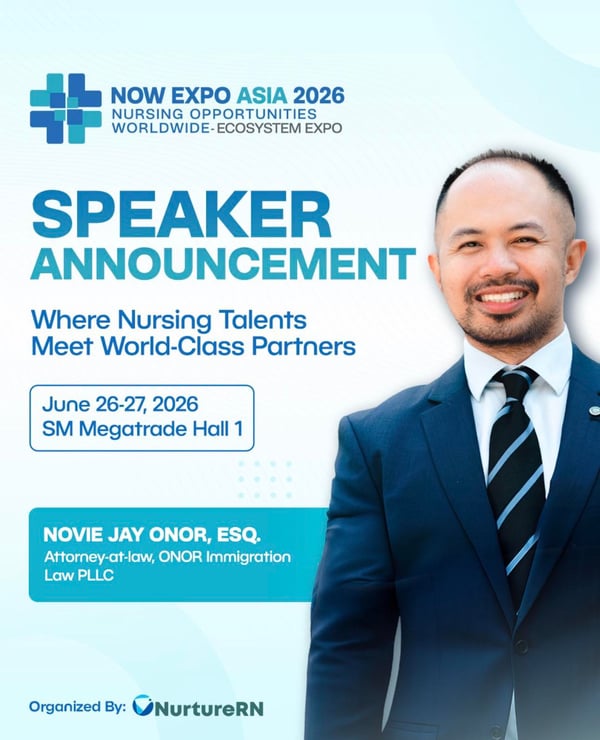
NOVIE ONOR, ESQ.

as FEATURED US IMMIGRATION LAWYER

in the

NOW EXPO ASIA 2026

Speaker Announcement - Now Asia

I am honored to be speaking at NOW (Nursing Opportunities Worldwide) Expo Asia 2026 in Manila and to have the opportunity to connect with nurses and healthcare professionals from across the Philippines.

I will be discussing the legal landscape surrounding international migration, particularly the common immigration issues applicants face when pursuing career opportunities in the United States. Immigration involves timing, employer strategy, licensing, credentialing, compliance, family planning, and long-term professional positioning.

This invitation is especially meaningful to me because it brings me back to where much of my own journey began. I once worked as a nurse at St. Luke’s Medical Center, experiencing firsthand the realities familiar to many Filipino healthcare professionals: demanding hospital shifts, long commutes, licensing requirements, regulatory hurdles, and the uncertainty that often comes with building a career across borders.

That journey shaped not only my professional path, but also my purpose. Today, as both a migrant and a U.S. immigration lawyer, I work closely with nurses, healthcare professionals, and families navigating life-changing decisions involving relocation, employment-based immigration, and family reunification. I understand that behind every petition is a person, a family, and a future being built.

Through ONOR Immigration Law, we provide strategic U.S. immigration guidance with clarity, credibility, and care. Through Onor Advisory, we support professionals and organizations with cross-border planning and practical pathways for long-term success.

At the venue, we will also have a booth where attendees can meet with us for initial discussions about their immigration goals, common legal concerns, and the practical challenges they may face in the process. We will be available to provide guidance, issue-spotting, and helpful insights on how to approach these transitions strategically and responsibly.

I am deeply grateful for the opportunity to return, share knowledge, and contribute to conversations that matter to the future of Filipino nurses and global healthcare mobility.

I look forward to meeting nurses, nursing students, employers, and collaborators at this premier gathering for the nursing ecosystem.

See you on June 26–27, 2026 at SM Megatrade Hall 1.

Register here: https://www.gevme.com/NOWExpoAsia
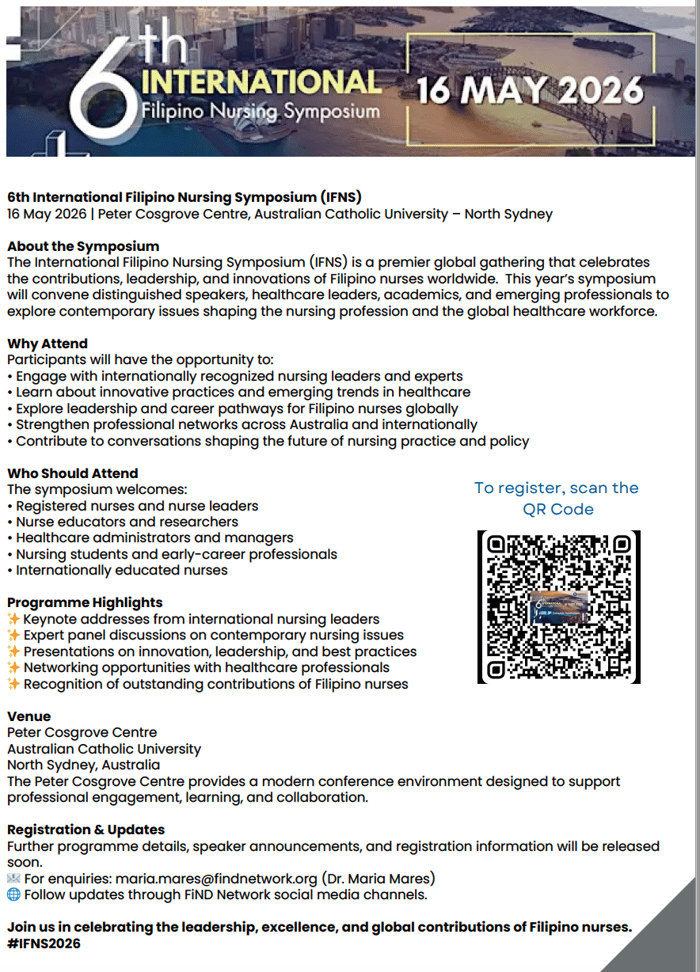
NOVIE ONOR, ESQ. and ONOR IMMIGRATION LAW participate in the

6th INTERNATIONAL FILIPINO NURSING SYMPOSIUM

Screenshot 2026-04-27 at 04.08.40

At ONOR Immigration Law, we are proud to participate in the 6th International Filipino Nursing Symposium in Sydney on 16 May 2026 and stand alongside the Filipino nursing community in Australia.

Filipino nurses have long played an essential role in Australia’s healthcare system. From hospitals and aged care facilities to leadership, education, and specialized clinical practice, they continue to serve with skill, compassion, and resilience. Their contribution goes far beyond bedside care. They strengthen communities, support families, and help shape the future of healthcare across the country.

This year’s theme, Level Up: Evolving Roles, Expanding Impact, is especially meaningful. It reflects the reality that Filipino nurses are no longer only filling critical workforce gaps. They are leading teams, driving innovation, mentoring the next generation, and building stronger pathways for those who come after them.

As a U.S. immigration law firm founded by a nurse and lawyer who understands this journey firsthand, we see how deeply migration, professional growth, and service are connected. This symposium is more than a conference. It is a gathering of professionals committed to stepping up, creating opportunities, and giving back to the community that shaped them.

As part of the program, US/Australia Immigration Lawyer and US/RN/Philippine RN Novie Onor will be speaking on:

Legal Literacy and Strategic Migration for Filipino Nurses

This session goes beyond general immigration information. It will focus on how nurses can approach international careers with clarity, structure, and long-term strategy, particularly in navigating U.S. pathways and aligning immigration decisions with professional growth.

This symposium brings together Filipino nurse leaders across clinical practice, academia, leadership, and business. If you are in Sydney, this is a strong opportunity to engage with a community that is actively shaping the future of nursing.

The symposium welcomes:

• Registered nurses and nurse leaders

• Nurse educators and researchers

• Healthcare administrators and managers

• Nursing students and early-career professionals

• Internationally educated nurses

Filipino or otherwise, all are welcome.

If you are serious about understanding how to position your career internationally, this is a room worth being in.

We look forward to meeting nurses from across Australia, sharing practical legal insights, and supporting those planning their next chapter, whether in leadership, global mobility, or international career opportunities.

Event details:
Where: Peter Cosgrove Centre, ACU North Sydney (Level 18, Tenison Woods House, 8 - 20 Napier Street, North Sydney NSW 2060)
How to get there: A short walk (about 10 mins) from North Sydney Station (train) or Victoria Cross Station (Metro), plus bus routes nearby; limited parking in the area
Registration opens: 8:30 AM
Program starts: 9:00 AM

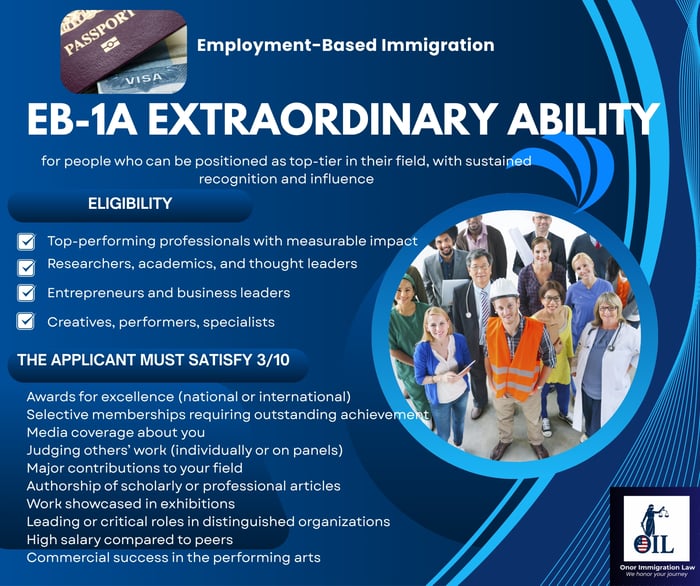
IN FOCUS: The EB-1A VISA

EB1-A

EB-1A Extraordinary Ability is currently current in the Visa Bulletin. For qualified applicants, that means no backlog and the ability to move forward now.

This category does not require employer sponsorship. The focus is on whether your work shows sustained recognition and impact at a high level, supported by evidence that meets USCIS standards.

Most cases fail not because of weak profiles, but because they are poorly positioned. EB-1A is not about checking criteria. It is about presenting a clear, defensible case that your work rises to the level required by law.

When the category is current, timing matters. Delaying can affect strategy, documentation, and overall positioning.

If you are considering EB-1A, the key question is whether your profile can be structured to meet the standard, and whether now is the right time to act.

LEARN MORE: novie@onorimmigrationlaw.com

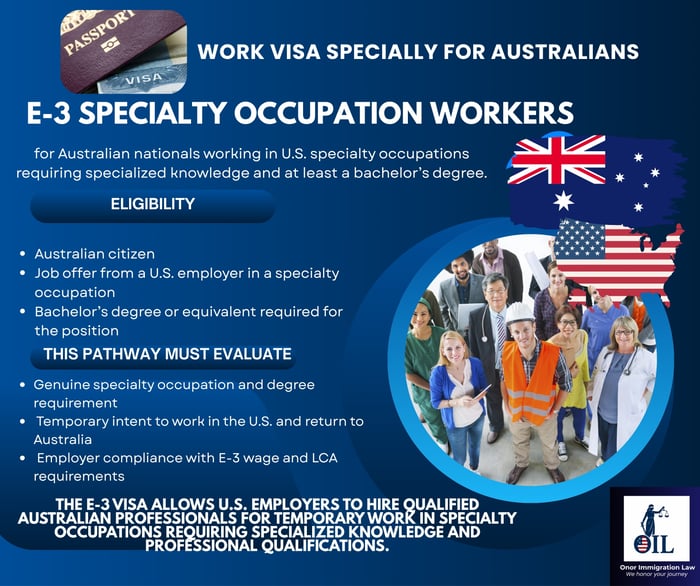
IN FOCUS: The E-3 VISA

E3 Visa for Australians

Australian professionals are uniquely positioned when it comes to U.S. work opportunities, yet many overlook one of the strongest visa options available to them: the E-3 visa.

Created exclusively for Australian nationals, the E-3 visa allows qualified professionals to work in the United States in specialty occupations requiring specialized knowledge and at least a bachelor’s degree or equivalent. This includes industries such as healthcare, law, engineering, finance, technology, education, and other professional sectors where expertise matters.

Compared to other employment-based visa pathways, the E-3 often offers greater flexibility, a more efficient process, and a practical route for professionals seeking to establish or advance their careers in the U.S.

What determines success is not simply the visa category itself, but the strength of the position offered, the employer’s compliance obligations, degree alignment, Labor Condition Application requirements, wage considerations, and long-term immigration planning. Timing and strategy matter.

Many avoidable problems arise because decisions are made too late, documentation is prepared too narrowly, or the broader immigration picture is ignored.

As a U.S. immigration lawyer admitted in New York, an Australian solicitor, and a registered nurse, I work closely with professionals and employers navigating complex cross-border transitions. My focus is building strong legal positioning from the outset so that opportunities are protected and long-term pathways remain open.

For Australians considering employment in the United States, the E-3 visa can be one of the most valuable and underutilized pathways available.

LEARN MORE: novie@onorimmigrationlaw.com

NOBLE AND HONORABLE ADVENTURES

Final Front Cover

At ONOR Immigration Law, we believe immigration is never purely administrative. Behind every petition, every visa strategy, and every relocation decision is a person navigating identity, sacrifice, uncertainty, and the pursuit of a better future.

This same philosophy extends across the broader ONOR ecosystem: ONOR Immigration Law for U.S. immigration legal services, ONOR Advisory Pty Ltd for cross-border strategy and professional transition support, and Noble and Honorable Adventures as the personal narrative that gives meaning to the work behind both.

Facebook Banner

More than a memoir, Noble and Honorable Adventures reflects the lived realities of migration, reinvention, and building a life across borders. Through experiences spanning the Philippines, New Zealand, Europe, Australia, and the path toward the United States, it explores ambition, resilience, identity, and the quiet cost of becoming.

For nurses, professionals, families, and migrants navigating change, this book is part of the same mission: helping people move forward with clarity, courage, and strategy. It reminds us that migration is not only a legal process or a professional decision. It is a human journey.

Because behind every visa is a life being rebuilt, and behind every journey is the deeper work of becoming.

Noble and Honorable Adventures now on Amazon:

https://www.amazon.com/dp/1764280709

photographic Demand for nurses across the United States remains strong but opportunity varies significantly between statesSome states absorb internati

Nursing Across America: Not One Market, Fifty Markets

Demand for nurses across the United States remains strong, but opportunity varies significantly between states.

Some states absorb internationally trained nurses more quickly because of population growth or healthcare expansion.

States such as Texas, Florida, Arizona, Nevada, and parts of the Midwest often experience continuous demand due to hospital growth and demographic changes.

Other locations move more slowly because of licensing board timelines, unionized labor environments, or hospital policies requiring local experience.

For many international nurses, the most strategic first job in the United States is not necessarily the one offering the highest salary.

It is the state that allows licensing, employment, and professional stability to occur as quickly as possible.


photographic Many professionals encounter the Visa Bulletin and assume it is impossibly complexIn reality three concepts explain most of itThe priorit-1

Understanding the Visa Bulletin

Many professionals encounter the Visa Bulletin and assume it is impossibly complex.

In reality, three concepts explain most of it.

The priority date represents your place in the immigration queue. The final action date indicates when a visa number becomes available for approval. The date for filing indicates when certain documentation can be submitted earlier in the process.

If a priority date is earlier than the date listed in the bulletin, the case is considered current. If it is later, the applicant must wait even if all other steps have been completed.

Three misconceptions appear frequently.

First, a job offer does not accelerate visa availability. Second, changing employers does not reset the waiting line. Finally, family members share the same visa quota as the principal applicant.

The Visa Bulletin functions primarily as a system of capacity control rather than processing speed.

photographic A growing portion of our work now involves individuals managing careers across multiple countriesThese include nurses working between Aus

The Rise of Cross-Border Immigration Cases

A growing portion of our work now involves individuals managing careers across multiple countries.

These include nurses working between Australia, the Philippines, and the United States, entrepreneurs exploring U.S. market entry, families maintaining ties in multiple jurisdictions, and professionals relocating gradually rather than immediately.

These cases rarely fit simple templates. They require strategic positioning that considers employment timelines, immigration pathways, and long-term residence planning across jurisdictions.

As global mobility increases, immigration cases are becoming less transactional and more strategic.


photographic Another timing issue that frequently arises in familybased immigration is the Child Status Protection Act commonly known as CSPAMany fami

Understanding the Child Status Protection Act (CSPA)

Another timing issue that frequently arises in family-based immigration is the Child Status Protection Act, commonly known as CSPA. Many families worry that their children will “age out” of eligibility while waiting for visas to become available.

Under U.S. immigration law, a child is generally defined as an unmarried person under the age of 21. Because visa waiting lines can last many years, Congress created CSPA to prevent children from losing eligibility simply because of government processing delays.

CSPA works by adjusting a child’s immigration age. The law subtracts the time that the immigrant petition was pending with immigration authorities from the child’s biological age when a visa number becomes available.

Because of the complexity of visa queues and family-based categories, CSPA calculations often require careful analysis of priority dates, petition approval timelines, and visa availability. For many families, understanding these timelines early can prevent unexpected age-out problems years later.

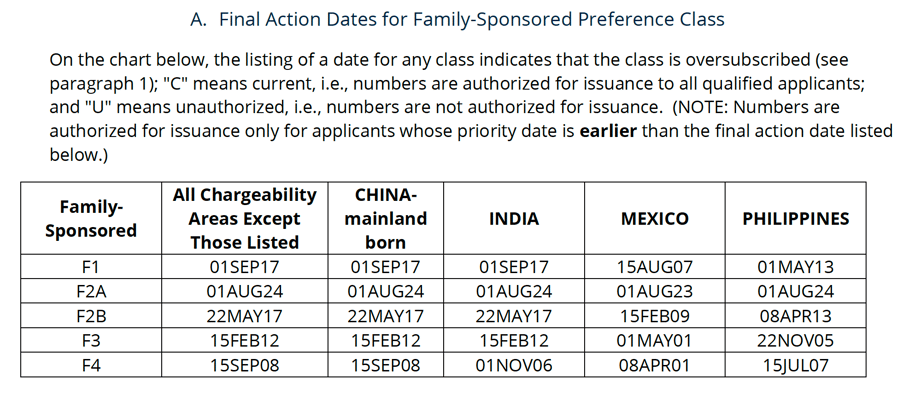
MAY 2026 VISA BULLETIN FAMILY-BASED IMMIGRATION

Screenshot 2026-04-27 at 01-31-28-png

Family-based immigration continues to reflect long waiting periods, especially for preference categories involving adult children and siblings.

F2A remains one of the strongest family categories

F2A for spouses and children of green card holders is at 01 August 2024 for the Philippines and remains one of the more favorable family-based pathways. This is important because many families assume marriage automatically means quick approval. It does not. Final Action Date still controls visa issuance.

Applicants must understand the difference between being able to file documents and actually being eligible for final approval.

F1, F2B, F3, and F4 remain heavily backlogged

F1 for unmarried adult children of U.S. citizens is at 01 May 2013 for the Philippines. F2B for unmarried adult children of green card holders is at 08 April 2013. F3 for married children of U.S. citizens is at 22 November 2005. F4 for siblings of U.S. citizens is at 15 July 2007.

 These are long-term family planning categories. Many families file these petitions assuming movement will be quick, only to realize later they are dealing with decade-long timelines.

The real issue in family-based cases

The biggest mistake in family immigration is treating the petition itself as the solution.

Filing the I-130 is only the beginning. Priority date movement, visa bulletin progression, age-out risks for children, maintenance of status, and cross-border planning all matter.

Overall family-based trend

Family-based immigration is about planning realistically. Understanding the Visa Bulletin early helps families make better decisions about timing, travel, marriage, children, and long-term relocation planning.

LEARN MORE: novie@onorimmigrationlaw.com

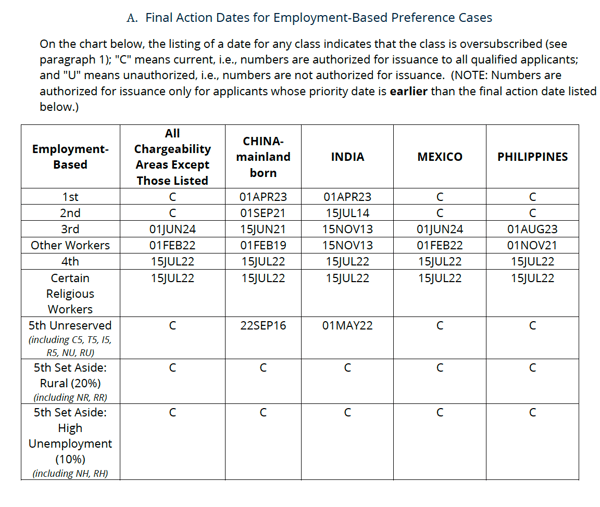
MAY 2026 VISA BULLETIN EMPLOYMENT-BASED IMMIGRATION

Screenshot 2026-04-27 at 01-31-08-png

The May 2026 Visa Bulletin shows a clear divide between higher-preference categories and backlog-heavy pathways.

EB-1 remains strong

EB-1 is current for the Philippines, Mexico, and most countries, while China and India remain backlogged at 01 April 2023. This continues to make EB-1 one of the strongest options for executives, physicians, researchers, and individuals with extraordinary ability.

The practical takeaway is simple: many professionals stay in EB-2 or EB-3 too long without properly evaluating whether they qualify for EB-1. That strategic mistake can cost years.

EB-2 remains highly favorable for the Philippines

EB-2 is current for the Philippines and most countries, while China and India continue to face significant retrogression. For advanced degree professionals and National Interest Waiver applicants, this is a strong category.

This is especially relevant for healthcare professionals, academics, and senior professionals who may have stronger qualifications than they realize. Too many applicants default to EB-3 when EB-2 may be faster and stronger.

EB-3 Philippines remains stalled

The biggest issue for Filipino nurses and Schedule A workers is that EB-3 Philippines remains at 01 August 2023 with no forward movement. This means an approved I-140 does not mean immediate immigrant visa availability. Priority date still controls the final step.

For nurses, employer readiness, prevailing wage timing, ETA-9089 strategy, and derivative family planning remain critical. Immigration strategy cannot begin after I-140 approval. It begins long before that.

Other Workers remains slow

Other Workers for the Philippines remains at 01 November 2021, significantly slower than standard EB-3. Applicants must ensure they are correctly classified. A wrong classification here is not a small technical issue. It can delay immigration by years.

Overall employment-based trend

Applicants should stop asking only “How fast can this be filed?” and start asking “Am I in the right category?”

LEARN MORE: novie@onorimmigrationlaw.com

IMMIGRATION TIP OF THE MONTH: Do not mistake an approved petition for a finished case.

One of the most common and costly misunderstandings in U.S. immigration is assuming that once an I-140 or I-130 is approved, the process is essentially done. 

Approval of the petition confirms eligibility for that category. It does not mean a visa number is available, permanent residence is guaranteed, or timing risks disappear. The Visa Bulletin, priority dates, consular processing timelines, adjustment of status eligibility, employer compliance, and dependent strategy still control what happens next.

This is especially important for employment-based cases such as EB-3 nurses and Schedule A filings. Many applicants receive I-140 approval and assume the green card is close, only to discover that visa retrogression, employer issues, or filing timing delays create months or years of additional waiting.

The strongest immigration cases are built before the filing, not after the problem appears. Priority date strategy, documentation readiness, employer structure, and family planning should be handled early, not treated as an afterthought.

Plan early. File strategically. Protect the process.

OUR COMMITMENT TO YOU

At Onor Immigration Law, we are more than a legal service provider. We are your partner in every step of your immigration journey.

We are committed to delivering:

Responsive Communication – Prompt updates and answers to your questions.
 
Transparent Guidance – Clear explanations of every process and option.
 
Personalized Support – A team that listens, understands, and works toward your goals.

Our vision is simple: to make the immigration process easier, clearer, and more human.

LET’S STAY CONNECTED

We value your trust and partnership. For questions, consultations, or future newsletter topics, feel free to reach out.

📧 Email: novie@onorimmigrationlaw.com
🌐 Website: www.onorimmigrationlaw.com
📱 Follow us: Facebook | LinkedIn | Instagram

At ONOR Immigration Law, we honor your journey.


Next Issue — July 2026

Join our community!

ONOR Immigration Law practices exclusively U.S. immigration law and New York state law. We do not provide legal advice on Australian or other non-U.S. laws. Where appropriate, we may refer clients to independent professionals in those jurisdictions.

© 2026. All rights reserved.